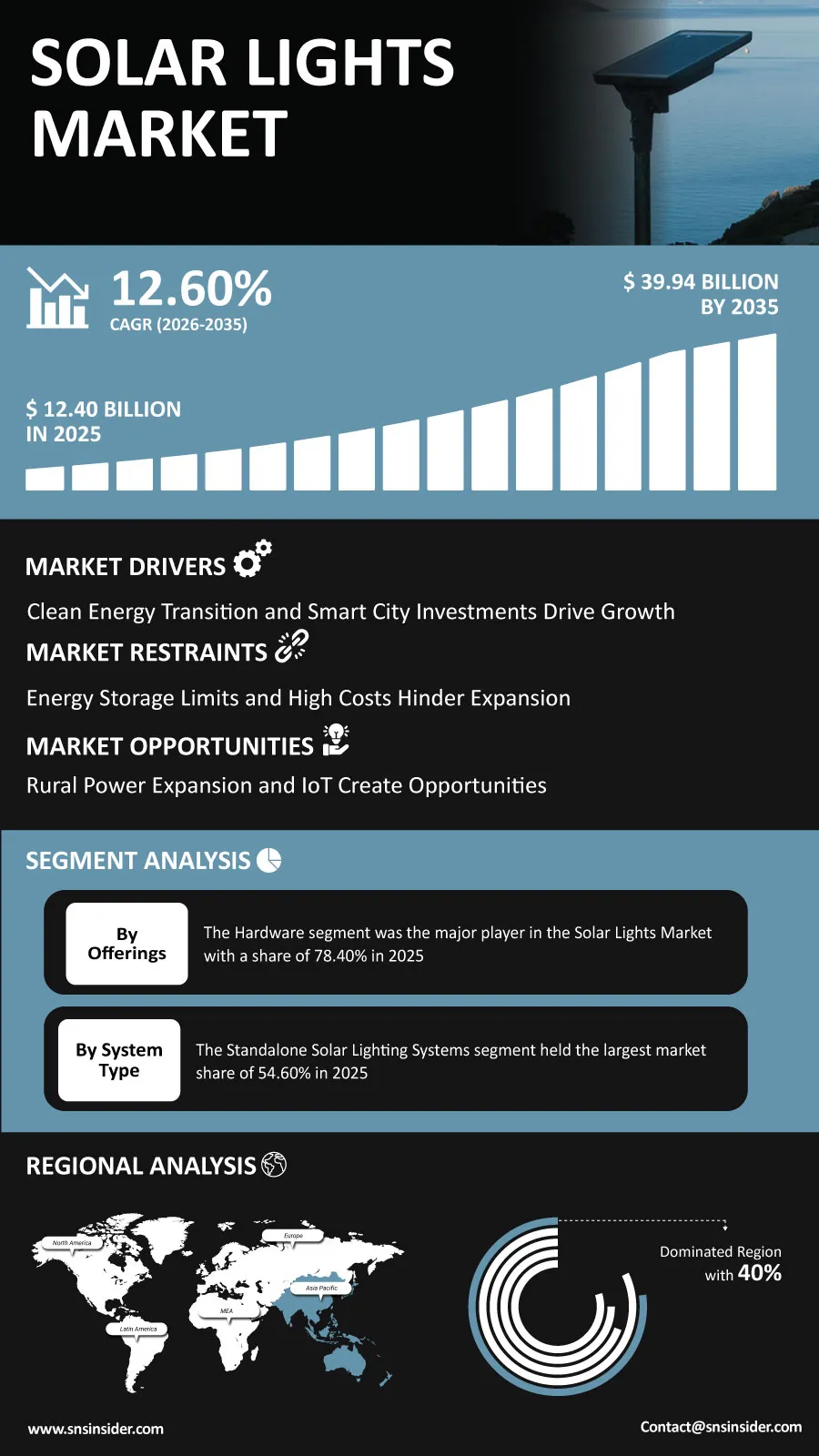
The global Solar Lights Market is set for significant expansion as clean energy transition and smart city infrastructure investment continue to reshape outdoor lighting worldwide. “According to a recent study by SNS Insider, the global Solar Lights Market size valued at USD 12.40 billion in 2025, is anticipated to grow to USD 39.94 billion by 2035, registering a CAGR of 12.60% over the 2026–2035 forecast period.”
There have been tremendous changes within solar lighting technology over time, due to which many manufacturers who aim at improving reliability and intelligence of their products can take advantage of this trend. This includes the need for more efficient batteries, smart controllers, and IoT-enabled monitoring systems that will provide municipalities and commercial operators with the ability to manage lighting infrastructure remotely. This applies in situations where solar lights are used for public infrastructure, rural electrification, and smart city deployment. Manufacturers are constantly working hard to ensure that their solar lighting systems perform better than before in order to meet various municipal, commercial, and off-grid community needs.
To Get Detailed Insights on the Solar Lights Market – Request a Sample Report
Smart City and Off-Grid Electrification Create New Demand
As the market of solar lights evolves, the technologies used become more sophisticated and advanced. As manufacturers of all sizes make increased investments in IoT-powered monitoring, adaptive brightness, and hybrid solar-grid integration of their systems, there is a need for solar lighting to become more reliable and energy-efficient.
New solutions will ensure increased reliability of energy storage, improved remote monitoring, and ability to expand into more difficult applications such as smart cities and rural electrification projects. In this way, cities and businesses can decrease expenses on electricity and reduce their carbon footprint, while increasing public safety and resilience of infrastructure.
Solar lighting manufacturers, financing companies, and organizations that deal with rural electrification increasingly cooperate due to rising interest in creating solutions for the future of off-grid lighting infrastructure.
Key Market Findings Highlight High-Growth Segments
The hardware segment dominated all categories in the solar lights market share with a market revenue share of 78.40% in 2025 due to the essential role of physical components in determining system performance. The fastest growing category is expected to be software which will grow at a CAGR of 15.80% through 2035, owing to rising adoption of smart, connected solar lighting systems.
By system type, standalone solar lighting systems held the largest share of total market revenue in 2025 due to wide adoption in off-grid and remote locations. Hybrid solar lighting systems will see the fastest growth in revenue generation at a CAGR of 14.90%, driven by growing need for reliable, uninterrupted lighting in urban and commercial environments.
Based on installation type, new installations generated the largest share of market revenue in 2025 thanks to rapid urbanization and smart city initiative expansion. On the other hand, retrofit installations will be the segment recording the fastest revenue growth at a CAGR of 15.40%, supported by growing replacement of conventional lighting infrastructure.
Distributive application trends are changing as well. Public infrastructure accounted for the largest revenue share in 2025 owing to large-scale government procurement for streets, highways, and parks. But commercial applications will turn out to be the fastest-growing category through 2035, on the back of growing adoption across offices, shopping complexes, and business campuses.
Reliability, Intelligence, and Affordability Gain Importance
In this regard, municipalities and commercial operators have been looking at solar lighting systems that would deliver more reliable illumination while requiring less maintenance and offering greater remote monitoring capability.
Innovation in battery storage technology, smart controller integration, and IoT-based monitoring has been making it possible for companies to come up with systems that can operate effectively across increasingly demanding urban and off-grid applications. In addition to that, increasing emphasis on affordability and standardization is also making it possible for manufacturers to find solutions that meet evolving procurement and reliability expectations across emerging markets. Such trends are likely to become even more prominent in the future.
Asia Pacific Emerges as the Largest Market with 40% Regional Revenue Share Amid Rising Urbanization
The Asia Pacific region represented the largest share of regional market revenue in 2025 at 40%, owing to rapid urbanization, expanding infrastructure development, and strong government initiatives supporting renewable energy adoption. On the other hand, the Middle East & Africa region is expected to be among the fastest-growing markets during the forecast period through 2035, propelled by rural electrification programs and international development partnerships expanding energy access to underserved communities.
Leading Companies Drive Innovation and Competition
The environment continues to stay very dynamic since players continue innovating on smart monitoring technology and battery storage as well as forming partnerships in order to enhance their position in the industry. Some of the major companies that operate in the global solar lights market are Clear Blue Technologies, ENGOPLANET Energy Solutions, Fonroche Lighting America, Greenshine New Energy, Jakson Solar, Leadsun, Lumiax, Orion Solar, SEPCO, and Signify Holding.
An SNS Insider analyst Sakshi Kale commented, "The growing convergence of smart city infrastructure investment and rural electrification demand is creating sustained opportunities for solar lighting manufacturers across both developed and emerging markets. Companies that successfully combine battery reliability, smart monitoring technology, and financing accessibility will be best positioned to capitalize on emerging opportunities across public infrastructure, commercial, and off-grid applications."
About the Author

Get in touch