
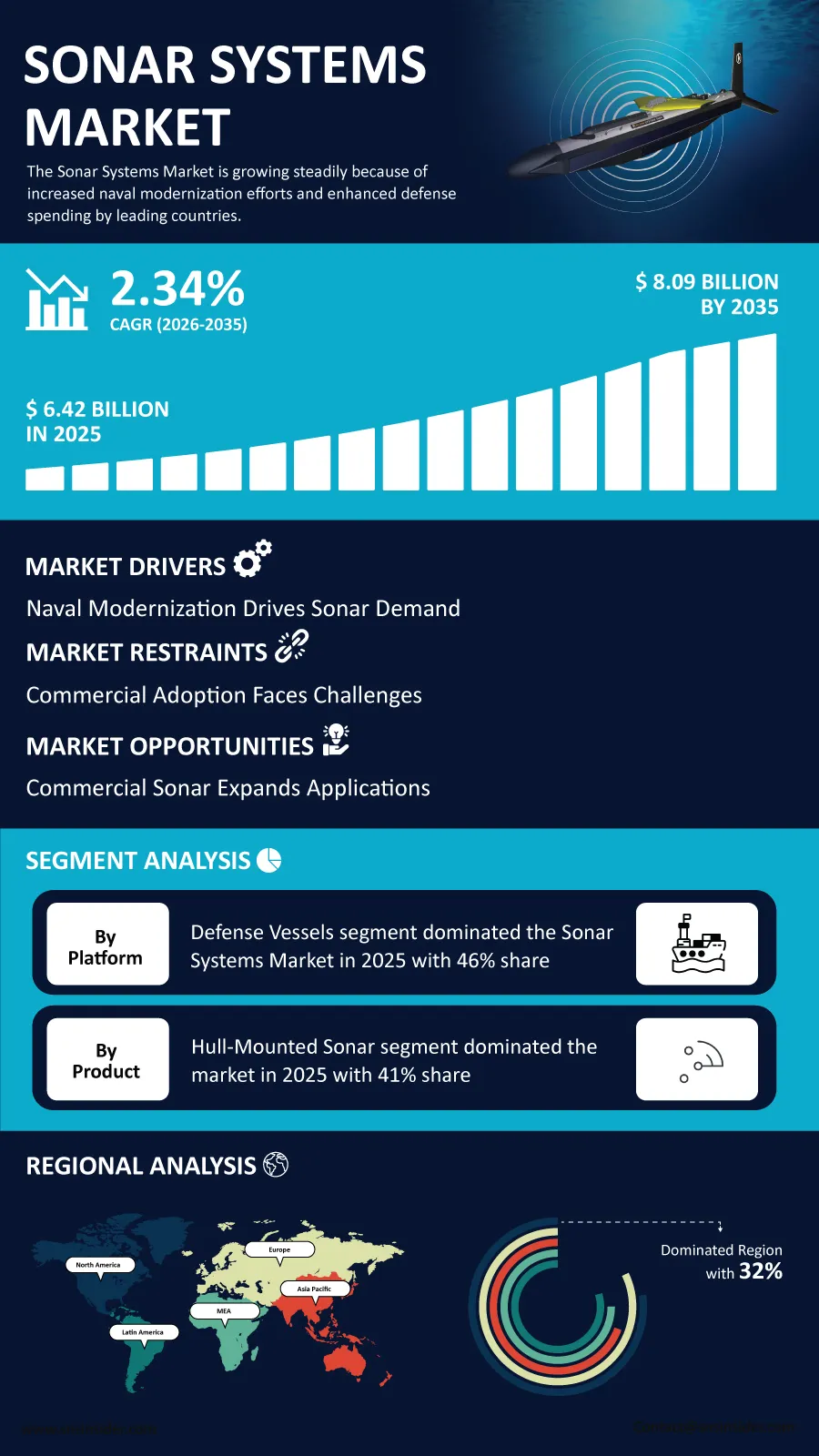
The global Sonar Systems Market is expected to witness stable long-term growth as governments strengthen maritime security capabilities while commercial industries increase investments in underwater exploration and monitoring technologies. “According to a recent study by SNS Insider, the global Sonar Systems Market size valued at USD 6.42 billion in 2025, is anticipated to grow to USD 8.09 billion by 2035, registering a CAGR of 2.34% over the 2026–2035 forecast period.”
The ongoing trends of increased geopolitical uncertainty, naval modernization programs, and requirements for underwater surveillance will further drive the global expenditure on next-generation sonar systems. Sonar technologies are being considered by the defense departments as essential components of the future development of anti-submarine warfare, coastal security, and underwater intelligence.
Additionally, the commercial sector makes an equally important contribution to the growth of the market by using the sonar technologies in their operations related to seabed mapping, underwater monitoring and maintenance of the necessary infrastructure.
To Get Detailed Insights on the Sonar Systems Market – Request a Sample Report
Naval Modernization and Autonomous Marine Technologies Generate New Growth Opportunities
The defense organizations around the globe are continuing to invest heavily in marine surveillance systems due to the growing sophistication of underwater threats. Modern naval forces need highly accurate sonars that can be used for surveillance, navigation, target recognition, and even underwater communication in varied operating conditions.
With the advent of autonomous underwater vehicles and unmanned maritime systems, new avenues have been opened for the companies’ developing sonars. Such systems rely on high-quality sensing solutions for conducting reconnaissance, environment monitoring, sea floor mapping, and inspections in order to minimize the risk associated with the operations.
Additionally, increased investment in offshore wind farms, subsea pipelines, and oil and gas projects in the offshore region is also boosting the commercial demand for underwater imaging and detection systems.
Key Market Insights Highlight Shifting Industry Priorities
Among platform categories, defense vessels generated 46% of total market revenue in 2025 as naval fleets continued investing in underwater surveillance capabilities to strengthen maritime security operations.
The unmanned underwater vehicles segment is forecast to record the fastest expansion through 2035 as autonomous naval technologies become increasingly important across defense and commercial applications.
By product type, hull-mounted sonar systems accounted for 41% of global revenue in 2025 because of their widespread deployment on naval ships for continuous underwater monitoring. Meanwhile, sonobuoys are expected to emerge as the fastest-growing product category due to rising airborne anti-submarine warfare requirements.
From an application perspective, anti-submarine warfare represented 38% of market revenue in 2025, reflecting continued investment in underwater defense capabilities. The mine detection and countermeasure systems segment is anticipated to deliver the highest growth rate during the forecast period.
Based on installation type, fixed sonar systems captured 63% of market revenue in 2025 owing to their extensive deployment across permanent naval platforms, while deployable systems continue gaining momentum through flexible mission-specific applications.
Advanced Underwater Intelligence Remains a Strategic Defense Priority
The topic of maritime security has gained prominence among governments who strive to secure their territorial waters, shipping lanes, and assets in the sea. With the adoption of technological advancements in sensing systems by naval forces, sonar technology has emerged as a key factor in underwater threat detection.
Innovators of technology are coming up with systems that have improved acoustic capabilities, better signal processing capabilities, advanced artificial intelligence algorithms, and the ability to integrate into autonomous underwater vessels. This is allowing the systems to be used efficiently and in a variety of different settings outside of the military.
Growing demand for precise underwater mapping is also supporting product innovation across oceanographic research, fisheries management, environmental monitoring, and subsea infrastructure maintenance.
North America Accounted for 32% Market Share in 2025; Asia Pacific Forecast to Expand at a 3.67% CAGR by 2035
In North America, the share of revenue in the Sonar Systems Market was around 32.94% in 2025 on the back of consistent defense expenditure, widespread naval modernization plans, and heavy investment in underwater surveillance equipment. Commercial operations associated with offshore energy exploration in the region are adding to the region’s dominance.
The fastest-growing region is anticipated to be Asia Pacific, with its revenue growing at a 3.67% CAGR until 2035. The rising naval procurement schemes, maritime security measures, offshore infrastructure development, and increasing use of autonomous underwater systems are helping generate strong demand for advanced sonar technology in the region.
With countries enhancing their capabilities in the maritime sector and commercial enterprises increasing underwater exploration activities, the demand for advanced sonar technologies in the region is likely to remain high during the forecast period.
Industry Participants Accelerate Innovation Across Defense and Marine Applications
Competition within the global Sonar Systems Market remains driven by continuous technological innovation, long-term defense contracts, and expanding commercial opportunities. Manufacturers are focusing on improving detection accuracy, operational reliability, digital integration, and autonomous platform compatibility to strengthen their market positions.
Key companies operating in the global Sonar Systems Market include Lockheed Martin Corporation, Thales Group, Raytheon Technologies Corporation, Northrop Grumman Corporation, BAE Systems plc, Leonardo S.p.A., Saab AB, Kongsberg Gruppen, L3Harris Technologies, Ultra Electronics Holdings plc, Atlas Elektronik GmbH, Teledyne Technologies Incorporated, Elbit Systems Ltd., General Dynamics Corporation, Furuno Electric Co., Ltd., ASELSAN A.Ş., Hensoldt AG, Mitsui Engineering & Shipbuilding, Wärtsilä Corporation, and Israel Aerospace Industries (IAI).
An SNS Insider analyst Santosh Bhul commented, "Growing maritime security requirements, continuous naval modernization, and expanding commercial underwater operations are creating sustained opportunities for sonar technology providers. Organizations investing in intelligent sensing capabilities, autonomous system integration, and advanced acoustic technologies will be well positioned to capitalize on long-term market growth."
About the Author

Get in touch




