
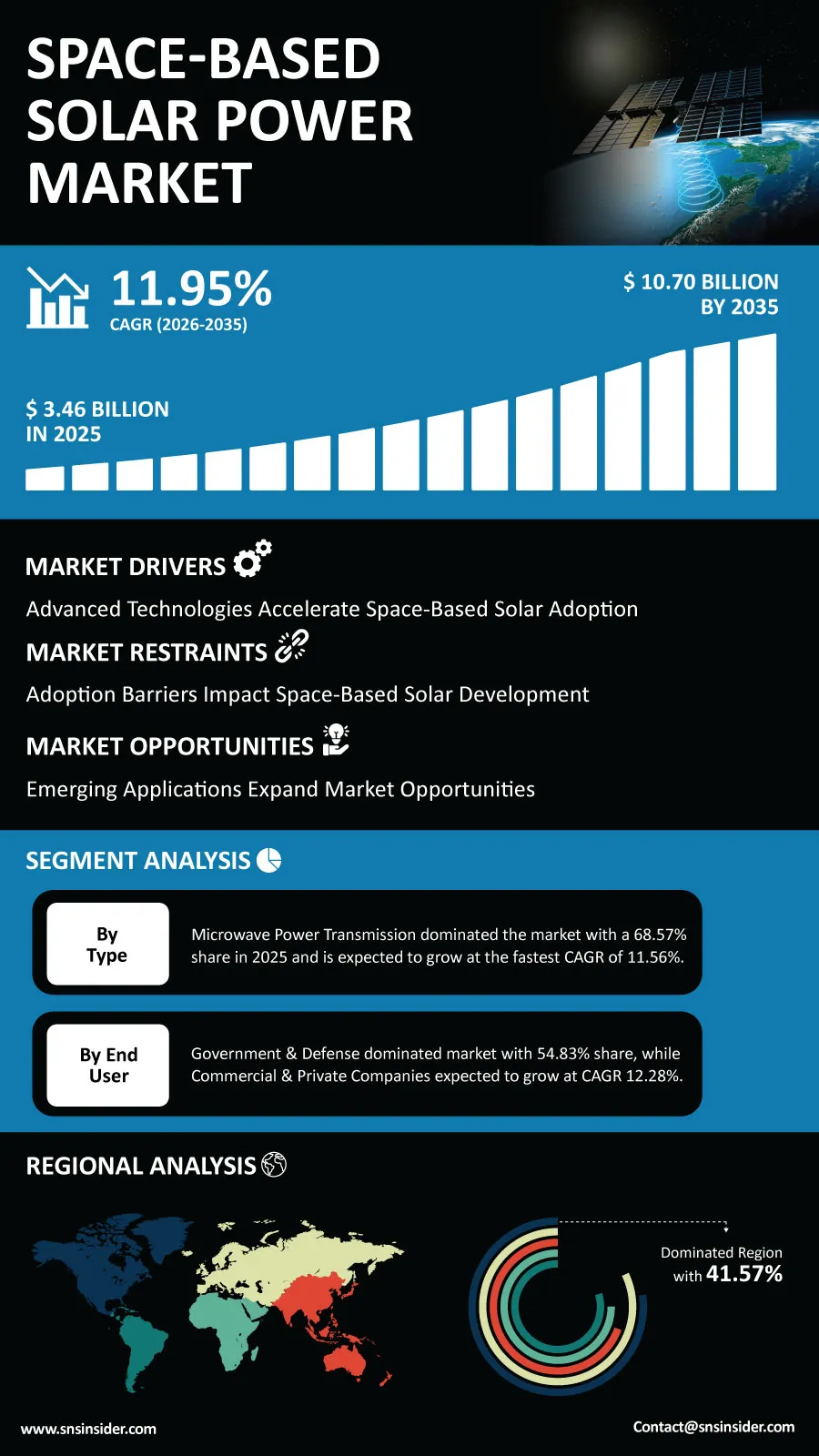
The global Space-Based Solar Power Market is gaining remarkable momentum as governments, aerospace companies, and clean energy innovators accelerate investments in next-generation renewable energy technologies. “According to a recent study by SNS Insider, the global Space-Based Solar Power Market size valued at USD 3.46 billion in 2025, is anticipated to grow to USD 10.70 billion by 2035, registering a CAGR of 11.95% over the 2026–2035 forecast period.”
With rising worldwide electricity usage, there is growing research into orbital solar power satellites that can provide continual and reliable renewable energy, irrespective of weather constraints and availability of sunlight. Advancements in satellite technology, wireless energy transfer, and the creation of an orbiting system are adding to the conviction in the economic viability of space-based power.
The government, military applications, and aerospace companies' involvement are hastening the validation of the technology while also enabling massive demonstrations. The increasing importance of carbon reductions and energy security makes space-based solar power a part of the future energy infrastructure.
To Get Detailed Insights on the Space-Based Solar Power Market – Request a Sample Report
Government Support and Private Investments Expand Commercial Opportunities
Space agencies and defense authorities remain focused on developing high-energy orbiting technologies that improve energy security for strategic purposes. In addition, private aerospace firms are stepping up their efforts by making more investments into satellite systems that can produce solar energy and deliver electric power to Earth through safe channels.
Cooperation among research centers, satellite makers, launchers, and renewable energy firms is helping to streamline technology development processes and drive innovations along the entire value chain. This trend is likely to foster commercialization and pave the way for innovations in electrification, off-shore activities, disaster relief services, and future lunar and deep space exploration missions.
Advances in autonomous assembly technologies, lightweight materials, and high-efficiency energy conversion systems are also improving the economic feasibility of large-scale orbital solar infrastructure.
Key Market Insights Reflect Rapid Technology Evolution
By type, Microwave Power Transmission accounted for 68.57% of total market revenue in 2025 and is expected to maintain strong growth through 2035 due to its proven efficiency for long-distance wireless energy transmission.
Based on component, Solar Collectors represented 38.64% of global revenue in 2025, benefiting from continuous improvements in photovoltaic efficiency and orbital energy harvesting capabilities. Power Conversion Units are projected to achieve the fastest growth during the forecast period as advanced conversion technologies improve transmission performance.
In terms of application, Electricity Generation (Terrestrial) contributed 63.78% of market revenue in 2025 and is forecast to remain the fastest-growing application through 2035 as demand rises for dependable renewable electricity supplies.
By end user, Government & Defense captured 54.83% of market share in 2025, reflecting strong institutional investment in strategic energy programs. Meanwhile, Commercial & Private Companies are anticipated to expand rapidly as commercialization initiatives continue attracting significant private capital.
Advanced Wireless Energy Technologies Accelerate Industry Transformation
Technology is developing very fast because firms create highly efficient microwave transmission technologies, satellite positioning system technologies, and intelligent energy management systems that can support the creation of orbital power supply continuously.
The use of artificial intelligence, robotics, and autonomous production processes will be increasingly important in designing and managing the space-based power stations of the future. The development of digital design software is making the launching of satellites increasingly effective and less complicated.
Innovation in the field of lightweight construction materials, modular satellite construction, and efficient solar power collection systems will be very helpful in achieving scalability and commercial sustainability in various applications.
North America Accounted for 41.57% Market Share in 2025; North America Forecast to Expand at a 12.37% CAGR by 2035
North America holds a share of 41.57% in the worldwide market revenue in 2025 due to its cutting-edge aerospace technologies, strong governmental support, and further innovations in satellites. North America is leading in terms of research due to the joint efforts of its federal agencies, defense establishments, and aerospace companies working in the development of new orbit energy systems.
Moreover, it is expected that the CAGR of North America will reach 12.37% through 2035 with the aid of further investment and technological advancements.
Asia Pacific is enhancing its market presence due to growing space programs of countries in the region, increasing investments in renewable energy sources, and collaboration between their governmental agencies and aerospace companies. Europe is growing steadily owing to research programs dealing with wireless energy transmission, sustainable power generation, and space exploration.
Industry Participants Accelerate Innovation Across Orbital Energy Systems
Competition within the Space-Based Solar Power Market continues to intensify as leading aerospace organizations expand research capabilities, strengthen strategic partnerships, and invest in advanced orbital power technologies. Continuous innovation in satellite engineering, wireless power transmission, autonomous assembly systems, and renewable energy infrastructure is expected to support commercialization while creating new opportunities across government and private-sector applications.
Key companies operating in the global Space-Based Solar Power Market include China Aerospace Science and Technology Corporation (CASC), Air Force Research Laboratory (AFRL), Northrop Grumman Corporation, Japan Aerospace Exploration Agency (JAXA), Solaren Corporation, Azur Space Solar Power GmbH, SolAero Technologies Corporation, Rostec Corporation, SpaceTech GmbH, Frazer-Nash Consultancy, Airbus, OHB SE, Thales Alenia Space, Boeing, Celestia Energy, Emrod, EnergySpace, Entropy Research and Development, Fibertek, and Aetherflux.
An SNS Insider analyst Santosh Bhul commented, “Space-based solar power is evolving from a long-term scientific concept into an emerging commercial opportunity as advances in satellite technologies, wireless power transmission, and international collaboration continue to accelerate. Organizations investing in scalable orbital energy platforms and next-generation space infrastructure are expected to play a significant role in shaping the future of sustainable global energy generation.”
About the Author

Get in touch




