
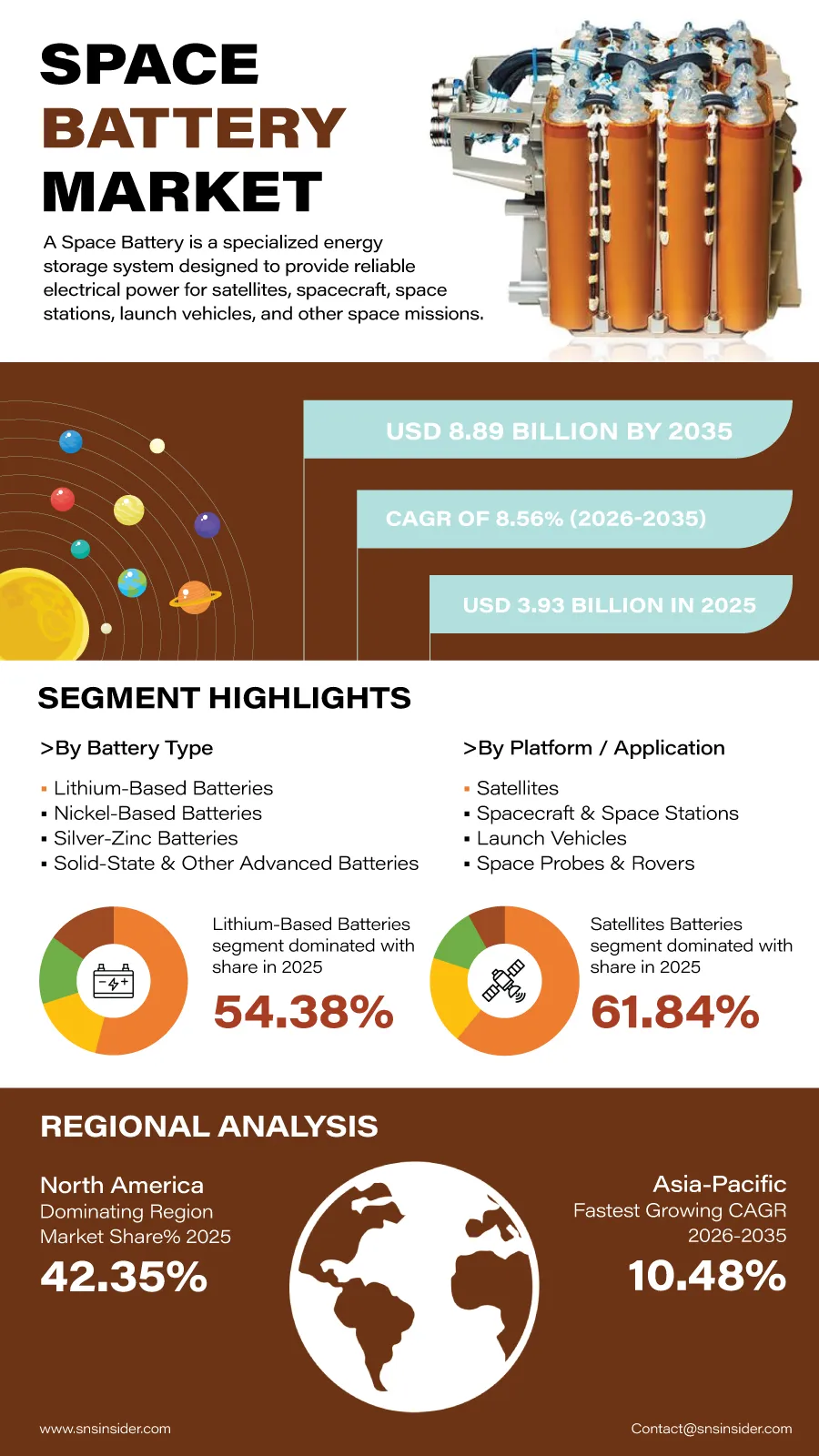
The global Space Battery Market is expected to witness robust expansion over the coming decade as governments, commercial satellite operators, and private space companies accelerate investments in next-generation space missions and orbital infrastructure. According to a recent study by SNS Insider, the global Space Battery Market size valued at USD 3.93 billion in 2025, is anticipated to grow to USD 8.89 billion by 2035, registering a CAGR of 8.56% over the 2026–2035 forecast period.
As more communications, Earth observation, navigations, and science satellites are being launched into space, there is an increased requirement for reliable on-board energy sources. With technological advancements in spacecraft and increase in mission duration, batteries that provide higher energy density, longer life span, and superior performance even in harsh environments are essential.
To Get Detailed Insights on the Space Battery Market – Request a Free Sample Report
With the developments in lithium-ion batteries, solid-state batteries, and other lighter battery forms, there has been a significant increase in the capabilities of the power generation units for spacecraft. At the same time, manufacturers have made efforts in developing highly radiation-tolerant batteries and efficient thermal management systems.
Expanding Space Exploration Programs Create Significant Growth Opportunities
Investment in space exploration by different nations is growing at a very fast pace owing to expansion in programs involving moon exploration, deep-space missions, military applications in space, and satellites. In this process, there will be a need for battery systems which can provide power during the whole lifecycle of these programs.
The increased trend of commercial use of space is also helping improve market opportunities. Private firms are now setting up satellite constellations in LEO, building reusable rockets, working on space tourism projects, and even developing future moon-related facilities. All this requires efficient and light-weight batteries.
Alongside this, there is also the fact of continued reduction in sizes of satellites, especially CubeSats and small satellites.
Key Market Insights Highlight Shifting Demand Patterns
In terms of the types of batteries, lithium-based batteries are expected to account for 54.38% of the total market revenue in 2025 attributed to their high energy density, weightlessness, and reliability in different space applications. Solid-state and other advanced battery types are predicted to exhibit the highest CAGR of 10.99% through 2035 owing to the increasing demand for safe, durable energy sources able to operate under harsh space conditions.
On the basis of platforms and applications, satellites will account for 61.84% of market revenue in 2025 due to the fast growth in communication, navigation, defense, and Earth observation space missions. It is expected that spacecrafts and space stations will be the segments with the highest CAGR of 8.15% till 2035 backed by increased funding in space explorations and human missions.
By functions, secondary (or rechargeable) batteries are expected to constitute 68.92% of the global market revenue in 2025 owing to their ability to deliver power supply throughout the whole mission. The same segment is also expected to register the highest CAGR of 9.16%.
Regarding end users, government space agencies will constitute 49.73% of market revenue in 2025 due to increased funding in national space programs, research, and military applications. Commercial space companies are expected to demonstrate the highest CAGR of 11.12%.
An Infographic Representation of the Global Space Battery Market
Next-Generation Battery Technologies Support Mission Reliability
Space mission battery systems must be capable of operating in high radiation and extreme temperatures, have long service lifecycles and require no maintenance or replacement. Manufacturers are looking at innovations to improve power density, thermal stability, charging efficiency and operational safety as missions are getting more complicated.
Advanced battery management systems, intelligent monitoring technologies and high-performance materials are improving overall spacecraft reliability and enabling increasingly ambitious exploration goals. These technologies are expected to take a big role in future lunar, Martian, and deep space missions.
Regional Markets Demonstrate Strong Investment Momentum
By 2025, North America is anticipated to account for 42.35% of the worldwide market revenue, driven by strong government financing, sophisticated aerospace capabilities, rising commercial launch activity, and strong collaboration between public agencies and private space businesses. Continued investments in satellite deployments and national security programmes are further strengthening the region’s market leadership.
Asia Pacific would have fastest regional growth with a CAGR of 10.48% to 2035. The growth of national space programmes in China, India, Japan and South Korea, and increased investments in indigenous satellite production and deep-space research are providing major prospects for battery makers across the region.
Demand for advanced energy storage systems is likely to stay robust throughout the projected period as additional countries build up their space capabilities and commercial operators extend orbital infrastructure.
Industry Participants Focus on Advanced Energy Storage Innovation
The competitive landscape is changing as manufacturers invest in next-generation lithium-ion technologies, solid-state battery development, lightweight materials, and mission-specific battery architectures. For companies looking to strengthen their market position, strategic partnerships with government agencies, satellite manufacturers and commercial launch providers remain a key priority.
Some of the major companies operating in the global Space Battery Market are EaglePicher Technologies, Saft Groupe S.A., GS Yuasa Corporation, EnerSys, Arotech Corporation, Mitsubishi Electric Corporation, Toshiba Corporation, Exide Technologies, BYD Company Limited, Panasonic Corporation, Ultralife Corporation, VARTA AG, ABSL Space Products, Sion Power Corporation, Plug Power Inc., Lockheed Martin Corporation, Northrop Grumman Corporation, Raytheon Technologies Corporation, Tadiran Batteries Ltd., and Maxell Holdings Ltd.
An SNS Insider analyst Santosh Bhul commented, “The rapid expansion of satellite constellations, increasing commercialization of space activities, and growing investment in deep-space exploration are driving sustained demand for high-performance space battery technologies. Companies focused on improving energy density, reliability, and mission longevity will be well positioned to capitalize on emerging opportunities across the global space industry.”
About the Author

Get in touch




