
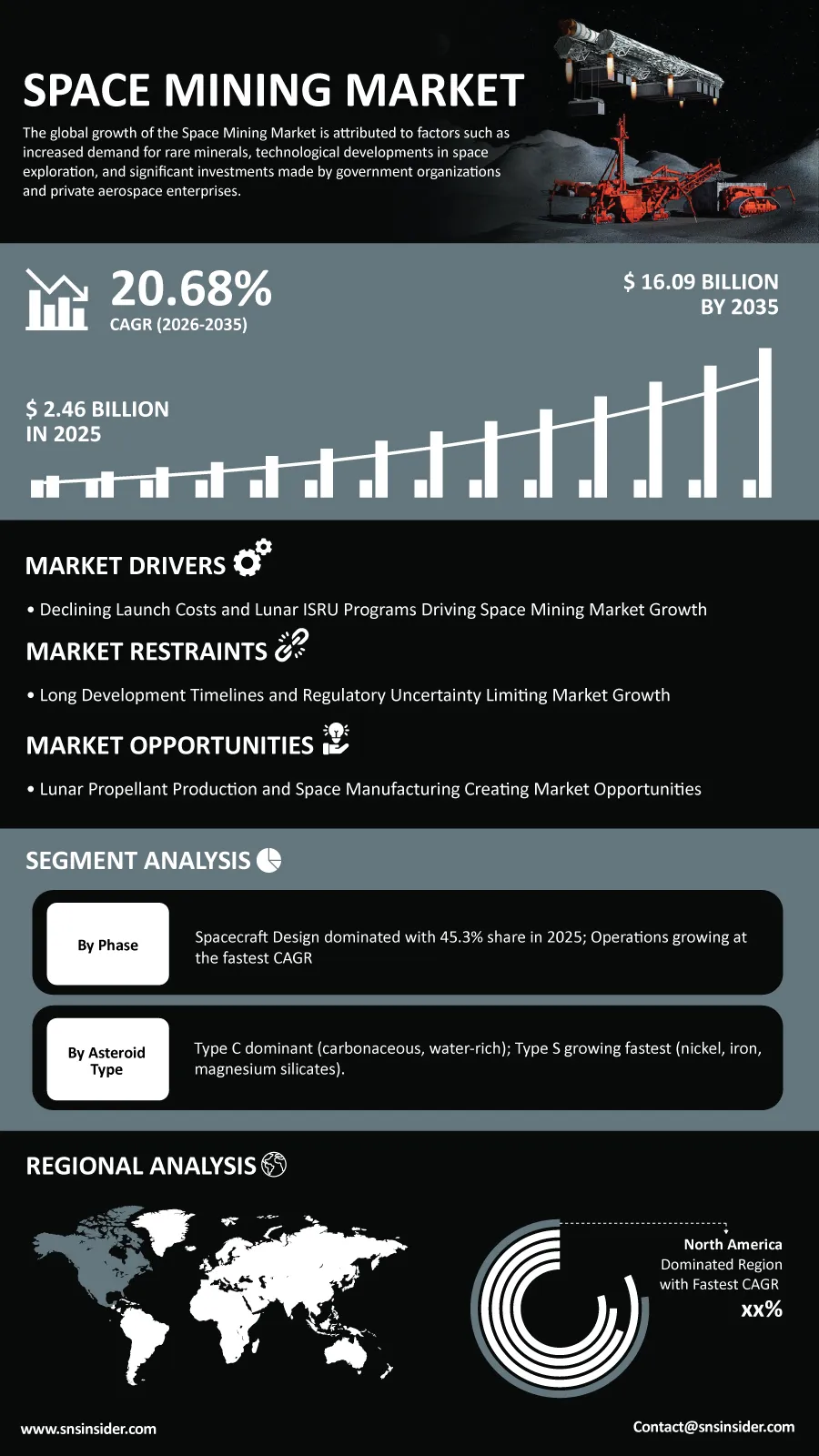
The global Space Mining Market is moving from long-term exploration concepts toward a more structured commercial ecosystem as governments and private aerospace companies invest in resource utilization beyond Earth. According to a recent study by SNS Insider, the global Space Mining Market size valued at USD 2.46 billion in 2025, is anticipated to grow to USD 16.09 billion by 2035, registering a CAGR of 20.68% over the 2026–2035 forecast period.
The increasing demand for strategic minerals, coupled with improvements in autonomy of spacecraft and decreasing launch costs, is adding weight to the idea of extraterrestrial resources. The lunar water, metal-rich asteroids, and other extraterrestrial resources may one day be used for propulsion, construction, and conducting exploration missions without having to rely on resources brought up from Earth.
Successful sample return missions have reinforced the idea of technical feasibility of resource extraction. With advancing capabilities of spacecraft and more commercial availability of launch services, investors and aerospace engineers are increasingly focusing on technologies needed for sustainable use of extraterrestrial resources.
To Get Detailed Insights on the Space Mining Market – Request a Sample Report
Lunar Resource Utilization Creates New Growth Opportunities
The potential of utilizing in-situ resources is becoming one of the most valuable opportunities for the development of the space mining industry. The possibility to mine water from lunar resources and process it to produce fuel in the form of hydrogen and oxygen can be used for further exploration and lessen the number of materials delivered from Earth.
In parallel, private enterprises are working on spacecraft and robots capable of exploration of the Moon and near-Earth asteroids, as well as technologies that will allow processing resources once they are discovered. Especially valuable improvements in this area are those related to autonomous navigation and robotic operations as long delays in communications make human control of the equipment impossible.
Low costs of launches also change the economic aspects of space exploration. As reusability of spacecraft decreases the costs involved in sending satellites into orbit, there appear new possibilities for exploration architecture.
Key Market Insights Highlight Shifting Demand Patterns
By phase, spacecraft design is expected to account for approximately 45.3% of global market revenue in 2025, reflecting the industry's current emphasis on engineering, mission planning, spacecraft development, and technology demonstrations. Operations are projected to be the fastest-growing phase as planned exploration programs advance toward actual deployment and resource extraction activities.
Based on asteroid type, Type C asteroids remain the leading focus for near-term commercial exploration because of their potential water and carbon-rich resources. Their composition makes them attractive targets for future propellant production and in-space resource utilization. Meanwhile, Type S asteroids are expected to experience the fastest growth as their concentrations of iron, nickel, cobalt, and other valuable materials increase their long-term commercial appeal.
By commodity resource, water is anticipated to remain the leading resource category due to its strategic importance for producing propellant and supporting human activity beyond Earth. Platinum group materials represent a major long-term opportunity because of their potential value for terrestrial industries and their concentration in certain metallic asteroid types.
Autonomous Robotics and Space Infrastructure Shape the Next Growth Phase
Space mining firms are more and more focusing on robot technology that will be able to carry out prospecting, drilling, excavation, material handling, and processing with limited human interaction. Technologies of artificial intelligence and self-governance are anticipated to have a significant role in dealing with complicated tasks that cannot be managed due to communication delays.
The creation of space-based production might eventually give rise to yet another market niche. The utilization of materials from space may allow reducing the necessity of launching great amounts of construction materials from Earth into space.
North America Leads the Space Mining Market as Asia Pacific Accelerates Deep-Space Investments
North America will still remain the leading market driven by active government space programs, private investments, and a well-established ecosystem of aerospace companies engaged in lunar and asteroids exploration. The US dominates regional activities thanks to its resource utilization programs and commercial space exploration ventures.
The Asia Pacific region is becoming an important market owing to Japan's asteroid exploration program, China's development of deep space exploration capabilities and growing investments into the country's space industry. Past successes of asteroids sample return missions have resulted in gaining necessary technical experience for future commercial missions.
Europe is becoming a strong player due to the development of space resources research and commercial activities, where Luxembourg has created a successful ecosystem of companies engaged in space resources utilization. Also, the UAE is enhancing its space capabilities and looking for possibilities related to lunar and asteroids missions.
Industry Participants Focus on Mission Readiness and Resource Technologies
The competitive landscape is evolving as aerospace companies, startups, research institutions, and government agencies invest in prospecting, autonomous robotics, spacecraft engineering, and resource-processing technologies. Industry participants are increasingly focused on moving from theoretical resource assessments toward practical technology demonstrations and commercially viable mission architectures.
Key companies and organizations operating in the global Space Mining Market include AstroForge Inc., TransAstra Corporation, ispace Inc., Redwire Corporation, Karman+ Inc., Planetary Resources, Deep Space Industries, Lunar Resources Inc., Astrobotic Technology Inc., Masten Space Systems, Intuitive Machines LLC, Bradford SPACE, Colorado School of Mines, SpaceX, Blue Origin LLC, Rocket Lab USA Inc., Sierra Space Corporation, Northrop Grumman Corporation, Lockheed Martin Space, and Boeing Company.
An SNS Insider analyst Sushant Kadam commented, “The space mining industry is progressing as launch economics, autonomous robotics, and in-situ resource utilization technologies continue to mature. Lunar water extraction is likely to provide the earliest commercial pathway, while asteroid-derived materials could ultimately support a much larger space-based economy. Companies that successfully convert exploration capabilities into reliable resource-processing systems will be well positioned to capture future opportunities.”
About the Author

Get in touch




