
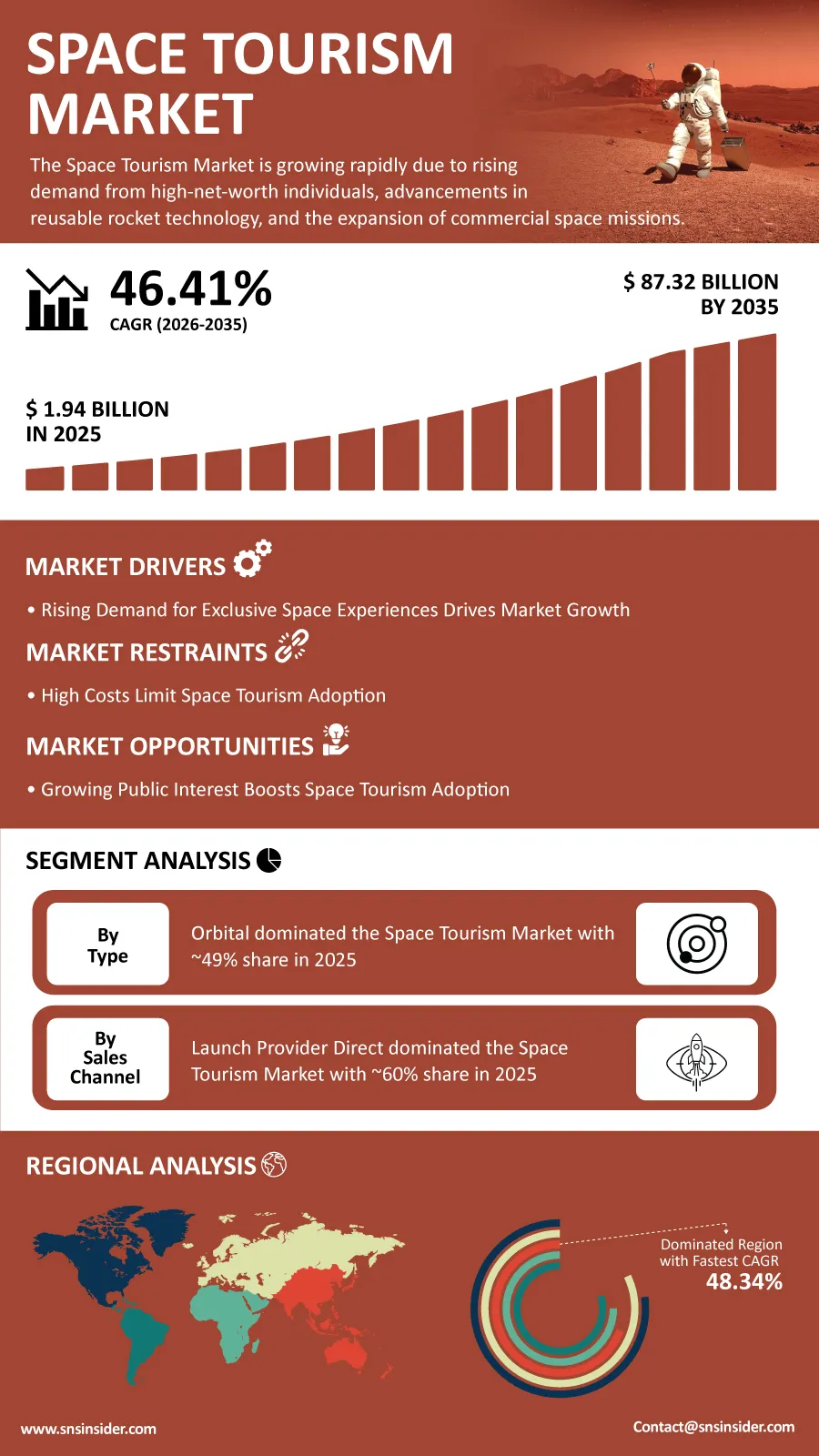
The global Space Tourism Market is expected to witness remarkable expansion as private aerospace companies accelerate commercial spaceflight programs and technological innovation makes civilian access to space increasingly feasible. “According to a recent study by SNS Insider, the global Space Tourism Market size valued at USD 1.94 billion in 2025, is anticipated to grow to USD 87.32 billion by 2035, registering a CAGR of 46.41% over the 2026–2035 forecast period.”
As more consumers desire unique once-in-a-lifetime travel experiences, and thanks to breakthroughs in the development of reusable space vehicles, space tourism is evolving into a burgeoning commercial business. Well-heeled travelers, adventure seekers, and scientists alike are starting to look at commercial space flights as their new frontier for luxury travel.
Rapid advancements in space vehicle technology, flight safety mechanisms, and launching rates are set to reinforce momentum in the market even further. As commercial companies keep upgrading themselves via suborbital, orbital, and even future missions to the Moon, the industry as a whole keeps progressing towards increased accessibility and receives substantial investments.
To Get Detailed Insights on the Space Tourism Market – Request a Sample Report
Commercial Space Innovation Creates Long-Term Growth Opportunities
Commercialization of space transportation services has led to the emergence of numerous possibilities in the spheres of tourism, hospitality, manufacturing of aircraft, and research activities. A large number of firms are actively engaged in the development of reusable launchers, innovative crew capsules, and spacecraft intended to enhance operational performance as well as decrease the cost of a particular mission.
Increasing popularity of orbital resorts, privately organized flights of astronauts into space, and luxurious space experience is prompting industry stakeholders to provide premium-level services that will not be limited to short-term travel. Collaboration of aerospace firms, travel agencies, and tech firms is also assisting in the creation of a comprehensive commercial space industry.
At the same time, further progress of propulsion, autonomous flight, and launch infrastructure solutions is helping to boost mission reliability and increase the frequency of commercial launches. These technologies will be crucial in attracting more customers to the space trips in the coming decade.
Key Market Insights Highlight Shifting Demand Patterns
Based on type, the orbital tourism is estimated to hold the highest share of about 49% of the global market revenue by 2025 due to high price rates, lengthy duration of mission and increasing consumer preference for immersive space tourism. The sub-orbital type of market will show the fastest growth up to 2035 driven by shorter duration of missions, increased affordability and commercial flights availability.
By high-net-worth (HNW) community, the segment with the net worth between USD 20 million and USD 40 million will capture nearly 44% of the global market revenue by 2025 owing to high spending power of affluent travelers who remain to be the key market target customers. The more than USD 60 million HNW segment will show the fastest growth over the forecast period because of increasing number of ultrahigh-net-worth individuals seeking personalized experiences in space.
In terms of sales channel, the launch provider direct is expected to account for the highest contribution of approximately 60% of the market revenue by 2025 driven by direct customer approach, premium services and comprehensive mission management offered by commercial spaceflight enterprises. The third-party partnership sales channel is projected to have the fastest growth rate during the forecast period due to cooperation with luxury travel agencies and service providers.
By end use, the commercial segment accounted for approximately 51% of market revenue in 2025, while the government segment is expected to register the strongest growth over the forecast period as international collaborations and research missions continue to expand.
Advanced Spaceflight Technologies Accelerate Industry Transformation
There are many improvements coming into the field of commercial spaceflight that include reusable launch vehicles, innovative spacecraft materials, smart flight controls, and innovations related to enhancing the safety of passengers. Such developments are making these missions efficient and reliable at the same time.
Further, the manufacturers are working on the development of next-generation spacecraft that will be able to take tourists into orbit for recreational purposes, conduct private research and even make trips to deep space in future. The innovations in these fields will make space tourism business viable and encourage more participants.
North America to Dominate the Space Tourism Market in 2025; Asia Pacific Forecast to Expand at a 48.34% CAGR During 2026–2035
North America is anticipated to be the dominant region for the Space Tourism Market by 2025 on the account of the availability of major spaceflight providers, established aerospace infrastructure, regulatory support, and further private investment towards reusable space technology.
Asia Pacific is forecasted to register the fastest CAGR of about 48.34% from 2026 to 2035 due to growing investments in commercial space programs in China, India, and Japan. Increasing partnerships between government agencies and the private sector as well as growing interest among high-end consumers contribute to the region's future growth perspective.
Europe is seen showing consistent growth with increasing aerospace innovations and collaborations in the area of space programs and spacecraft developments. Middle East, Africa, and Latin America regions have also been gradually gaining momentum within the industry thanks to strategic partnerships and infrastructural developments.
Industry Participants Focus on Innovation and Commercial Space Accessibility
The competitive landscape remains highly dynamic as leading aerospace companies continue investing in reusable spacecraft, advanced launch systems, passenger safety technologies, and next-generation commercial flight platforms. Strategic partnerships, technology development, and long-term infrastructure investments are enabling market participants to accelerate commercialization while improving accessibility to civilian space travel.
Key companies operating in the global Space Tourism Market include SpaceX, Blue Origin, Virgin Galactic, Axiom Space, Inc., Space Adventures, Airbus Group SE, The Boeing Company, Space Perspective, Sierra Space, Orbital Assembly Corporation, Nanoracks, Zero 2 Infinity, Bigelow Aerospace, Voyager Space, ExPace, Galactic Suite Space Resort, SpaceCorridor, Space Explorers, PD AeroSpace, and Starchaser Industries.
An SNS Insider analyst Sakshi Kale commented, "Rapid advances in reusable launch technologies, increasing private sector investment, and growing consumer demand for exclusive space experiences are reshaping the future of commercial human spaceflight. Organizations that continue investing in safe, scalable, and cost-efficient space transportation platforms will be well positioned to capitalize on the significant long-term opportunities emerging across the global space tourism industry."
About the Author

Get in touch




