
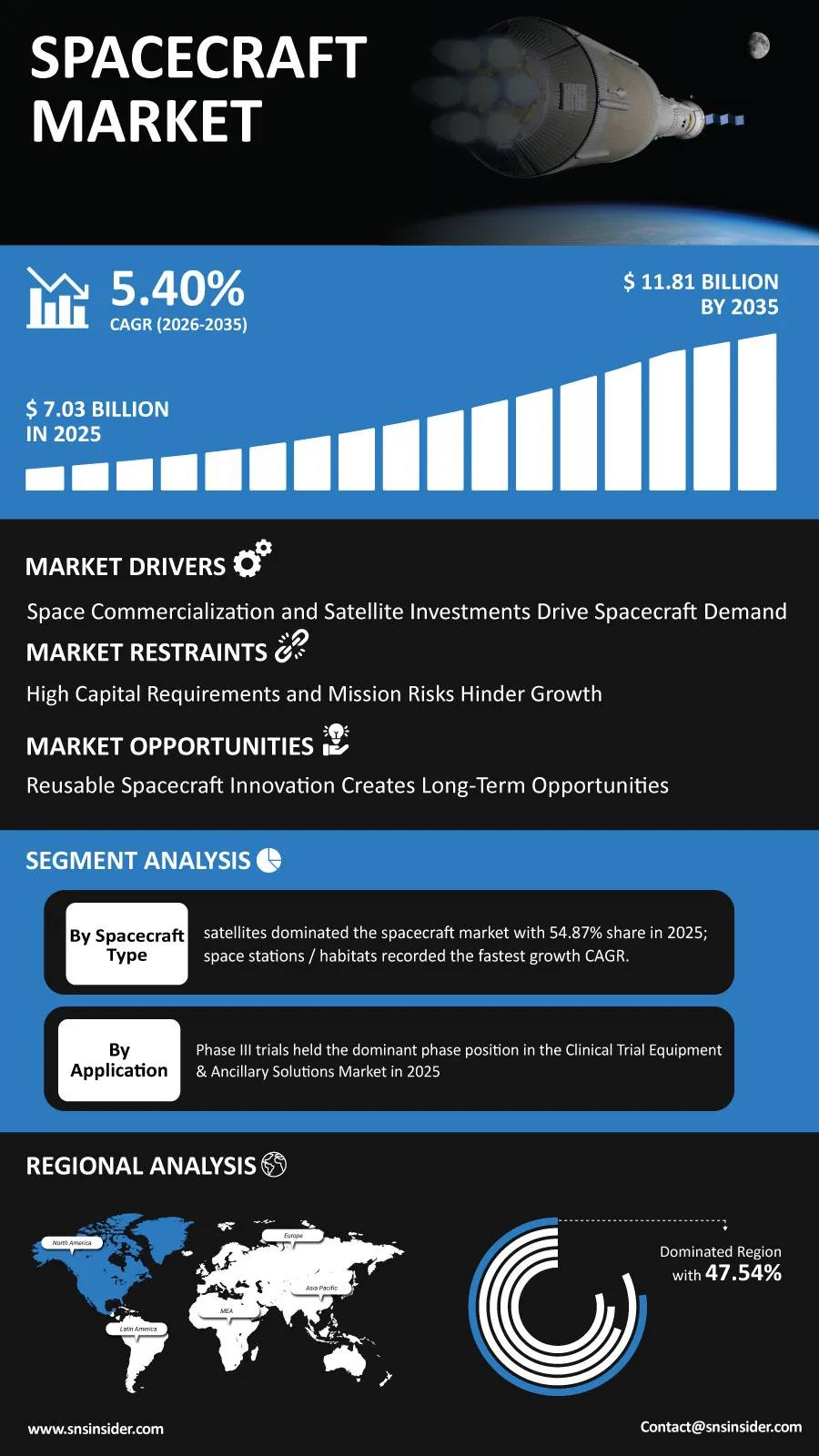
The global Spacecraft Market is entering a period of sustained expansion as public agencies and private aerospace companies increase spending on satellite networks, exploration programs, orbital services, and next-generation transportation systems. “According to a recent study by SNS Insider, the global Spacecraft Market size valued at USD 7.03 billion in 2025, is anticipated to grow to USD 11.81 billion by 2035, registering a CAGR of 5.40% over the 2026–2035 forecast period.”
The changing demand can be explained by the fast pace of development of the space infrastructure required for commercial purposes. In particular, satellite communications, Earth observation, navigation, military and scientific applications are forming the need for satellites which have higher computational capabilities, higher maneuverability, and extended operational lifetime. Simultaneously, reduced cost of launches and increased involvement of the private sector make orbital space missions affordable to a wider array of entities.
Reusability, autonomous functionality, advanced propulsion systems, and small spacecraft are other aspects that influence the formation of mission architecture, allowing for more flexible deployment options and new space logistics, exploration, and human spaceflight opportunities.
To Get Detailed Insights on the Spacecraft Market – Request a Sample Report
Commercial Space Expansion Creates New Investment Opportunities
Opportunities beyond typical government procurement contracts are emerging as space commercialization continues to develop. Satellite providers are increasing their constellation capability, and start-ups are creating platforms for research, communications, observation, and in-space services.
Reusable spacecraft platforms present a second major opportunity. Reusable platforms have the potential to enhance efficiency and possibly bring down the cost of repeatable space missions. Autonomous rendezvous, docking, and servicing technologies may help create a new ecosystem for servicing spacecraft and building orbital infrastructure.
Commercial habitat and astronaut opportunities are growing the potential market even more. With space stations, tourism facilities, and lunar programs continuing to advance, spacecraft makers will be developing unique platforms able to handle increasingly difficult missions.
Key Market Insights Highlight Shifting Space Industry Demand
By spacecraft type, satellites accounted for 54.87% of global revenue in 2025, reflecting widespread requirements for communications, navigation, observation, and surveillance. Space stations and habitats are projected to record the fastest growth as commercial orbital infrastructure and long-duration missions gain momentum.
By application, communication represented 31.29% of market revenue in 2025. Growing demand for high-capacity connectivity and satellite-enabled services continues to support this segment. Space tourism is expected to expand at the fastest pace as private companies develop suborbital and orbital travel offerings.
Based on orbit type, Low Earth Orbit (LEO) held the leading position with a 46.54% share in 2025. Its suitability for broadband, Earth observation, and low-latency applications supports continued deployment. Sun-Synchronous Orbit (SSO) is forecast to experience the fastest growth, supported by increasing demand for consistent imaging conditions in observation missions.
By subsystem, propulsion systems generated 22.51% of market revenue in 2025. Advanced electric propulsion and next-generation thrusters are supporting maneuverability and mission endurance. Payload systems are projected to grow fastest as operators seek increasingly sophisticated communication, imaging, and scientific capabilities.
Autonomous Systems and Advanced Propulsion Accelerate Spacecraft Transformation
Engineers are integrating AI, navigation autonomy, on-board analysis, and advanced propulsion into spacecraft design. This could enable spacecrafts to make decision-based operations with minimum interaction from the ground station during complex and distant missions.
The manufacturers are also focusing on modularity in the design of spacecrafts and the integration of payloads that are efficient and perform well. These advancements could help reduce the time of development and also adapt the spacecraft platforms to suit other requirements apart from their primary objective.
North America Accounted for 47.54% Market Share in 2025; Asia Pacific Forecast to Expand at a 6.59% CAGR by 2035
In 2025, North America will contribute to 47.54% of worldwide spacecraft revenue due to the availability of large aerospace industries, space programs, commercial launches, and investments made in satellite infrastructure and exploration infrastructure. The U.S. will continue to be the dominant player in the market on account of development in satellites communication, defense satellites, lunar satellites, and commercial orbiting satellites.
The Asia Pacific region is expected to witness the highest CAGR of 6.59% till 2035 due to growing space programs of countries like China, India, Japan, and others in the region along with investments from the private sector.
Europe continues to be a major player in earth observation, science missions, and satellite manufacturing, whereas the Middle East, Africa, and Latin America are making gradual investments in their national space infrastructure and satellites.
Industry Participants Intensify Innovation Across Commercial and Government Missions
The competitive landscape is evolving as established aerospace contractors compete alongside specialized space companies developing reusable vehicles, satellite platforms, orbital infrastructure, and autonomous systems. Strategic partnerships, technology investments, and mission-specific spacecraft development are becoming increasingly important as the industry moves toward higher launch frequency and more diverse applications.
Key companies operating in the global Spacecraft Market include SpaceX, Lockheed Martin Corporation, Northrop Grumman Corporation, Airbus Defence and Space, Boeing Defense, Space & Security, Thales Alenia Space, Maxar Technologies, Sierra Space, Blue Origin, Rocket Lab USA Inc., L3Harris Technologies Inc., RTX Corporation, Mitsubishi Electric Corporation, OHB SE, Ball Aerospace Technologies Corp., Planet Labs PBC, Terran Orbital Corporation, Redwire Corporation, Firefly Aerospace, and Axiom Space.
An SNS Insider analyst Santosh Bhul commented, “The continued commercialization of orbital services, expansion of satellite infrastructure, and acceleration of lunar and deep-space programs are creating a broader opportunity landscape for spacecraft manufacturers. Companies combining reusable architectures, autonomous capabilities, advanced propulsion, and flexible spacecraft platforms will be strongly positioned as space activity becomes increasingly commercial and interconnected.”
About the Author

Get in touch




