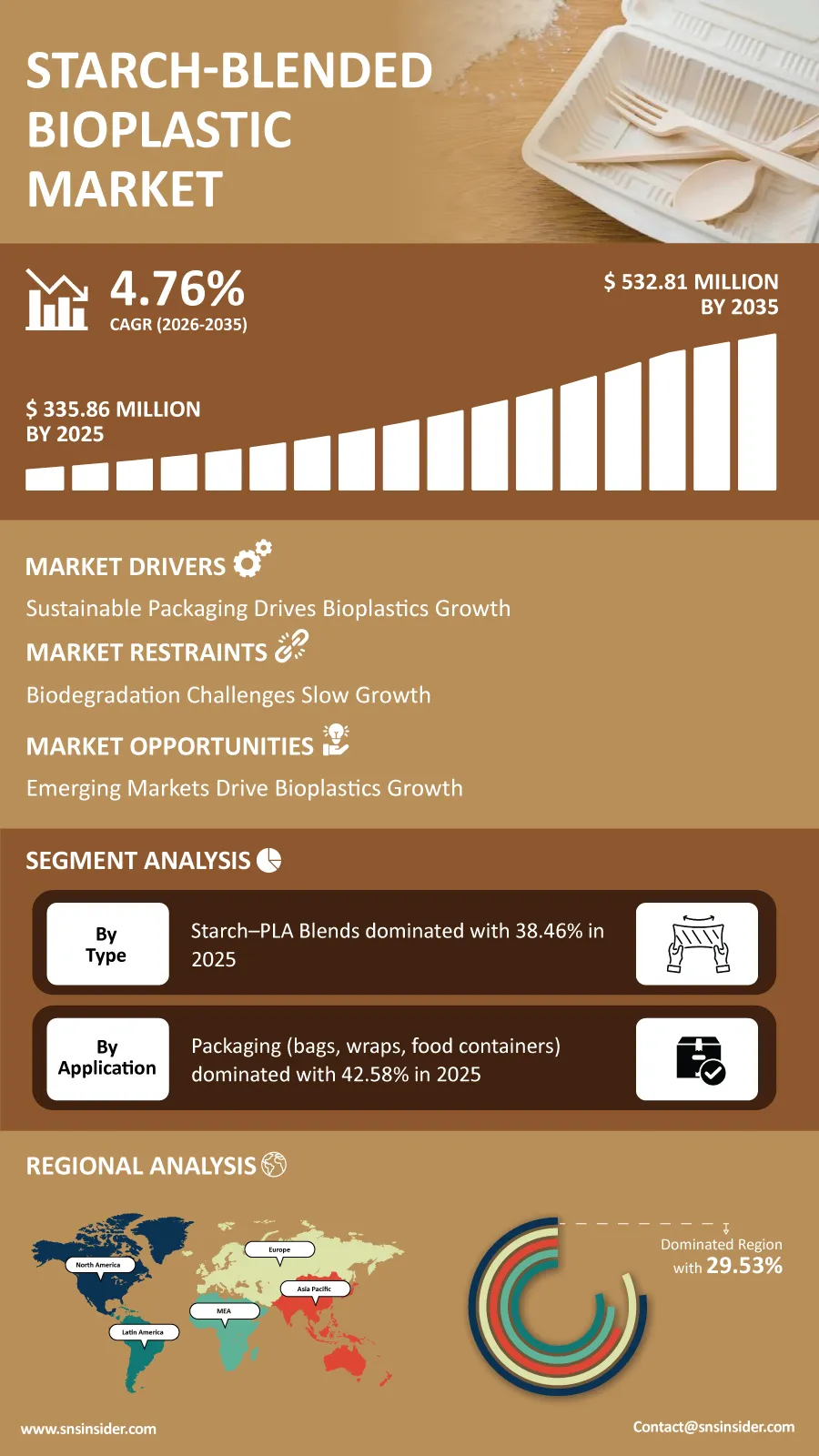
The global market for Starch-Blended Bioplastics is gaining momentum as companies are hastening the switch to environmentally sustainable products due to mounting pressure from regulations against plastics. “According to a recent study by SNS Insider, the global Starch-blended Bioplastic Market size valued at USD 335.86 Million in 2025, is anticipated to grow to USD 532.81 Million by 2035, registering a CAGR of 4.76% over the 2026–2035 forecast period.”
The rising trend towards use of eco-friendly alternatives in packaging, agricultural, household products, and retail industries is changing the trends of material choice around the world. Companies are developing new formulations based on starch, which provide better ecological properties without compromising their functionality.
Rising consumer awareness about sustainable products and government campaigns for encouraging the use of bio-based materials continue to drive growth in the market. New technological innovations in blending of starch and polymers are also leading to improved product performance.
To Get Detailed Insights on the Starch-blended Bioplastic Market – Request a Sample Report
Sustainable Packaging and Circular Economy Initiatives Create Long-Term Growth Opportunities
Circular economy practices are creating many new opportunities for companies that manufacture starch blends bioplastic. Companies in the food, beverages, e-commerce, and consumer goods industries are opting for the replacement of traditional plastics with renewable and compostable alternatives to meet their sustainability goals and new regulations.
Another promising area of growth is agricultural use of bioplastics. Biodegradable mulching films, nursery pots, and planting pots not only help farmers avoid producing agricultural plastic waste but also increase efficiency of their operations by removing the requirement for collecting plastic waste after harvest.
Research investments are making new commercial prospects possible through improved compatibility of starch with biopolymers like PLA, PHA, and PBS. It improves the physical properties of these materials making them useful in various industrial and consumer applications.
Key Market Insights Highlight Evolving Demand Patterns
In relation to types, starch–PLA blends comprised 38.46% of global revenue share in the year 2025 owing to their high levels of biodegradability, processability, and availability. Other blends based on starch polymers will likely witness the fastest growth up to the year 2035 as technology improves their ability to perform in particular industries.
In relation to applications, packaging industry had 42.58% share of total market consumption in 2025, driven by increasing usage in the food packing industry, shopping bags, wraps, and disposable containers. The fibers and textiles industry will likely witness the fastest growth in the forecast period due to sustainable fashion and technological advancement in fibers production.
In relation to product form, films and sheets constituted 39.64% of market revenue in 2025, attributable to the wide use of these products in the packaging and agriculture industries. On the other hand, fibers and other special products will likely witness the fastest growth due to expanding product lines to suit emerging industries.
Material Innovation Accelerates Commercial Adoption
Innovation through technology has remained an important means for further development of the bioplastics made from starch blends. There are many new formulations that increase mechanical properties, processability, thermodynamic stability, and durability without affecting biodegradation.
Studies of novel additives, natural fillers, and plasticizers help produce new generations of bioplastics which can be used even in the most challenging tasks of packaging and consumer industries. Such developments contribute to closing the gap in performance between traditional plastics and biodegradable substitutes while contributing to sustainable development.
Companies are also working on scalable manufacturing technologies that will increase production efficiency and lower costs. This will make the starch-based materials more competitive in commercial markets.
Europe Holds 37.34% Market Share in 2025 as Asia Pacific Registers Highest CAGR Through 2035
Europe is likely to retain its leading position in terms of 37.34% share of world market revenue in 2025 due to strict environmental legislation, wide prohibition of single-use plastics, and high consumer preferences for green products. Germany, France, and Italy are key players driving innovations and commercialization of biodegradable products in Europe.
Asia Pacific is estimated to register the highest growth rate during 2025-2035 due to rapid industrialization, favorable government policies, and increased awareness about environmental issues. Countries such as China, India, Japan, and others are likely to invest in development of sustainable packaging products and increase manufacturing capacities.
North America continues to be a dominant player in the market thanks to the growing demand for eco-friendly packaging, increasing bioplastics manufacturing capabilities, and growing applications in fast-food services, retail and consumer goods industry. Latin America and the Middle East & Africa are emerging markets that are likely to attract government investments in the field of environmentally friendly materials and circular economy concept.
Industry Participants Focus on Product Innovation and Sustainable Materials
Innovation within the competitive environment still goes on as manufacturers enhance their research capabilities, improve their manufacturing capacities, and develop sophisticated starch-based products used in packaging, agriculture, clothing, and household applications. Collaboration and product development play key roles in ensuring continued competitiveness in the ever-changing biodegradable materials industry.
Key companies operating in the global Starch-Blended Bioplastic Market include Novamont S.p.A., NatureWorks LLC, BASF SE, Biome Bioplastics Ltd., Corbion N.V., Toray Industries Inc., Roquette Frères, FKuR Kunststoff GmbH, Cardia Bioplastics, Plantic Technologies Limited, Mitsubishi Chemical Corporation, Futerro, Biotec GmbH & Co. KG, Tianan Biologic Material Co., Ltd., AGRANA Beteiligungs-AG, Danimer Scientific, Green Dot Bioplastics, Treva (Eastman Chemical Company), Kingfa Sci. & Tech. Co., Ltd., and Solanyl Biopolymers Inc.
An SNS Insider analyst Himanshu Sharma commented, “The accelerating transition toward sustainable materials is positioning starch-blended bioplastics as an important solution for industries seeking lower environmental impact without compromising functionality. Continued advances in material science, supportive regulatory policies, and broader commercialization across packaging and consumer applications are expected to create significant long-term growth opportunities for market participants.”
About the Author

Get in touch