
The global substrates industry has become a key factor in semiconductor supply planning. Chip designers now build larger and more complex packages. As a result, the board that sits between the die and the system has a direct effect on cost, yield, and delivery timelines. Buyers no longer see substrates as a routine part. They see them as a supply decision that can speed up or delay a full product launch.
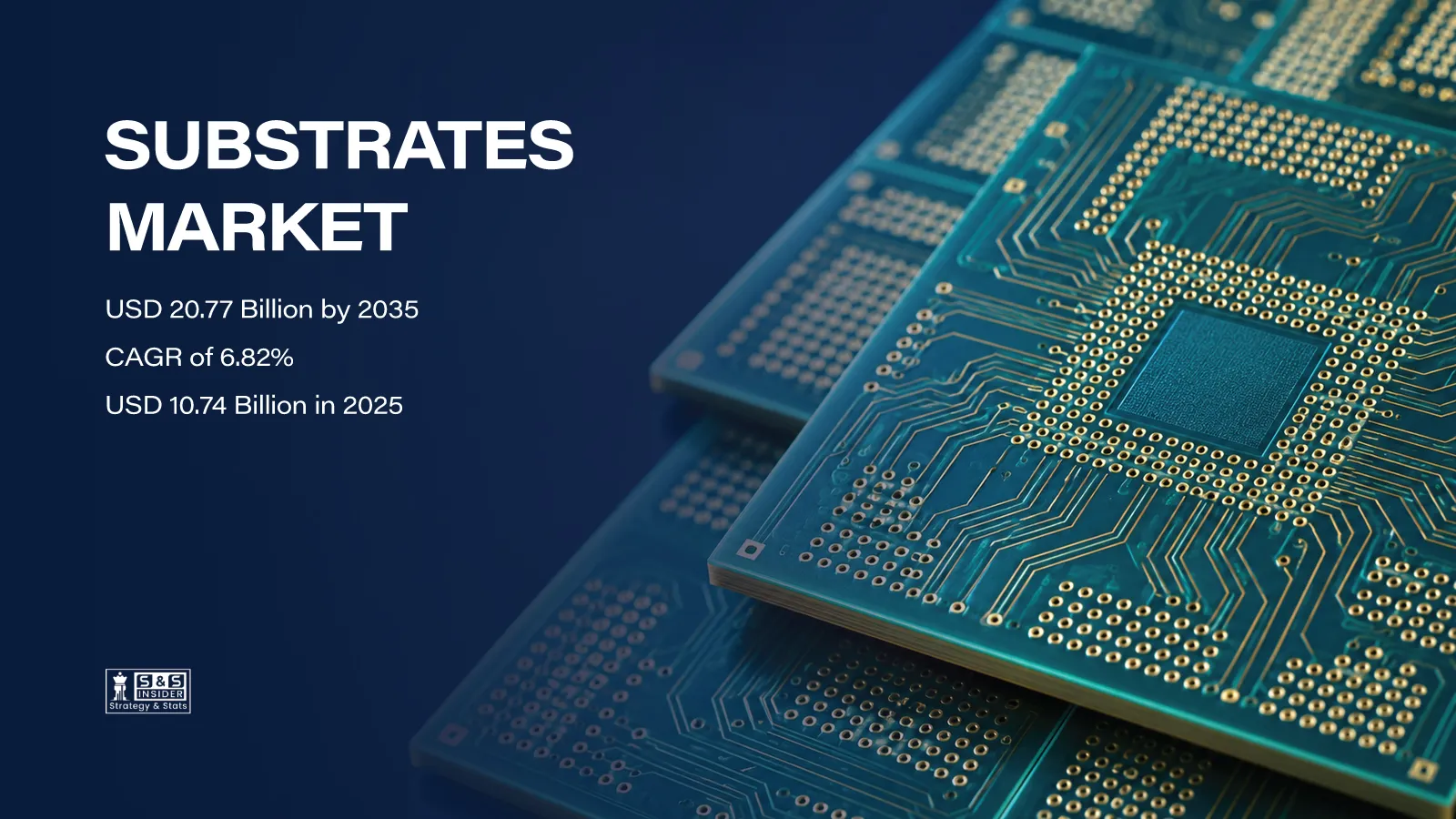
According to a recent study by SNS Insider, the global Substrates Market size was valued at USD 10.74 Billion in 2025 and is anticipated to reach USD 20.77 Billion by 2035, registering a CAGR of 6.82% over the forecast period 2026–2035. The market is estimated at USD 11.47 Billion in 2026.
Supply Security Is Becoming a Board-Level Priority for Chip Buyers
A shortage of advanced substrates can hold back chip shipments even when wafer output is available. For system makers, a single missing component can delay revenue across a full product line. This risk has moved substrate sourcing from the purchasing desk to senior management.
Chip companies are signing longer supply agreements and in some cases helping to fund new production lines. These deals give suppliers better visibility into future demand. They also give buyers more confidence that capacity will be ready when new products launch.
Substrate makers that can offer dependable capacity, stable quality, and clear expansion plans are well placed to secure long-term contracts at better terms.
To Get Detailed Insights on the Substrates Market – Request a Sample Report
Higher Content per Package Opens New Revenue Opportunities
Each new generation of computing packages uses more substrate area, more layers, and tighter wiring. This means the value of the substrate rises even when unit volumes grow slowly. Suppliers can earn more from each package they support.
Boards have to deal with dense connections and heat for packages that combine several small chips together into one unit. Suppliers that can address these engineering problems early on will become the go-to partner for new chip programs.
Joint development, design support services, and custom material options to strengthen customer relationships. They also make it harder for buyers to switch suppliers once a program is underway.
Substrates Market Segmentation Highlights
By Type
FC-BGA held the largest market share of 45.31% in 2025, reflecting its central role in processors and high-performance chips. FC-CSP is expected to register the fastest CAGR of 8.47%. This creates opportunities for suppliers that serve compact devices that need thin, high-density packages.
By Material
ABF accounted for 52.18% of the market in 2025, as it remains the preferred build-up material for advanced packages. Glass core is anticipated to grow at the highest CAGR of 9.86%. Material suppliers and early adopters looking for better flatness and finer wiring for next-generation chips can find opportunities in this segment.
By Application
Mobile and consumer electronics accounted for the largest market share of 37.96% in 2025. The data center, AI and HPC segment is expected to register a CAGR of 9.41%. Growth in this segment is supported by commercial opportunities in accelerator chips, server processors, and high-bandwidth computing modules.
Asia Pacific Leads with 67.38% Market Share as North America Advances at 8.79% CAGR
Asia Pacific dominated the Substrates Market with the highest revenue share of 67.38% in 2025. The region is a good place for suppliers that are close to large sites for chip assembly and electronics manufacturing. Buyers in this region make buying decisions on the basis of production scale, lead times and cost efficiency.
North America contributed 20.14% of revenue in 2025 and is projected to record the fastest CAGR of 8.79% over 2026–2035. The U.S. market was valued at USD 1.67 Billion in 2025 and is projected to grow at a CAGR of 8.66%. New domestic packaging projects and public funding programs are creating demand for local substrate capacity, technical partnerships, and supply chain services.
Europe held a 8.61% share of the global market in 2025, followed by the Middle East & Africa at 2.25% and Latin America at 1.62%. Opportunities in these regions will depend on industrial policy, automotive and industrial chip demand, and the pace of local packaging investment.
Co-Investment and Capacity Partnerships Could Unlock New Commercial Models
Advanced substrate plants require a large capital investment and long build times. A lot of suppliers don’t want to add capacity unless they have firm demand commitments. Co-investment deals, prepaid capacity agreements and shared facility models offer a realistic way forward for both parties.
By partnering with assembly and test companies, chip designers and material suppliers, substrate makers can grow their customer base. These links help distribution of investment risk and help faster qualification of new products.
These models can also generate stable income through long-term supply contracts, engineering service fees and joint development programs.
Competitive Outlook: Capacity Reliability to Become a Key Differentiator
Future competition in the substrates industry is likely to depend on more than technical capability. Customers increasingly expect suppliers to deliver on time, scale output quickly, and support new package designs from the earliest stage.
Suppliers with a combination of advanced process skills, reliable capacity, good quality control and flexible commercial terms may enjoy a stronger market position. Collaborations with chip designers, equipment makers and material firms can also help to extend commercial reach.
Substrates Market Outlook Through 2035
Over the next decade, substrates are set to play a larger role in semiconductor product planning, supply chain strategy, and computing performance. Suppliers that can show clear gains in yield, delivery reliability, and package performance will be best placed to capture new demand across AI, data center, mobile, and automotive programs.
About the Author

Get in touch




