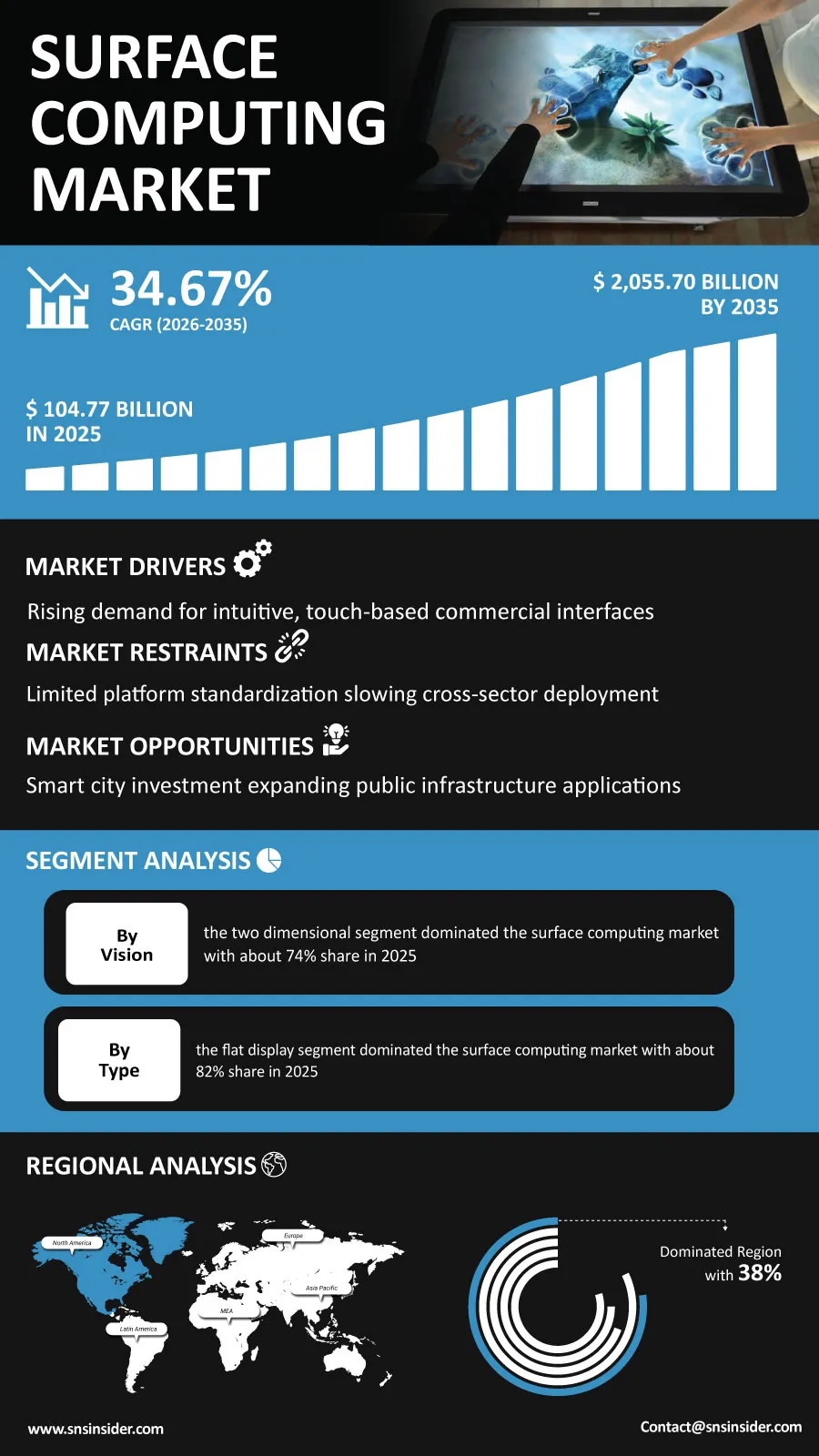
The Surface Computing Market is entering a high-growth phase as organizations replace conventional interfaces with interactive computing environments across commercial, educational, healthcare, and public-sector applications.“According to a recent study by SNS Insider, the global Surface Computing Market size valued at USD 104.77 billion in 2025, is anticipated to grow to USD 2,055.70 billion by 2035, registering a CAGR of 34.67% over the 2026–2035 forecast period.”
Touch-centric interface systems are gaining momentum due to advances in display technology, sensing technology, computing power, and interactive software applications. Digital product displays and self-service interfaces are being deployed by retailers, and interactive visualization technologies are being integrated in health care settings. Educational facilities, hospitality industry, corporate settings, and transport infrastructure are also emerging areas of deployment.
To Get Detailed Insights on the Surface Computing Market – Request a Sample Report
Intelligent Interfaces and Digital Infrastructure Open New Growth Opportunities Globally
The increasing investments made by governments in smart city technology are also contributing to the development of a larger addressable market for interactive kiosks, travel information systems, government portals, and citizen engagement services. Such applications could offer users real-time information through intuitive interfaces while allowing organizations to revamp their customer service.
The healthcare industry could also emerge as a lucrative area of application due to the rising adoption of visualization techniques within medical imaging, patient data, and surgery planning. Multi-touch functionality combined with higher resolutions screens could be utilized effectively in this area.
Key Market Insights Highlight Shifting Demand Patterns
By vision, Two-dimensional solutions contributed to nearly 74% of the market’s revenues in 2025 owing to lower implementation costs, easier integration and compatibility. The three-dimensional surface computing will witness the fastest growth rate with a CAGR of around 36.45% owing to an increase in the applications, such as gaming, medical imaging, industrial design and visualizations.
By type, the flat displays constituted about 82% of the total market in 2025 due to their well-established manufacturing infrastructure, affordable pricing and wide implementation. The curved display will be the fastest growing type in the market with the CAGR of about 37.81%, since the premium retail spaces and collaboration areas require wider angle of viewing.
By end user, Retail accounted for around 28% share in 2025, thereby emerging as the foremost application segment. The healthcare sector will witness maximum growth until 2035 at a CAGR of about 36.94%, owing to the increasing digitalization and need for advanced diagnostic and treatment management solutions.
By touch technology, multi-touch solutions constituted 61% in 2025 and are forecasted to retain the highest growth rate of 35.21%. Their unique capability of handling multiple interactions at the same time makes them more appropriate for application in classroom settings, conference rooms, retail outlets, and collaboration spaces.
Advanced Displays and Multi-User Computing Accelerate Market Transformation
The surface computing is advancing beyond traditional touch screen applications as companies start to deploy more high-resolution screens, better gesture recognition technology, three-dimensional imaging, and curves designs. With this, the surface computing is not only becoming more immersive but also increasing the number of different settings in which interactive computing can be applied.
Furthermore, the application of AI, sensors and responsive software is enhancing the capacity of interactive devices to understand users' actions. As such technologies develop, surface computing will have the opportunity to provide more personalized experiences in commercial and enterprise settings.
North America Held 38% of the Surface Computing Market Share in 2025; Asia Pacific Projected to Register the Fastest CAGR Through 2035
The North American region held a revenue share of about 38% in the global Surface Computing Market during 2025. This dominance of the region is due to robust technology infrastructure, early acceptance of interactive solutions, and customer base requirements in retail, healthcare, and enterprise sectors. The US held 82% of the regional revenue.
It is expected that the Asia Pacific region will dominate the fastest growth rate in terms of CAGR at around 36.54% between 2025 and 2035. Digital infrastructure expansion, smart city projects, technology acceptance by consumers, and investments made in countries, such as China, India, Japan, and South Korea are driving market growth. China held a revenue share of about 39% of the regional revenue in 2025.
Europe offers major opportunities through digitalization in industrial, healthcare, automotive, and retail application areas, while the Middle East and Latin America benefit from smart infrastructure initiatives.
Industry Participants Focus on Interactive Technology Innovation
In the Surface Computing Market, Competition will continue to focus on advancements in display technology, touch technology, visualization technology, software, and application-oriented solutions. Key companies operating in the market include Microsoft Corporation, Samsung Electronics Co., Ltd., LG Electronics Inc., Dell Technologies Inc., Lenovo Group Limited, HP Inc., Apple Inc., ViewSonic Corporation, Sharp Corporation, NEC Corporation, Panasonic Holdings Corporation, Elo Touch Solutions, Inc., Planar Systems, Inc., SMART Technologies ULC, BenQ Corporation, Promethean Limited, Ideum, Inc., Meridian Kiosks LLC, TouchMagix Media Pvt. Ltd., and Crystal Display Systems Ltd.
An SNS Insider analyst Sakshi Kale commented, “The rapid convergence of interactive displays, intelligent sensing, and immersive visualization is creating new pathways for surface computing across both established and emerging applications. As organizations prioritize intuitive digital experiences, scalable interactive technologies will become increasingly important to customer engagement, collaboration, and operational efficiency.”
About the Author

Get in touch