
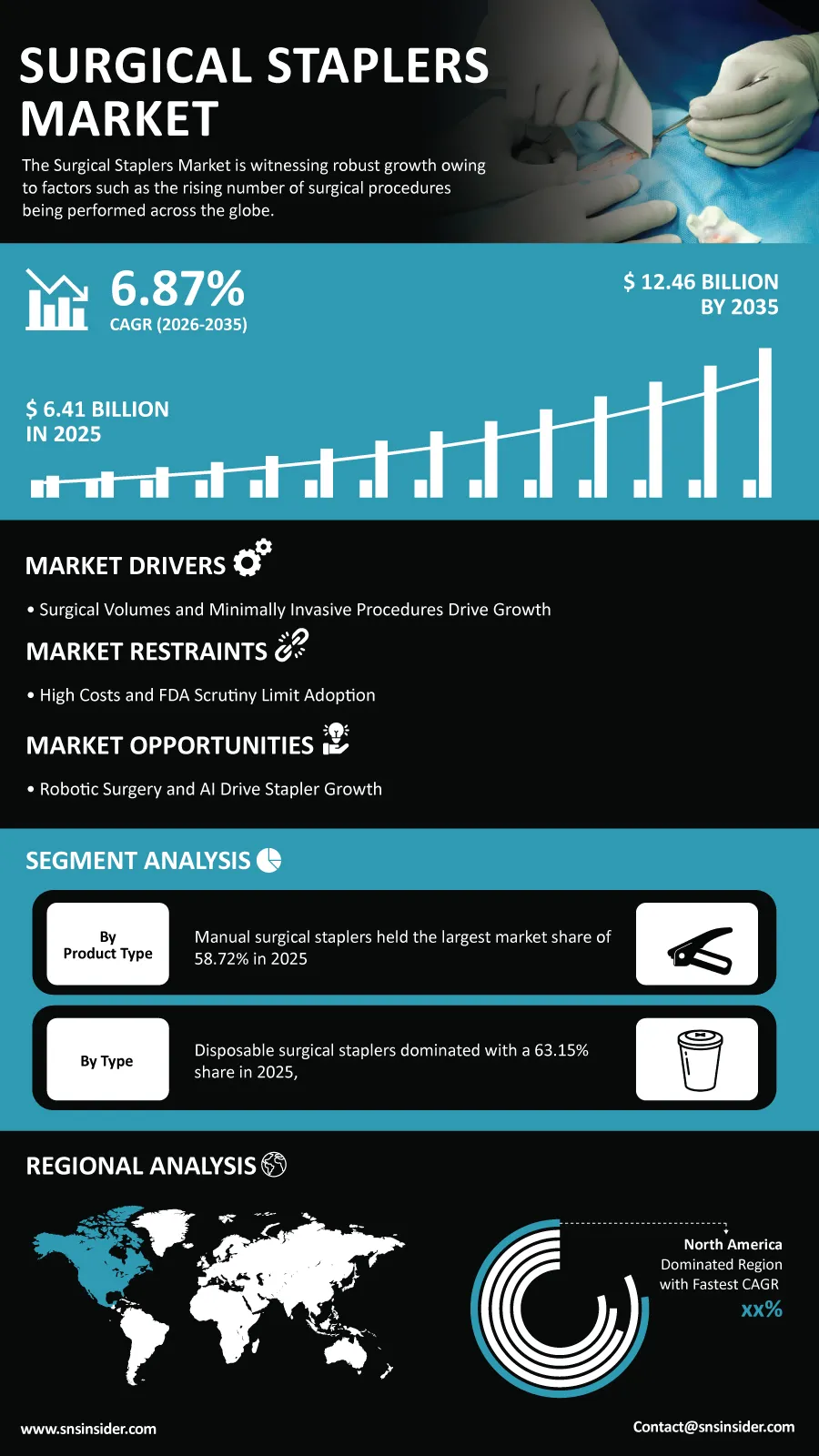
The global Surgical Staplers Market is poised for significant growth as healthcare providers worldwide continue investing in advanced surgical technologies that improve procedural efficiency, support better clinical outcomes, and enhance operating room performance. “According to a recent study by SNS Insider, the global Surgical Staplers Market size valued at USD 6.41 billion in 2025, is anticipated to grow to USD 12.46 billion by 2035, registering a CAGR of 6.87% over the 2026–2035 forecast period.”
The rising number of surgical operations being carried out all over the world, along with the growing use of minimally invasive approaches and advancements in healthcare facilities, is fueling the demand for cutting-edge tissue closure solutions. The focus of healthcare organizations on surgical solutions that increase process efficiency and help achieve reliable results has grown in recent years.
Growing investments in operating room modernization and the expansion of specialized surgical centers are also encouraging broader adoption of innovative stapling systems designed to meet evolving clinical requirements.
To Get Detailed Insights on the Surgical Staplers Market – Request a Sample Report
Innovation Continues to Shape the Future of Modern Surgery
Technological innovation continues to play a major role in changing the surgical staplers market. Manufacturers are offering the latest innovations, including the use of powered devices, advanced ergonomics, increased articulation abilities, and advanced feedback tools that enable surgeons to perform complicated operations with more accuracy and confidence.
Robotic surgery and digital OR technologies are also making their contribution to generating new opportunities for stapling technology by providing solutions that are capable of complementing minimally invasive procedures and enhancing consistency and recovery of patients.
Industry participants are also investing in products that support enhanced safety, optimized tissue management, and improved surgical workflow, reinforcing the role of advanced staplers across modern operating environments.
Key Market Findings Highlight Growth Opportunities
Among product categories, manual surgical staplers accounted for 58.72% of global market revenue in 2025, reflecting their continued use across a wide range of surgical specialties and healthcare facilities.
Meanwhile, powered surgical staplers are projected to record the fastest growth through 2035, expanding at a CAGR of 9.62%, driven by increasing demand for greater precision, consistency, and surgeon comfort during complex procedures.
By type, disposable surgical staplers represented 63.15% of market revenue in 2025, supported by growing emphasis on infection prevention and operational efficiency. At the same time, reusable surgical staplers are expected to witness the fastest growth at a CAGR of 9.47%, reflecting increasing interest in cost-effective and environmentally sustainable healthcare solutions.
Application analysis indicates that abdominal and pelvic surgery accounted for 35.88% of total market revenue in 2025, while cardiac and thoracic surgery is projected to expand at the fastest CAGR of 9.84% during the forecast period, supported by increasing procedural volumes and continued adoption of advanced surgical technologies.
Among end users, hospitals and clinics held 71.42% of global market revenue in 2025, maintaining their position as the largest users of surgical stapling devices. Diagnostic centers are anticipated to register the fastest growth, advancing at a CAGR of 9.75%, reflecting expanding outpatient care capabilities and broader availability of minimally invasive surgical services.
Expanding Surgical Infrastructure Supports Long-Term Market Growth
Operating facilities in various countries are continuously upgrading their surgical skills by making necessary expenditures on sophisticated operating rooms, dedicated treatment centers, and advanced medical equipment. Availability of quality surgical treatments is helping in the creation of a positive environment for innovation in surgical devices.
The growing importance of patient safety, quick recovery, and good results of procedures is prompting medical practitioners to use technology that is reliable and facilitates new trends in medicine.
North America Leads, Asia Pacific to Grow at 8.34% CAGR Through 2035
North America still dominates as the largest regional market, driven by sophisticated healthcare facilities, high volumes of procedures, and use of surgical innovations. The region continues to see huge investments made in upgrading hospitals, as well as medical equipment manufacturers based there.
Asia Pacific is set to be the fastest growing regional market at a CAGR of 8.34% until 2035. Increased healthcare spending, increased hospital networks, increased volumes of surgeries, and increased adoption of minimally invasive techniques have opened up significant growth prospects in many countries of the region.
Industry Leaders Accelerate Product Innovation
Competition within the surgical staplers market remains dynamic as leading medical device companies continue investing in product development, advanced surgical technologies, strategic collaborations, and global expansion initiatives.
Key companies operating in the global surgical staplers market include Johnson & Johnson, Medtronic, B. Braun, 3M, Smith & Nephew, CONMED, Intuitive Surgical, Stryker, Zimmer Biomet, and Boston Scientific.
An SNS Insider analyst Parry Kardani commented, "The surgical staplers market is evolving rapidly as healthcare providers increasingly prioritize procedural efficiency, minimally invasive techniques, and advanced surgical technologies. Continued innovation in powered stapling systems and digital surgical solutions is expected to create significant opportunities for manufacturers throughout the forecast period.
About the Author

Get in touch




