
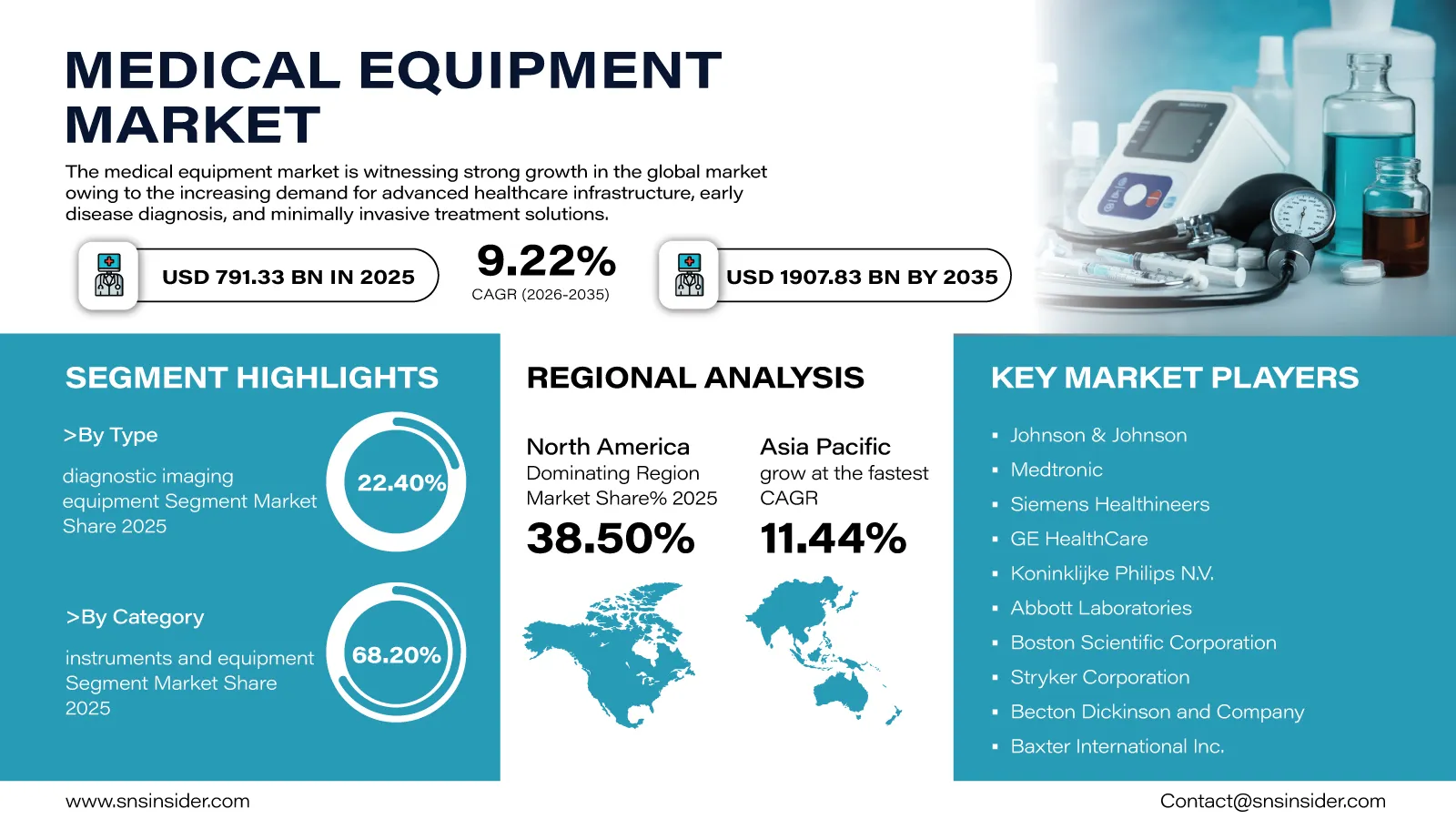
The global Medical Equipment Market is poised for substantial expansion as healthcare providers continue investing in advanced technologies that improve patient care, enhance clinical efficiency, and support early disease detection. “According to a recent study by SNS Insider, the global Medical Equipment Market size valued at USD 791.33 billion in 2025, is anticipated to grow to USD 1907.83 billion by 2035, registering a CAGR of 9.22% over the 2026–2035 forecast period.”
As the need for efficient healthcare facilities rises, along with increasing pressure on healthcare institutions to give precise diagnoses and treatment, hospitals and clinics are encouraged to invest more into modern medical technology. Innovations in digital healthcare, medical devices, and intelligent clinical solutions revolutionize healthcare practice and present new opportunities for medical equipment manufacturers.
As healthcare systems continue shifting toward preventive care and value-based medicine, demand for innovative medical equipment is expected to remain strong across both developed and emerging economies.
To Get Detailed Insights on the Medical Equipment Market – Request a Free Sample Report
Innovation Continues to Redefine Healthcare Delivery
Advancements in technology have greatly influenced the worldwide medical equipment industry. With the help of artificial intelligence, robots, digital imaging, monitoring system technology, and wearable medical equipment, it is now possible for healthcare professionals to diagnose patients accurately, make their clinical processes streamlined, and provide patient-centered care.
Digital transformation initiatives, which will incorporate imaging technology, remote monitoring, and smart data management technology, are being adopted by healthcare facilities at a much quicker pace, which helps doctors to take timely decisions and increase the efficiency of their operations.
There has been a greater focus on minimally invasive procedures and home healthcare, which has increased the need for medical equipment with portability and high performance.
Key Market Findings Highlight Growth Opportunities
Within various categories of equipment, diagnostic imaging equipment has a revenue share of 22.40% in 2025 and is leading in terms of revenue, which can be attributed to the rising demand for advanced imaging equipment.
Patient monitoring devices, on the other hand, are expected to exhibit the highest growth rate in revenue through 2035 at a CAGR of 14.67%. This can be attributed to the rising adoption of remote patient monitoring and connected care solutions.
In terms of category, instruments and equipment have contributed to 68.20% of total market revenue in 2025, which is driven by consistent investments being made in modernizing the hospitals' clinical infrastructure. On the contrary, disposables and consumables are estimated to grow at a CAGR of 11.01% during the forecast period, fueled by increased healthcare consumption and rising importance of infection control.
From an end-user perspective, hospitals and clinics accounted for 61.40% of market revenue in 2025, highlighting their continued role as primary purchasers of advanced medical technologies. However, homecare and diagnostic centers are anticipated to record the fastest growth at a CAGR of 12.04%, supported by rising demand for decentralized healthcare delivery and convenient diagnostic services.
An Infographic Representation of the Global Medical Equipment Market
Digital Health and AI Drive Industry Transformation
Artificial intelligence is currently being incorporated by healthcare professionals in the areas of diagnostics, decision support, and patient monitoring to enhance the process and improve health outcomes. Remote patient monitoring through connected devices, cloud-enabled health platform solutions, and smart medical devices is aiding continuous patient monitoring and enhancing clinical decision-making processes.
Remote healthcare, wearables, and intelligent monitoring solutions will be instrumental in easing the load on hospitals and managing chronic diseases effectively in the future. It is anticipated that these trends will open up considerable opportunities for manufacturers of medical devices over the next decade.
Regional Markets Continue to Expand
The share of North America in the total global market revenue was estimated at 38.50% in 2025, owing to a well-established health care infrastructure, technological advancements, and massive spending on medical innovation. The region will continue to benefit from strong demand for technologically advanced diagnostic tools and procedures.
On the other hand, Asia Pacific will be identified as the fastest-growing market among all the regional markets throughout the forecast period, due to developing health care infrastructure, growth in medical device manufacturing, increased health care spending, and growing demand for technologically advanced diagnostic tools and therapies.
Leading Companies Strengthen Global Market Position
Competition within the medical equipment market remains highly dynamic as manufacturers continue investing in research and development, digital innovation, strategic acquisitions, and global expansion initiatives to strengthen their product portfolios.
Key companies operating in the global medical equipment market include Johnson & Johnson, Medtronic, Siemens Healthineers, GE HealthCare, Koninklijke Philips N.V., Abbott Laboratories, Boston Scientific, Stryker Corporation, Becton Dickinson and Company, and Intuitive Surgical.
An SNS Insider analyst Parry Kardani commented, "Healthcare is entering a new era defined by intelligent technologies, connected medical ecosystems, and patient-centered care. Continued innovation in AI-enabled diagnostics, minimally invasive procedures, and digital health platforms will remain fundamental to the long-term evolution of the global medical equipment industry."
About the Author

Get in touch




