
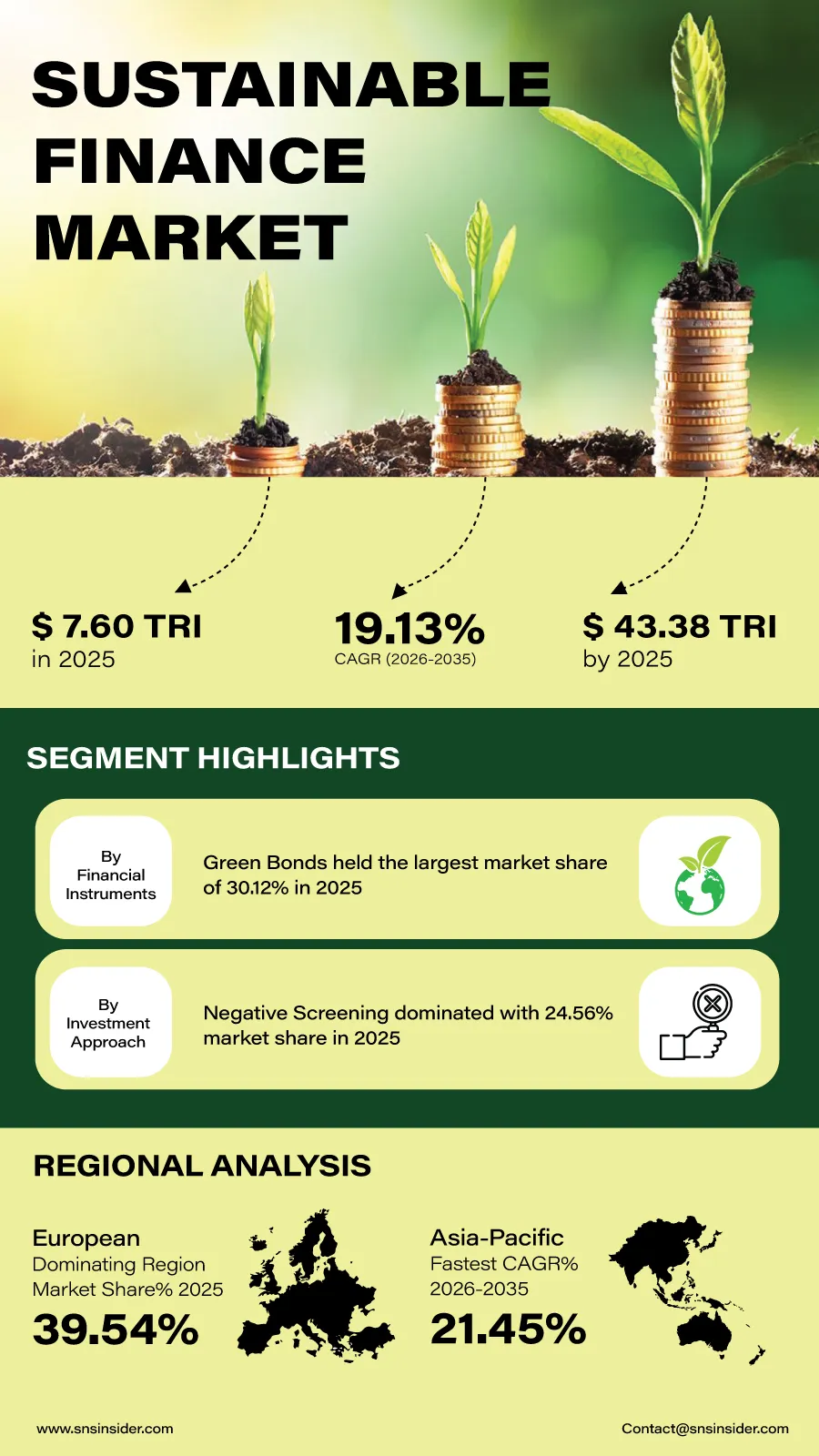
The global Sustainable Finance Market is expected to witness remarkable expansion as financial institutions, governments, and investors increasingly prioritize environmentally and socially responsible investments. “According to a recent study by SNS Insider, the global Sustainable Finance Market size valued at USD 7.60 trillion in 2025, is anticipated to grow to USD 43.38 trillion by 2035, registering a CAGR of 19.13% over the 2026–2035 forecast period.”
This shift to low-carbon economies globally is having an impact on the capital markets since the investors are looking for financial products that generate profits in the long term but also help achieve sustainability targets. The rise in ESG investing, climate-related disclosures, and pledges for zero emissions have increased the demand for sustainable financing.
To Get Detailed Insights on the Sustainable Finance Market – Request a Free Sample Report
Financial innovations are contributing to even greater market development using ESG analytics driven by AI, green bond markets built with the help of blockchain, and digital solutions for sustainability reporting that make it possible to measure sustainability performance more effectively.
Climate Investment and ESG Integration Create Long-Term Growth Opportunities
Both public and private entities have never invested such amounts of money into renewables, resilience initiatives, sustainable transportation, nature protection, and adaptation activities. With the introduction of regulatory measures and sustainability classification frameworks by governments, banks and other financial organizations increase their portfolios in line with international environmental and social development trends.
The demand for sustainability-linked loans, transition finance, and impact investment options will only rise since corporations look for ways to obtain financing based on environmentally-friendly activities. Moreover, financial institutions are creating novel investment products to facilitate decarbonization in addition to solving such issues as resource and economic resilience and social inclusion.
Meanwhile, increased cooperation between financial institutions will improve sustainable capital markets. The use of advanced technologies allows collecting and analyzing information about environmental and social performance and climate risks much faster than before.
Key Market Insights Highlight Shifting Demand Patterns
Based on financial instruments, green bonds are anticipated to be valued at 30.12% of market revenue by 2025 because of their extensive use in financing renewables, sustainable infrastructure projects and other ventures related to environmental conservation in both private and public sectors. Sustainable equity funds are likely to show the fastest growth rate until 2035 as more retail investors take part in diversified ESG investments.
By investment approach, negative screening accounts for 24.56% of market revenue by 2025 since institutional investors are still likely to exclude those sectors that are inconsistent with sustainability goals from their portfolios. Impact investing is set to grow most rapidly during the forecast period due to the increasing popularity of the investments that yield not only financial but environmental or social benefits.
By investors type, institutional investors comprised 65.41% of market share in 2025 as the use of ESG principles grows among pension funds, insurers, sovereign wealth funds, and asset managers. Retail investors are forecast to show the most rapid growth until 2035 due to increased awareness, online investment platforms and inexpensive ESG products.
By sector focus, renewable energy is valued at 35.19% of market revenue in 2025 whereas sustainable agriculture is expected to have the most rapid growth due to the increasing need for food safety and sustainable management of natural resources.
An Infographic Representation of the Global Sustainable Finance Market
Advanced Financial Technologies Accelerate Industry Transformation
Sustainable finance is rapidly changing due to the implementation of technologies such as artificial intelligence, machine learning, blockchain, and analytics in the process of making investment decisions and generating ESG reports. This allows for quicker evaluation of the sustainability risks, increased transparency of portfolios, and efficient verification of their environmental impacts.
The producers of digital platforms for financial activities and investment solutions have also started developing automated sustainability scorecards, climate risk models, and systems of issuing bonds through blockchain, which makes it easier to comply with the requirements and helps build trust among investors.
Regional Markets Demonstrate Strong Growth Potential
The share of Europe in the global market revenue by 2025 will be 39.54% due to the existence of well-regulated sustainable finance framework, high prevalence of ESG investment, and state support in this area. European countries such as Germany are increasing investments in renewable energy sources, green infrastructure, and climate finance products.
The Asia-Pacific region is forecasted to show the highest growth rate among all other regions up to 2035 due to governmental sustainability regulations and renewable energy investment growth, as well as promotion of green finance. The Chinese, Japanese, Indian, and other economies of the region are channeling more resources into environmentally oriented projects and increasing the number of ESG reports.
North America will retain its strong market position due to active participation of institutions, high demand for ESG investment products, and innovation in the sphere of sustainable financial technologies. Growing attention to climate disclosures and responsible investing can further contribute to the regional market growth.
Industry Participants Focus on Innovation and Responsible Investment Solutions
The competitive landscape remains highly dynamic as global asset managers, investment banks, and financial institutions continue expanding ESG product portfolios, climate-focused financing solutions, and digital sustainability capabilities. Strategic investments in artificial intelligence, climate analytics, sustainable lending, and transparent reporting frameworks are enabling industry participants to address growing investor expectations while strengthening long-term competitiveness.
Key companies operating in the global Sustainable Finance Market include BlackRock, Vanguard, State Street Global Advisors, JPMorgan Chase, Goldman Sachs, Morgan Stanley, Citigroup, HSBC, Barclays, BNP Paribas, Crédit Agricole, Deutsche Bank, UBS, Société Générale, Bank of America, Wells Fargo, Standard Chartered, Nomura Holdings, Mitsubishi UFJ Financial Group (MUFG), and Royal Bank of Canada (RBC).
An SNS Insider analyst Sakshi Kale commented, “The accelerating integration of ESG principles into mainstream investment strategies, combined with regulatory evolution and rapid financial innovation, is transforming the global sustainable finance landscape. Organizations investing in transparent reporting, advanced sustainability analytics, and next-generation green financing solutions will be well positioned to capitalize on the growing demand for responsible investment opportunities over the next decade.”
About the Author

Get in touch




