
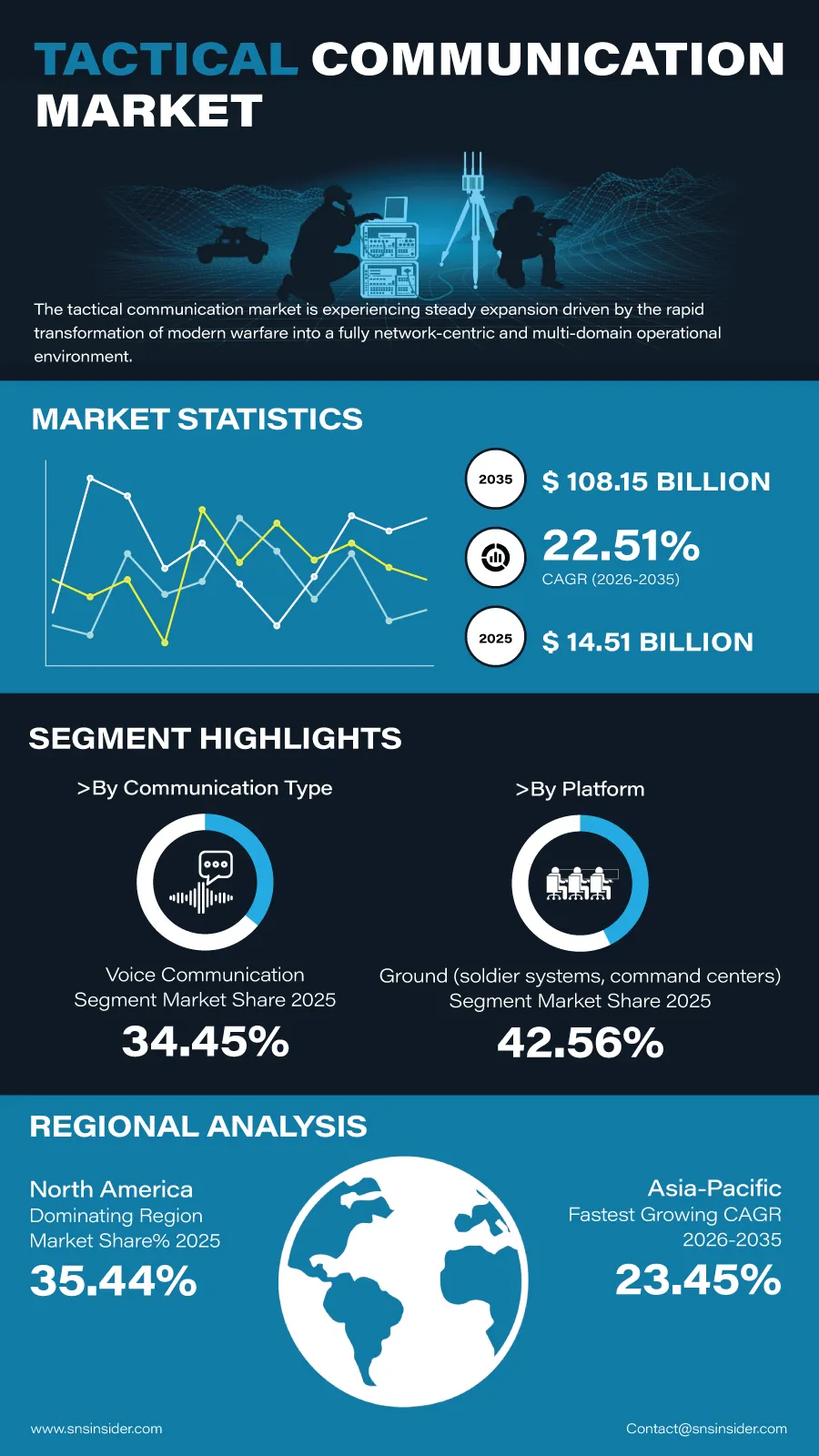
The Tactical Communication Market around the world is about to experience an accelerated growth phase because the military forces are increasing their investments in battlefield communication, intelligence exchange, and command and control facilities.“According to a recent study by SNS Insider, the global Tactical Communication Market size valued at USD 14.51 billion in 2025, is anticipated to grow to USD 108.15 billion by 2035, registering a CAGR of 22.51% over the 2026–2035 forecast period.”
The process of military modernization has affected the structure of communication networks by making the need for highly secure, interoperable, and mobile communication networks that can facilitate highly complex military actions very important. Multi-domain warfare, along with the need for quick decision-making and situational awareness, is pushing armed forces to change old communication systems with new digital communication networks.
To Get Detailed Insights on the Tactical Communication Market – Request a Free Sample Report
The defense organizations are also focusing more on the development of resilient communication systems that are capable of ensuring continuous connectivity even under contested conditions. This is providing good prospects for the technology vendors who are developing new communication systems for the military.
Defense Digitalization Creates New Opportunities for Tactical Communication Providers
Shift toward digital networks on the battlefield keeps on increasing across the world. It is because modern armies need the solution for communication that can enable them to coordinate between people, vehicles, unmanned aircraft, command stations, and intelligence stations through all domains of land, sea, air, cyber, and space.
Increased use of software-based networking technologies, satellite communication platforms, and encryption is providing them flexibility. The requirement for communication infrastructure remains high among defense forces due to their efforts towards having an integrated command structure.
While at the same time, the growing investments in border surveillance, peacekeeping operations, disaster response efforts, and homeland security operations are increasing the range of application for UAVs.
Key Market Insights Reflect Strong Technology Adoption
In terms of communications, voice communication was the dominating market player in 2025 contributing 34.45% of the total revenue owing to its relevance in strategic coordination and task execution. In addition, the video communication mode is expected to record the highest rate of growth during 2025-2035 as military agencies make greater use of live intelligence feeds and battle-field visualization.
With regard to platform type, the land segment held 42.56% of global revenue share in 2025 owing to ongoing upgrades to soldier communication equipment and command stations. The naval platform segment is expected to experience the most rapid growth rate of 25.35% CAGR as military agencies continue to invest in fleet modernization and maritime security.
Regarding components, hardware, which include radios, antennas, and communication terminals, held 38.29% of total revenue share in 2025. On the contrary, the software component is expected to record the highest growth rate as military agencies adopt intelligent network management platforms, encryption and communication applications.
As far as technology is concerned, the SDR technology held the major revenue share in 2025 at 38.46%. It is expected that the fastest growing technology segment will be the SATCOM technology due to increasing out-of-sight communications among military forces.
An Infographic Representation of the Global Tactical Communication Market
Secure Connectivity and Battlefield Intelligence Drive Industry Innovation
A growing focus of military communication strategies on improving their operational resilience to cyber-attacks, electronic disruptions and changing battlefield environments. This has resulted in the development of highly secure communications platforms that incorporate complex encryption mechanisms, intelligent routing and adaptive networking.
Artificial intelligence is already affecting tactical communication systems through its ability to enhance network optimization and traffic prioritization, as well as enhance reliability of communication in dynamic operations. In combination with cloud-based command systems and advanced networking techniques, such technology is fostering better operational decision making.
Technology companies continue to make investments in communication systems that will be able to accommodate autonomous systems and unmanned vehicles, and future defense systems based on data-driven operations.
Regional Markets Continue Expanding Defense Communication Investments
North America was responsible for 35.44% share of the total Tactical Communication Market value in 2025 due to the availability of large military budget, modernization of military equipment and utilization of secure communication technology on the battlefield. Further investments in the next generation defense networking will keep the region in leading position.
Asia Pacific is expected to witness fastest CAGR growth in the market with CAGR of 23.45% from 2026 to 2035. Rise in defense spending, military modernization initiatives, security concerns in the region and development of advanced communications technologies in countries, such as China, India, Japan, South Korea, and Australia will open up numerous opportunities.
Europe will still be a key market region where governments invest in secure communication technologies to improve their military capabilities. Latin American and Middle Eastern nations will continue with their military modernization and tactical mobility projects.
Industry Participants Accelerate Innovation Across Defense Networks
The competitive environment is still very much unpredictable since major defense technology corporations keep on developing high-end communication systems that aim at improving connectivity and operability of military forces. The areas of interest for producers include software defined systems, satellites, cybersecurity, and artificial intelligence.
Key companies operating in the global Tactical Communication Market include RTX Corporation (Collins Aerospace), L3Harris Technologies Inc., Thales Group, BAE Systems plc, Northrop Grumman Corporation, General Dynamics Corporation, Leonardo S.p.A., Saab AB, Rohde & Schwarz GmbH & Co. KG, Elbit Systems Ltd., Honeywell International Inc., Leonardo DRS, Motorola Solutions Inc., Viasat Inc., Iridium Communications Inc., Cobham Limited, Curtiss-Wright Corporation, Airbus Defence and Space, Kongsberg Gruppen ASA, and ASELSAN A.S.
An SNS Insider analyst Santosh Bhul commented, "The growing shift toward network-centric warfare, combined with continuous investments in secure multi-domain communication infrastructure, is fundamentally transforming military operations worldwide. Organizations that deliver resilient, intelligent, and interoperable communication technologies will be well positioned to capitalize on the next generation of defense modernization initiatives."
About the Author

Get in touch




