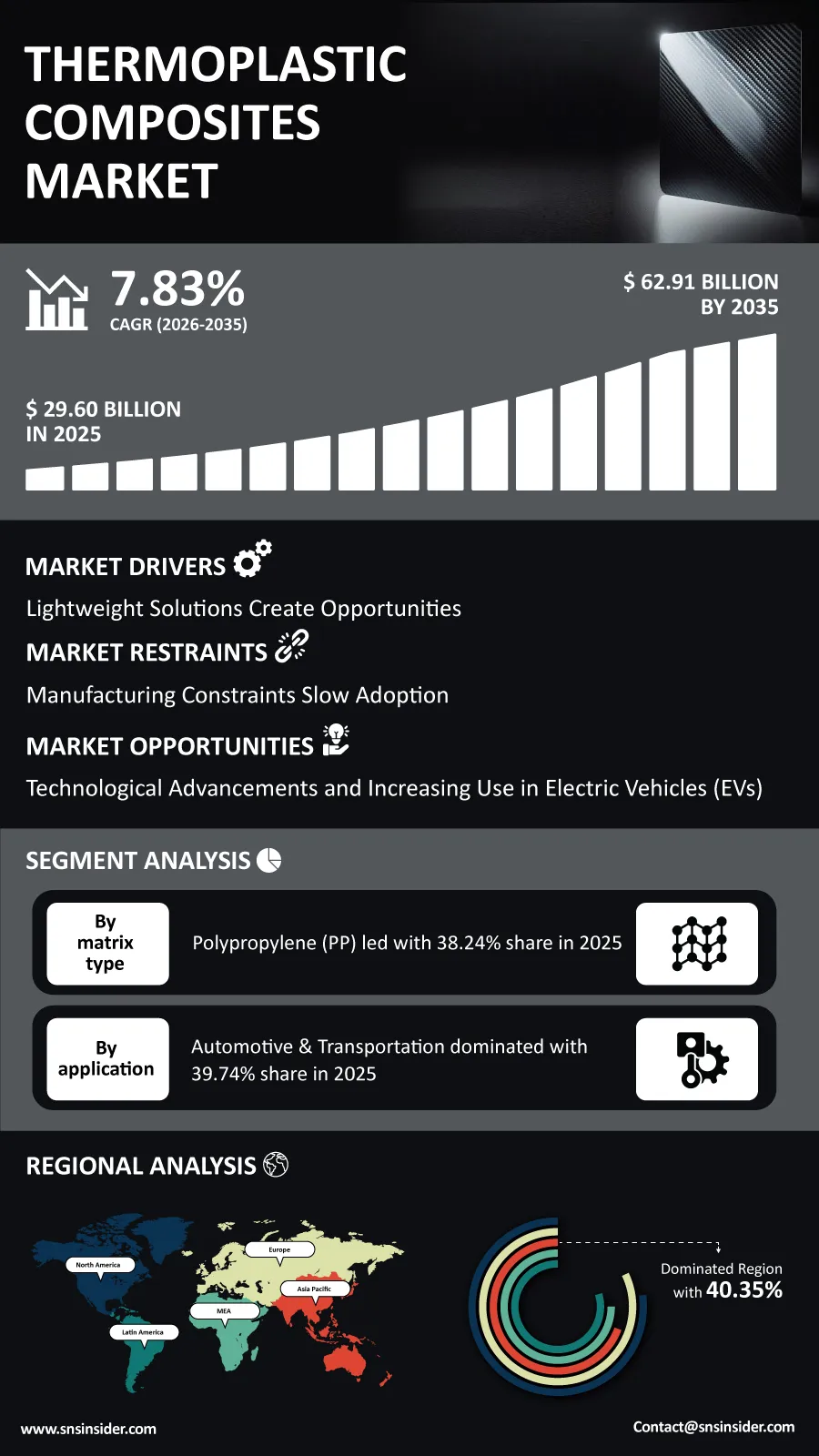
Thermoplastic Composites Market is projected for a robust growth globally as manufacturers increasingly seek lightweight, durable and recyclable materials in their transportation, aerospace, electronics and industrial applications. “According to a recent study by SNS Insider, the global Thermoplastic Composites Market size valued at USD 29.60 Billion in 2025, is anticipated to grow to USD 62.91 Billion by 2035, registering a CAGR of 7.83% over the 2026–2035 forecast period.”
The increasing need to increase fuel efficiency, decrease emissions and improve product performance is driving adoption of thermoplastic composites throughout a range of industries. These advanced composites offer a unique combination of weight reduction, strength, corrosion resistance and design flexibility – an attractive alternative to traditional materials for use in next-generation manufacturing.
Universities and Degree Programs That Are Helping You Get To Your Goals.The introduction of technologies such as automated processing, fiber placement systems, and fast molding methods provide production efficiency facilitating large-scale commercialization. Manufacturers continue to invest in advanced composite solutions capable of meeting the ever-increasing performance and sustainability demands.
To Get Detailed Insights on the Thermoplastic Composites Market – Request a Sample Report
Electrification and Sustainable Manufacturing Create Significant Growth Opportunities
One of the fastest-growing areas with new opportunities for thermoplastic composite (TPC) manufacturers around the world is electric mobility and renewable energy infrastructure. The need for lightweight structural materials is crucial to support the long-term driving range of electric vehicles, while simultaneously enhancing structural safety and thermoelectric performance and vehicle efficiency.
Simultaneously, the industry is reinforcing sustainable opportunities by embedding recyclable composite material into manufacturing processes for production. Ongoing development of bio-based polymers, automated manufacturing technology and high-performance reinforcement materials are likely to expand the reach of thermoplastic composites into automotive components from consumer electronics to construction and industrial equipment.
Key Market Insights Highlight Shifting Demand Patterns
In 2025, according to the matrix type Polypropylene (PP) represents around 38.24m of the overall worldwide plastic film market income, determined by its costeffectiveness, magnificent handling properties and wide application scope especially in automobile and industrial manufacturing application segment. Polyetheretherketone (PEEK) is anticipated to register the fastest growth over the next 12 years due to strong demand for high-performance polymers that can utilize in extreme thermal and mechanical environment.
By application Automotive & Transportation segment accounted for over 39.74% of overall market revenue in 2025, this can be attributed by rising demand for lightweight structural components and electric vehicle production. The Aerospace & Defense segment is projected to register the fastest growth during the forecast years as other manufacturers continue replacing traditional materials with advanced composites as a means for enhancing durability and efficiency of aircraft.
Referring to the form, in 2025, Sheets & Plates accounted for around 41.60% market revenue share mainly because of its high usage oot out in structural and industrial applications. The fastest growth is expected in Pellets, as automated molding technologies and other manufacturing methods such as injection molding and additive manufacturing become more popular.
Advanced Processing Technologies Accelerate Industry Transformation
Continued innovation marks the thermoplastic composites space as manufacturers hone in on speeding up manufacturing, improving product consistency, and enhancing material performance. This also includes automated production systems and technologies for fiber reinforcement that reduce the use of materials while shortening the cycle time.
The we will also train companies for developing materials with thermal stability, impact resistance and impact pressure significant for aerospace, automotive, renewable energy and electronics applications. Such innovations will enhance product competitiveness and contribute to global sustainability goals.
Asia Pacific Captured 40.35% of the Thermoplastic Composites Market in 2025, North America to Record Fastest Growth Through 2035
In 2025, Asia Pacific was responsible for nearly 40.35% of revenue share in global Thermoplastic Composites Market due to stable automotive production, increasing aerospace manufacturing, rapid industrialization and augmented electric vehicle manufacturing spending across China, India, Japan and South Korea. The region's leadership is continually bolstered by strong production capabilities and ongoing infrastructure development.
The growth in the North America market is expected to be fastest through 2035, primarily due to developments in aerospace and defense programs, increasing production of electric vehicles, rising investments in advanced manufacturing, and a growing adoption of sustainable composite materials. The regional market growth can be attributed to ongoing research & development activities coupled with collaboration between OEMs & material suppliers which are anticipated to further accelerate the industry expansion.
Industry Participants Focus on Advanced Materials and Sustainable Innovation
The competition in the thermoplastic composites market is amicable as many manufactures are investing heavily for advanced polymers, recyclable composite technologies, automated manufacturing systems and next-generation reinforcement materials. High-growth industries continue to rely on strategic partnerships, product innovation and capacity expansion as fundamental strategies for strengthening global market presence while responding to evolving customer requirements.
Key companies operating in the global Thermoplastic Composites Market include BASF SE, Celanese Corporation, DSM, DuPont, Hanwha, Lanxess, Mitsubishi Chemical Advanced Materials, PPG Industries, SABIC, Solvay SA, Toray Industries Inc., Victrex plc, Teijin Limited, SGL Carbon, RTP Company, Avient Corporation, Covestro AG, PlastiComp Inc., Asahi Kasei Corporation, and Ensinger GmbH.
An SNS Insider analyst Himanshu Sharma commented, "The growing transition toward lightweight engineering, sustainable manufacturing, and electric mobility continues to reshape demand across the global thermoplastic composites industry. Organizations investing in advanced processing technologies, recyclable material innovation, and high-performance composite solutions are expected to secure significant long-term growth opportunities as industrial applications continue to diversify."
About the Author

Get in touch