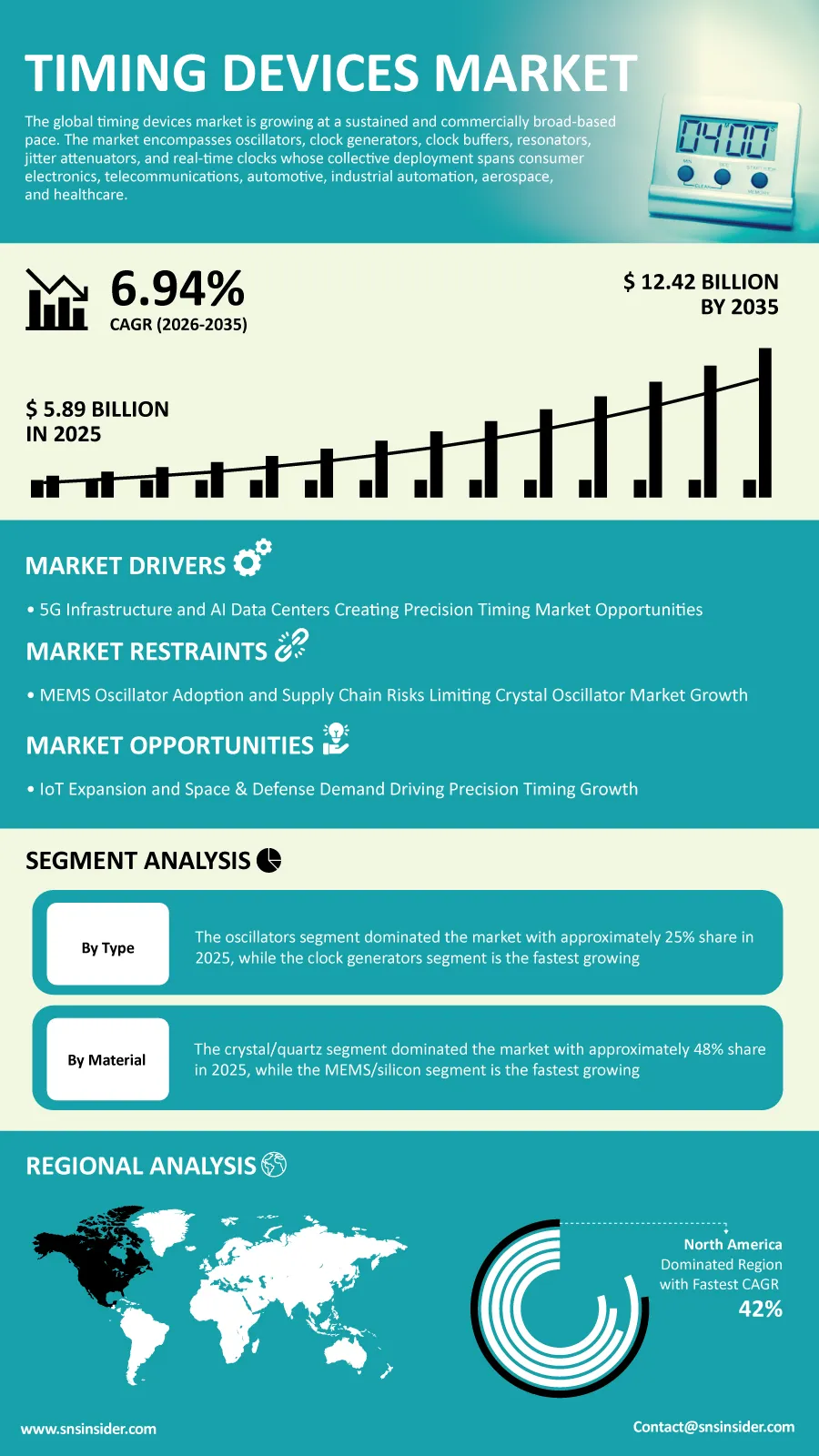
The global Timing Devices Market is on a steady growth trajectory as advanced electronics, connected infrastructure, and high-performance computing systems demand increasingly accurate synchronization. According to a recent study by SNS Insider, the global Timing Devices Market size valued at USD 5.89 billion in 2025, is anticipated to grow to USD 12.42 billion by 2035, registering a CAGR of 6.94% over the 2026–2035 forecast period.
Due to the rise in the use of 5G technology infrastructure, AI technology infrastructure, automobile electronics, industrial automation, and IoT technology, there arises the need for the development of timing and frequency solutions that can be used in these various systems. This is due to the fact that the systems are becoming more interconnected, thereby requiring high-performance components.
With the shift to small and multifunctional timing systems, there are several advantages that have been coming up in the field of semiconductor technology. This has been made possible by the use of MEMS and multiple functionality clocks.
To Get Detailed Insights on the Timing Devices Market – Request a Sample Report
AI Infrastructure and 5G Expansion Create New Growth Opportunities
Fast development of the AI data centers will most probably turn out to be an important driver in premium demand for novel timing devices. Computing systems imply highly synchronized processors, which results in the requirement for highly accurate clocks that would provide communication between computing, memory, and network components.
Another sphere with great opportunities for growth is that of telecommunications. In connection with the development of 5G networks, the requirement for the synchronization of network equipment increases, and on the other hand, automobile producers use more sophisticated electronics in their cars.
The expansion of the connected industry equipment and smart devices provides further opportunities for the low power timing solutions market.
Key Market Insights Highlight Shifting Demand Patterns
By type, oscillators accounted for approximately 25% of global market revenue in 2025, supported by their widespread role as frequency references across electronic systems. Clock generators are projected to be the fastest-growing category as data centers, telecommunications infrastructure, and advanced computing platforms require increasingly sophisticated clock distribution and synchronization capabilities.
Based on material, crystal and quartz technologies held approximately 48% of market revenue in 2025 due to their established manufacturing ecosystem and extensive use across consumer and industrial electronics. MEMS and silicon-based timing solutions are expected to register the fastest growth as their compact architecture, vibration resistance, and performance advantages increase adoption in automotive, telecom, and high-performance computing applications.
In terms of application, consumer electronics segment dominated with approximately 35% of market revenue in 2025, reflecting the enormous volume of smartphones, computers, wearable devices, and connected products manufactured globally. Automotive applications are expected to experience the fastest growth as advanced driver assistance systems, electric vehicles, and vehicle-to-everything communication technologies increase electronic content per vehicle.
By end user, consumer electronics segment dominated with 32% of market revenue in 2025. IT and telecommunications are projected to grow at the fastest pace as investments in 5G infrastructure and AI data centers increase demand for precision timing solutions.
Precision Synchronization Becomes Critical Across Emerging Technologies
Timing Devices industry becomes more and more influenced by the requirements imposed on the next generation of computer equipment. Contemporary computers require reliable clock circuits to coordinate complicated procedures, and telecommunication systems need precise synchronization to ensure proper data transmission.
Another emerging trend driven by automotive electronics industry implies the necessity to create timing devices which can operate under varied conditions of temperature and vibration. In addition, timing devices that provide various clock functions allow decreasing the quantity of the devices used for creating complicated systems.
These trends drive companies to develop products that are characterized by high accuracy, low power consumption, higher reliability and increased functionality.
North America Holds 42% RF Front-End Module Market Share in 2025 as Asia Pacific Emerges as the Fastest-Growing Region
North America will account for the largest revenue share owing to substantial investment in artificial intelligence computing capacity, 5G connectivity, electronics in aerospace and defense, and semiconductor devices in the region, estimated at 42% in 2025. The U.S. will remain the key regional demand generator owing to the presence of some of the leading technology firms and electronics systems in the country.
The fastest growth will be seen in the Asia Pacific region on account of increasing electronics manufacturing, semiconductor manufacturing, telecommunication infrastructure development, and automotive technology developments. China will become one of the biggest revenue generators in the region while Japan, South Korea, Taiwan, and India will strengthen their presence in electronics and technology value chains.
Increasing 5G deployment, expanding data center capacity, and the growth of domestic electronics manufacturing are expected to sustain strong demand throughout the forecast period.
Industry Participants Focus on Next-Generation Timing Innovation
The competitive landscape remains technology-driven, with manufacturers concentrating on MEMS innovation, integrated clock architectures, low-jitter performance, automotive qualification, and application-specific timing solutions. Companies are also expanding their portfolios to address emerging requirements from AI computing, telecommunications, automotive electronics, and connected devices.
Key companies operating in the global Timing Devices Market include SiTime Corporation, Microchip Technology Inc., Qorvo Inc., Texas Instruments Inc., Analog Devices Inc., Seiko Epson Corporation, TXC Corporation, Murata Manufacturing Co., Ltd., Kyocera Corporation, IQD Frequency Products Ltd., Nihon Dempa Kogyo Co., Ltd. (NDK), Rakon Limited, Abracon LLC, Bliley Technologies Inc., CTS Corporation, Crystek Corporation, Silicon Laboratories Inc., NXP Semiconductors, Infineon Technologies AG, and Daishinku Corporation.
An SNS Insider analyst Sushant Kadam commented, “The accelerating deployment of AI computing, 5G communications, connected devices, and advanced automotive electronics is raising the performance bar for timing technologies. Manufacturers that combine precision, low power consumption, compact architectures, and application-specific reliability will be well positioned to capture the next wave of demand across high-growth technology markets.”
About the Author

Get in touch