
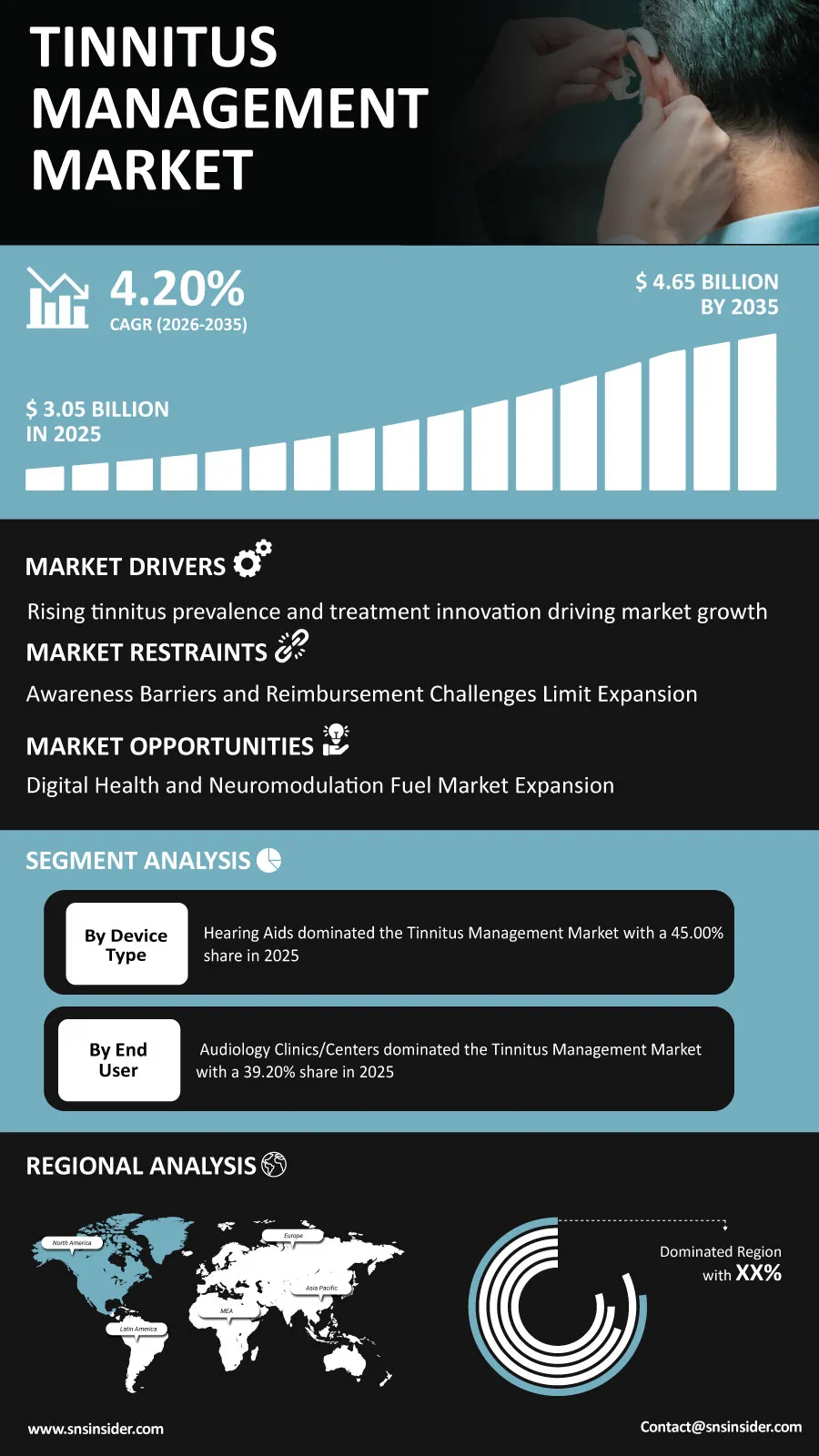
The global Tinnitus Management Market is set for steady expansion as hearing disorder awareness and treatment innovation continue to reshape patient care worldwide. “According to a recent study by SNS Insider, the global Tinnitus Management Market size valued at USD 3.05 billion in 2025, is anticipated to grow to USD 4.65 billion by 2035, registering a CAGR of 4.20% over the 2026–2035 forecast period.”
There have been notable changes within hearing healthcare technology over time, due to which many manufacturers who aim at improving patient outcomes can take advantage of this trend. This includes the need for more personalized, adaptive sound therapy solutions that will provide patients with the ability to manage tinnitus symptoms more effectively. This applies in situations where patients experience tinnitus tied to noise exposure, age-related hearing loss, or underlying vascular and muscular conditions. Manufacturers are constantly working hard to ensure that their tinnitus management solutions perform better than before in order to meet various patient needs across audiology, hospital, and homecare settings.
To Get Detailed Insights on the Tinnitus Management Market – Request a Sample Report
Personalized Sound Therapy Creates New Demand
The technology behind tinnitus treatment has evolved from a basic sound-masking mechanism to a more advanced approach that utilizes artificial intelligence. The need for investment in neuromodulation technology, digital health capabilities, and multi-modal treatment techniques in all types of hearing aid manufacturers has led to the development of advanced tinnitus management solutions.
Advances in technology can help with improving the symptom management, improving the adherence, and even the constant monitoring through application of the progress in tinnitus management. Therefore, tinnitus management technology gives the possibility to improve the process of adapting the treatment to hearing and symptoms profile.
Hearing device manufacturers, digital health platforms, and audiology practices are increasingly cooperating thanks to the growing interest in developing future solutions for comprehensive, personalized tinnitus care.
Key Market Findings Highlight High-Growth Segments
Hearing aids was the most significant category within the market share for the tinnitus treatment market, accounting for 45.00% of market revenues by 2025 because of the high prevalence rate of tinnitus with hearing impairment due to aging. The neuromodulation devices category is expected to witness the highest growth rate, estimated at 9.20% from 2026 through 2035, driven by approvals of new non-invasive stimulation therapy technology.
By indication, subjective tinnitus held the largest share of total market revenue at 56.20% in 2025 due to its significantly higher prevalence compared to objective tinnitus. Objective tinnitus will see the fastest growth in revenue generation at a CAGR of 5.80%, supported by improved diagnostic capability for identifying underlying causes.
Based on treatment type, device-based approaches generated a share of 62.40% of market revenue in 2025 thanks to widespread availability and clinical acceptance as the first-line management approach. On the other hand, cognitive behavioral therapy will be the segment recording the fastest revenue growth at a CAGR of 9.20%, driven by growing recognition of the psychological aspects of tinnitus.
Distributive end-user trends are changing as well. Audiology clinics and centers accounted for a 39.20% revenue share in 2025 owing to their specialized diagnostic and fitting capabilities. But homecare settings will turn out to be the fastest-growing end-user category through 2035, on the back of growing availability of app-based tinnitus management tools and remote monitoring technology.
Personalization, Access, and Patient Outcomes Gain Importance
In this regard, patients and clinicians have been looking at tinnitus management solutions that would deliver more personalized relief while requiring less frequent in-clinic visits.
Innovation in AI-based sound therapy customization, neuromodulation technology, and telehealth integration has been making it possible for companies to come up with products that can adapt to individual patient needs more effectively. In addition to that, increasing emphasis on addressing the psychological and quality-of-life impact of tinnitus is also making it possible for manufacturers to find solutions that improve overall patient outcomes. Such trends are likely to become even more prominent in the future.
North America Emerges as the Largest Market with 85.00% Regional Revenue Share Amid Rising Hearing Healthcare Investment
The North America region represented the largest share of regional market revenue in 2025, owing to high tinnitus prevalence among veterans and noise-exposed workers, strong awareness through structured management programs, and robust hearing healthcare infrastructure across the region. On the other hand, Asia Pacific is expected to be the fastest-growing market during the forecast period through 2035, propelled by rising healthcare investment, growing awareness of hearing disorders, and expanding hearing device manufacturing and distribution capacity.
Leading Companies Drive Innovation and Competition
The environment continues to stay very dynamic since players continue innovating on sound therapy and neuromodulation technology as well as forming partnerships in order to enhance their position in the industry. Some of the major companies that operate in the global tinnitus management market are Sonova, William Demant Holding, GN Hearing, Starkey Hearing Technologies, WS Audiology, Oticon, Cochlear Limited, MED-EL, Neuromod Devices, and Eargo.
An SNS Insider analyst Santosh Bhul commented, "The growing recognition that effective tinnitus management options exist is creating sustained demand for personalized, technology-enabled treatment solutions. Manufacturers that successfully combine sound therapy innovation, neuromodulation technology, and digital health integration will be best positioned to capitalize on emerging opportunities across clinical and homecare settings."
About the Author

Get in touch




