
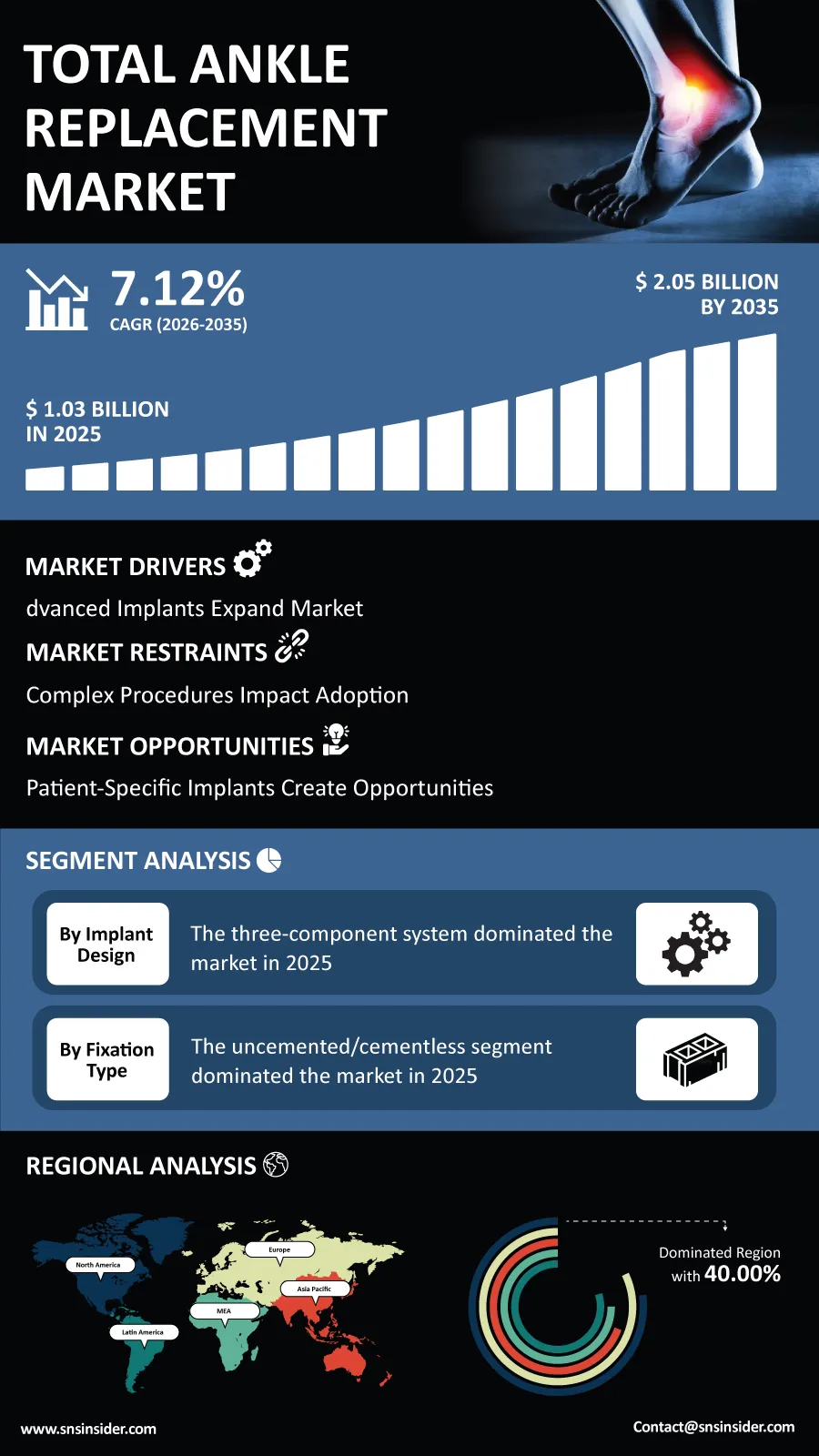
The global Total Ankle Replacement Market is expected to experience significant expansion over the next decade as orthopedic surgeons increasingly adopt advanced joint replacement technologies that improve mobility while preserving natural ankle function. “According to a recent study by SNS Insider, the global Total Ankle Replacement Market size valued at USD 1.03 billion in 2025, is anticipated to grow to USD 2.05 billion by 2035, registering a CAGR of 7.12% over the 2026–2035 forecast period.”
The market is reaping rewards from ongoing innovation in orthopedic implants, greater recognition of joint-preserving therapies, and growing preference for treatments that enable patients to recover their mobility. Healthcare institutions are providing greater access to orthopedic solutions by acquiring better tools that increase the accuracy of surgery and improve the patient’s chances of recovery.
As patient expectations continue shifting toward treatments that restore movement rather than permanently limit joint function, advanced ankle replacement procedures are becoming an increasingly important option within modern orthopedic care.
To Get Detailed Insights on the Total Ankle Replacement Market – Request a Sample Report
Innovation in Implant Technology Accelerates Clinical Adoption
The swift progress that is being made in the field of implant engineering is transforming the future outlook for ankle arthroplasties. New implant systems are coming out which are meant to offer better anatomical fit, stability, and clinical results.
The advances in technology are also penetrating into the field of robot-assisted surgery, surgical planning using digital technology, and the manufacturing of implants that are specific to a particular patient.
Increasing efforts are also being made in educating the orthopedic surgeons, training them, and carrying out clinical studies so as to increase their confidence in the new procedure of ankle replacement.
Key Market Findings Highlight Emerging Opportunities
Among implant designs, three-component systems dominated the global market in 2025, reflecting their widespread clinical adoption and long-established use in orthopedic practice. Meanwhile, two-component implant systems are expected to record the fastest growth through 2035, supported by simplified surgical techniques and increasing acceptance among orthopedic specialists.
By fixation method, uncemented (cementless) implants accounted for the largest market share in 2025, while cemented fixation continues to serve selected revision procedures and patients requiring specialized treatment approaches.
From a material perspective, metal and polyethylene implants represented the leading market segment in 2025, supported by proven clinical performance and broad commercial availability. At the same time, ceramic-based materials continue gaining attention as manufacturers pursue improvements in bearing surface durability and implant longevity.
Clinical demand remains strongest for osteoarthritis-related procedures, which represented the largest indication in 2025, while post-traumatic arthritis is projected to emerge as the fastest-growing indication during the forecast period, reflecting increasing recognition of motion-preserving surgical options among active patient populations.
Healthcare delivery trends are also evolving. Hospitals remained the largest end-user segment in 2025, whereas ambulatory surgical centers are expected to experience the fastest growth through 2035, driven by advances in minimally invasive techniques and expanding outpatient orthopedic capabilities.
Advances in Precision Surgery Support Better Patient Outcomes
With increased adoption of digital technology in orthopedics, the process of surgery preparation, implant placement, and surgery in general is becoming increasingly efficient. The application of advanced imaging methods, computer navigation, and personalized surgeries enables better results and helps avoid variance in complicated procedures.
Healthcare professionals pay attention to faster rehabilitation period, decreased need for hospitalization, and patient-oriented recovery program, thus making advanced ankle replacements more acceptable to both doctors and patients.
Regional Markets Continue to Expand
North America held around 40.00% of the market share in the year 2025 due to advanced infrastructure in orthopedics, efficient reimbursement policies, and increased use of advanced joint replacement technology. The US is one of the main drivers of the North American region owing to high number of procedures and presence of advanced orthopedic care facilities.
On the other hand, Asia Pacific is forecast to grow rapidly between 2026-2035 as a result of the expanding healthcare infrastructure, aging populations, increased volume of orthopedic procedures, and awareness about advanced joint replacement technology.
Industry Leaders Continue Investing in Next-Generation Orthopedic Solutions
Competition within the total ankle replacement market remains dynamic as manufacturers continue investing in implant innovation, surgeon training, clinical evidence generation, and strategic product expansion.
Leading companies operating in the global total ankle replacement market include Integra LifeSciences, Stryker, Zimmer Biomet, Smith+Nephew, Corin Group, Exactech, Arthrex, Globus Medical, Enovis, and B. Braun.
An SNS Insider analyst Parry Kardani commented, "Ongoing advances in implant design, precision surgical technologies, and surgeon education are transforming the treatment landscape for ankle arthritis. As confidence in long-term clinical outcomes continues to grow, total ankle replacement is expected to become an increasingly important option for restoring mobility and improving patient quality of life."
About the Author

Get in touch




