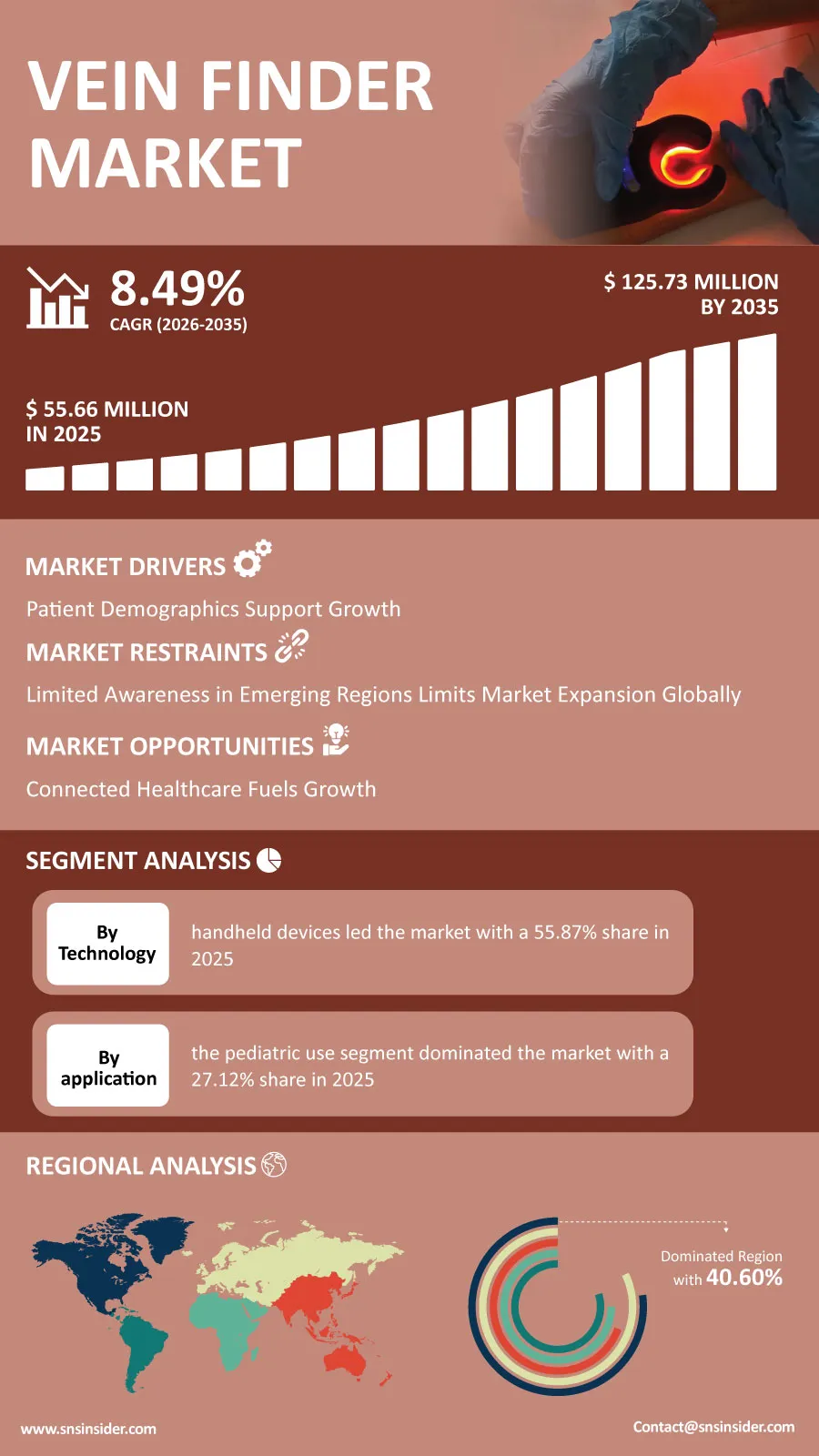
The global Vein Finder Market is witnessing sustained momentum as healthcare systems increasingly prioritize accurate vascular access, improved patient comfort, and enhanced procedural efficiency. "According to a recent study by SNS Insider, the global Vein Finder Market size valued at USD 55.66 Million in 2025, is anticipated to grow to USD 125.73 Million by 2035, registering a CAGR of 8.49% over the 2026–2035 forecast period."
Hospitals and healthcare providers are being encouraged to invest in contemporary vein visualization systems due to the growing acceptance of advanced imaging technology and the growing demand for safer venipuncture operations. In patient populations where problematic venous access is still a clinical barrier, such as pediatric, geriatric, cancer, and obese patients, the demand is especially great. The market outlook is being further strengthened by ongoing advancements in digital healthcare integration and portable imaging technologies.
To Get Detailed Insights on the Vein Finder Market – Request a Sample Report
Advanced Imaging Technologies Transform Clinical Procedures
Innovative imaging systems that increase first-attempt success during IV access and blood collection are being embraced by healthcare providers more and more. With the use of computerized guidance, artificial intelligence, and near-infrared imaging, modern vein visualization systems allow doctors to conduct procedures more precisely while causing the least amount of discomfort to their patients.
Vein finders are being used in emergency medical services, ambulatory care, and home healthcare outside of hospitals thanks to portable and handheld devices. Manufacturers are concentrating on lightweight, connected, and intelligent solutions that enhance workflow efficiency and support improved treatment outcomes as healthcare organizations continue to invest in patient-centered technologies.
Key Market Findings Highlight High-Growth Segments
The infrared vein finders segment accounted for 43.88% of market revenue in 2025, reflecting widespread adoption across hospitals and clinical environments. Meanwhile, near-infrared imaging systems are projected to register the fastest growth, advancing at a 9.06% CAGR through 2035 due to superior visualization capabilities.
Among applications, pediatric use represented the largest share at 27.12% in 2025 and is also expected to record the fastest expansion with a 9.08% CAGR, supported by increasing demand for accurate vascular access in children.
By technology, handheld devices dominated with a 55.87% revenue share in 2025 because of their portability and ease of operation. Portable vein finders are forecast to be the fastest-growing technology segment, expanding at a 9.06% CAGR throughout the forecast period.
Hospitals remained the leading end users, contributing 57.85% of total market revenue in 2025. However, ambulatory surgical centers are anticipated to experience the strongest growth, registering a 9.16% CAGR as outpatient procedures continue to increase worldwide.
Artificial Intelligence and Digital Healthcare Create New Opportunities
Technology keeps reshaping vascular access by making clinical workflows smarter and more connected. To top it up artificial intelligence provides tools to physicians to identify difficult veins at much faster speed and digital healthcare solutions can be used for chronic ailment monitoring which provides better continuity in care and consistency during procedures.
Organizations offering healthcare services are now working on augmenting reality, ability to connect with the cloud and real time analytics to assist while making decisions during venipuncture. Innovations such as these are likely to bolster adoption in hospitals, specialty clinics, ambulatory surgical centers, and home healthcare settings.
Increasing collaboration of medical device manufacturers, software developers and healthcare institutions is speeding up the commercialization of next-generation vein visualization technologies that merge imaging precision with smart clinical support.
Regional Markets Continue Expanding Worldwide
North America had a share of 40.60% in the local income for worldwide income in 2025. The dominance of the regional market would continue to be supported by strong healthcare infrastructure and growing adoption of advanced medical technologies alongside high demand from pediatric, oncology, and geriatric care. The United States generated USD 19.26 Million in revenue during 2025 and is projected to reach USD 43.19 Million by 2035, reflecting a CAGR of 8.41%.
Asia-Pacific region is expected to grow at the highest CAGR of 9.40% from 2026 to 2035 Rapid regional expansion is fueled by extending social insurance framework, upgrading understanding security projects in view of expanding commonness of constant ailments and higher interest for spearheading advanced medical devices across China, India, and Japan.
Europe still accounts for a major share in the global market, largely due to well-defined healthcare policies and advanced hospital networks and increasing adoption of vein visualization technologies among pediatric care centers and surgical settings. Healthcare expansion in Latin America and the Middle East & Africa is at a gradual pace, owing to increasing initiatives of modernizing healthcare which is further leading to improved access for advanced medical equipment.
Leading Companies Strengthen Market Competition Through Innovation
Competition remains strong as manufacturers focus on expanding product capabilities through advanced imaging, AI integration, portability, and improved clinical performance. Companies are also investing in strategic collaborations and product launches to strengthen their global presence.
Major participants operating in the global vein finder market include AccuVein Inc., Christie Medical Holdings, Inc., TransLite LLC, Near Infrared Imaging, Inc., Infrared Imaging Systems, Inc., Venoscope LLC, AimVein, Zhongke Meiling Cryogenics Co., Ltd., Shenzhen Bestman Instrument Co., Ltd., Healicom Medical Equipment Co., Ltd., OSANG Healthcare Co. Ltd., Bio-Medical Devices Intl., Medtronic plc, Koninklijke Philips N.V., GE HealthCare Technologies Inc., Shenzhen Vivolight Medical Device Technology Co., Ltd., RaBandy Vein Finder, Novarix Ltd., BLZ Technology, and Venoscope Europe GmbH.
An SNS Insider analyst Parry Kardani commented, "Healthcare providers are increasingly prioritizing technologies that improve first-attempt vascular access while enhancing patient comfort and clinical efficiency. Continued innovation in AI-assisted imaging, portable device design, and digital integration is expected to unlock significant opportunities for manufacturers serving hospitals, outpatient facilities, and home healthcare providers worldwide.
About the Author

Get in touch