
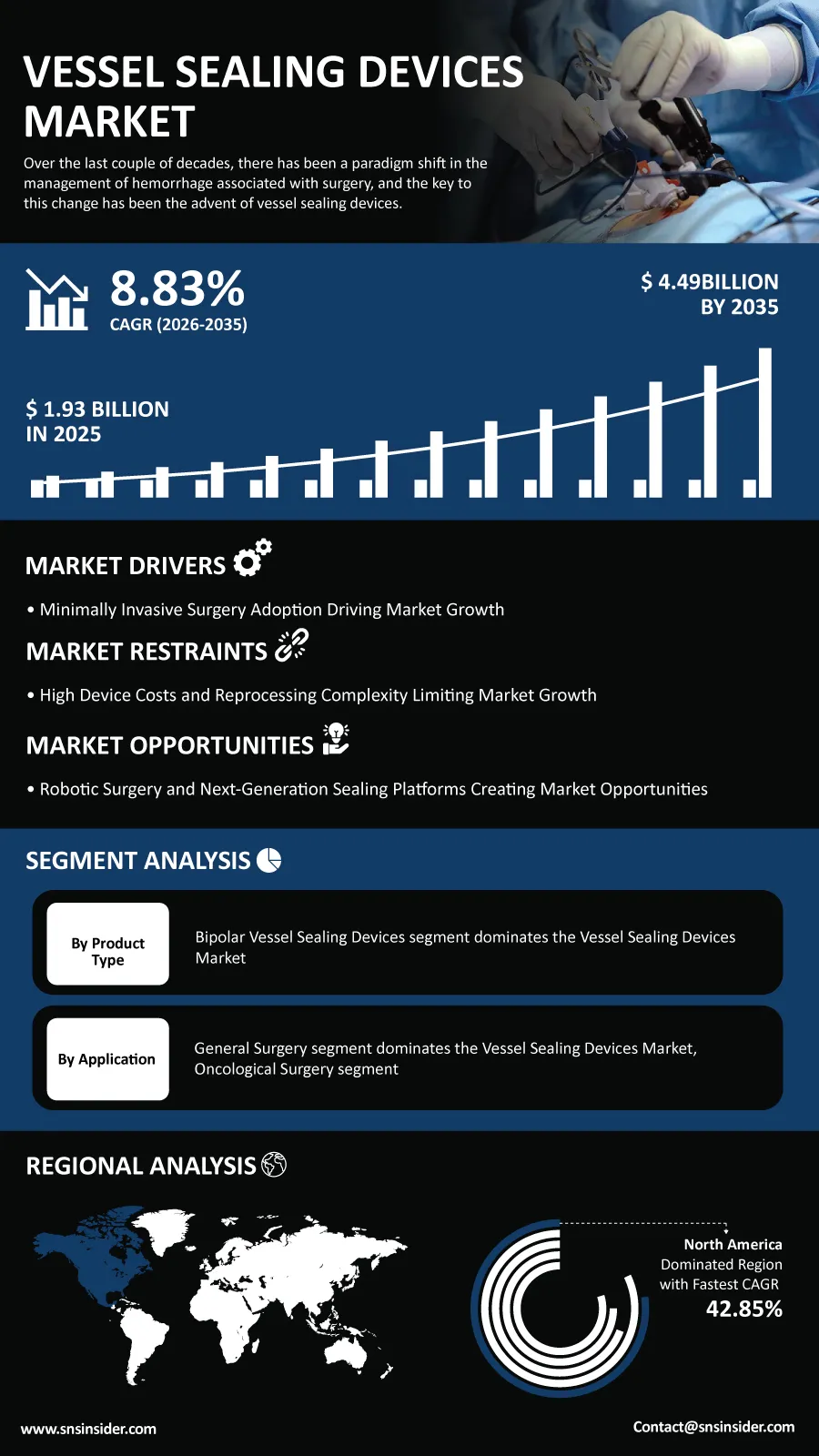
The global Vessel Sealing Devices Market is witnessing robust growth as healthcare providers increasingly adopt advanced surgical technologies designed to improve precision, efficiency, and patient outcomes. According to a recent study by SNS Insider, the global Vessel Sealing Devices Market size valued at USD 1.93 billion in 2025, is anticipated to grow to USD 4.49 billion by 2035, registering a CAGR of 8.83% over the 2026–2035 forecast period. Rising surgical volumes, expanding access to minimally invasive procedures, and continuous advancements in energy-based medical devices are creating strong demand across hospitals and ambulatory care facilities worldwide.
Modern surgical practice is increasingly focused on reducing operative time, minimizing blood loss, and supporting faster patient recovery. Vessel sealing systems have become valuable tools across numerous specialties by allowing surgeons to achieve reliable hemostasis while improving procedural workflow. As healthcare systems continue investing in advanced operating room technologies, manufacturers are introducing smarter platforms that integrate improved energy delivery, enhanced tissue feedback, and greater procedural versatility.
To Get Detailed Insights on the Vessel Sealing Devices Market – Request a Sample Report
Advanced Surgical Technologies Accelerate Market Expansion
Healthcare professionals around the world have quickly adopted minimally invasive procedures that involve very effective surgical devices. The trend towards the use of laparoscopic procedures along with an increase in the number of robotic surgery programs has created consistent opportunities for vessel sealers in the fields of general surgery, gynecology, urology, and oncology.
Innovation is still a key characteristic of the industry. Manufacturers are now offering innovative surgical tools that are able to seal, dissect, and cut tissue at once, making the procedure easier for clinicians and boosting efficiency in the operating room. Wider use of disposables and technology for monitoring tissue in real time is also increasing demand in the industry.
Key Market Findings Highlight Strong Growth Opportunities
By product type, bipolar vessel sealing devices accounted for the largest market share in 2025 due to their broad clinical acceptance across multiple surgical specialties. Ultrasonic vessel sealing devices are projected to register the fastest growth throughout the forecast period as surgeons increasingly seek precision instruments with minimal thermal spread.
Based on application, general surgery represented the largest market segment in 2025, supported by the high volume of abdominal and laparoscopic procedures performed globally. Oncological surgery is expected to emerge as the fastest-growing application as rising cancer surgeries increase demand for advanced surgical energy devices.
By end user, hospitals maintained the dominant market position during 2025 owing to their high procedural volumes and investment in advanced operating room equipment. Ambulatory Surgical Centers (ASCs) are forecast to record the fastest expansion, growing at a CAGR of 9.38% through 2035 as outpatient surgical care continues expanding worldwide.
Innovation Continues to Transform Surgical Practice
Manufacturers have also been showing increasing interest in technologies that enhance surgical precision along with providing improved clinical results. Better jaw designs, advanced energy delivery technology and tissue sensing intelligence make it possible for surgeons to conduct complicated procedures more easily and confidently.
There are other factors that can be contributing positively to the market as well, including the incorporation of the latest technologies into robotic surgical platforms. In light of the growing popularity of robotic-assisted surgeries worldwide, the demand for vessel sealing devices designed especially for use with robotic surgical systems is anticipated to increase sharply.
Regional Markets Show Broad-Based Growth
North America is still the largest regional market, which constituted about 42.85% of total global revenue in 2025. This region enjoys a sophisticated health care infrastructure, large volumes of surgeries performed, and a fast adoption rate of innovations in medicine. The U.S.was responsible for nearly 85% of the regional demand and made about USD 0.71 billion of the market revenue during 2025. The market in the U.S. will amount to about USD 1.63 billion by 2035, with a CAGR of 8.65%.
The Asia Pacific region will be one of the most dynamic markets, growing with a CAGR of 9.67% till 2035. Investments in health care infrastructure, increasing capacities of surgeries, and growing popularity of minimally invasive surgeries in China, India, Japan, and Southeast Asia will drive the regional growth. China was responsible for nearly 43% of the regional revenue in 2025.
Europe is still a significant contributor to the global demand, where Germany constitutes nearly 29% of the regional revenue. Emerging markets include Brazil that makes nearly 50% of Latin American revenue, and UAE that is responsible for 31% of the Middle East & Africa market demand.
Leading Companies Strengthen Competitive Landscape
The competitive environment remains highly dynamic as medical technology companies continue investing in research, product development, and regulatory approvals. Leading participants operating in the global vessel sealing devices market include Medtronic plc, Johnson & Johnson (Ethicon), Olympus Corporation, B. Braun Melsungen AG, Stryker Corporation, Becton, Dickinson and Company, Intuitive Surgical Inc., KLS Martin Group, Erbe Elektromedizin GmbH, Integra LifeSciences Holdings Corporation, CONMED Corporation, Teleflex Incorporated, Applied Medical Resources Corporation, LiNA Medical, Bowa Electronic GmbH & Co. KG, Richard Wolf GmbH, Aesculap AG, Karl Storz GmbH & Co. KG, Microline Surgical Inc., and AtriCure Inc.
An SNS Insider analyst Parry Kardani commented, "The continued expansion of minimally invasive and robotic-assisted surgery is creating sustained demand for advanced vessel sealing technologies. Companies that combine clinical innovation, procedural efficiency, and next-generation energy delivery systems will be well positioned to capitalize on long-term opportunities across global surgical care."
About the Author

Get in touch




