
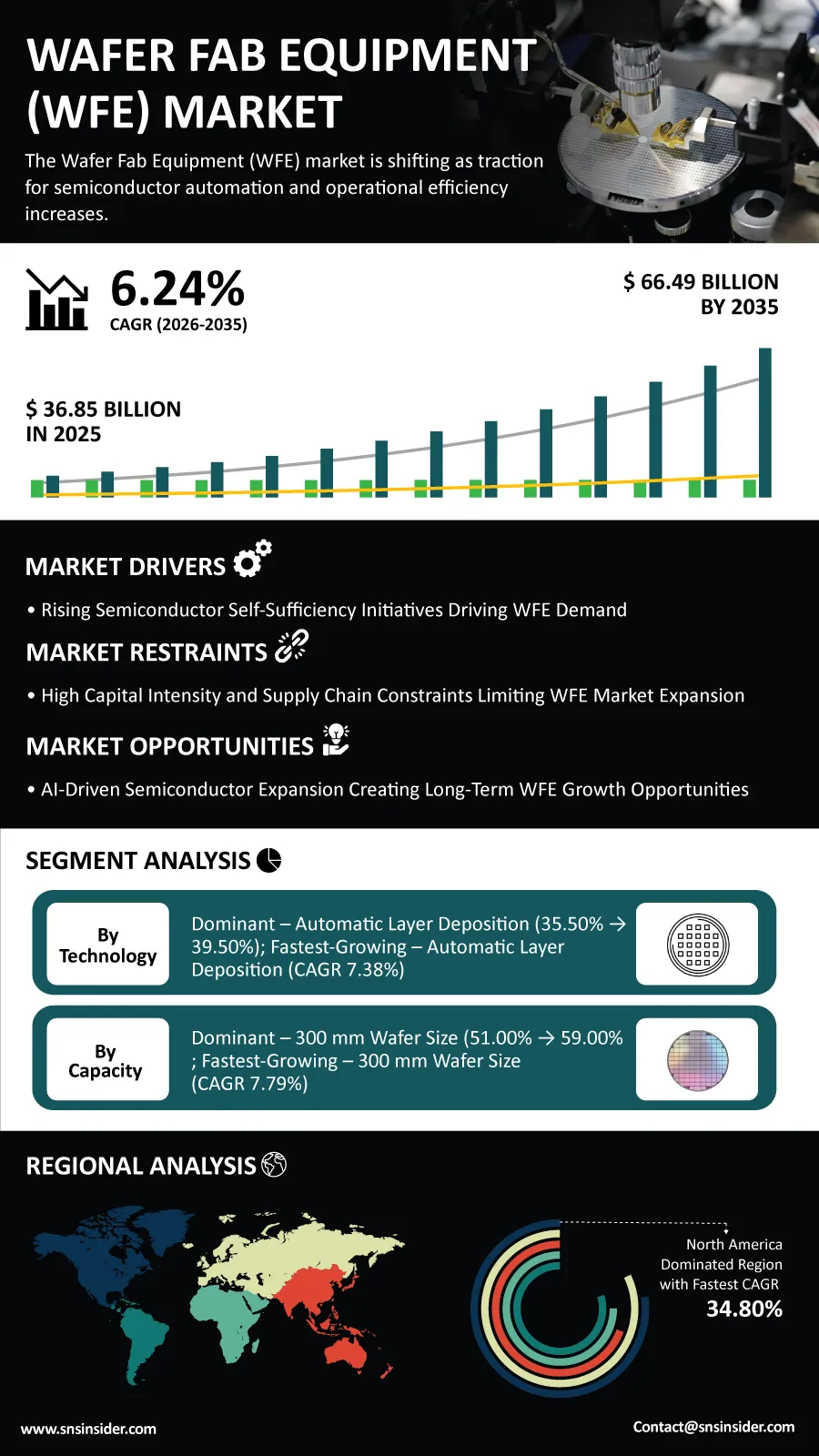
The global Wafer Fab Equipment (WFE) Market is poised for sustained expansion due to the increasing production of semiconductors which will meet the increased demand for artificial intelligence, high performance computing, automotive and consumer electronics. According to a recent study by SNS Insider, the global Wafer Fab Equipment Market size valued at USD 36.85 billion in 2025, is anticipated to grow to USD 66.49 billion by 2035, registering a CAGR of 6.24% over the 2026–2035 forecast period.
With the rising sophistication of the semiconductor industry, manufacturers have started to focus on increasing productivity through automation, accuracy in production, and optimizing processes. Increased spending in building advanced fabrication plants and continued progress towards more advanced process nodes is pushing equipment providers to come up with manufacturing solutions that are highly specialized for semiconductors.
There are also gains resulting from growing investment in local fabrication of semiconductors, diversified supply chains, and smart factories. Advanced lithography, deposition, etching, metrology, and inspection technology is being used more often to increase manufacturing efficiency, as well as to meet the increasing global demands for advanced integrated circuits.
To Get Detailed Insights on the Wafer Fab Equipment Market – Request a Sample Report
Semiconductor Capacity Expansion Continues to Drive Market Growth
Both governments and semiconductor firms privately are investing significant sums of money in boosting the capability of regions in semiconductor manufacturing and reducing their dependence on external supply chains. Such actions have resulted in speeding up the development of new fabrication facilities along with increasing existing manufacturing capabilities within leading semiconductor producers.
The quick adoption of artificial intelligence technology, Internet of Things, cloud computing, and data centers is driving consistent demand for high-quality semiconductor products. With increased levels of sophistication in semiconductors, more sophisticated wafer fabrication equipment will be needed to ensure higher accuracy and manufacturing capabilities.
Ongoing investments in next-generation semiconductor technologies, including advanced logic and memory devices, are expected to generate long-term opportunities for equipment manufacturers focused on innovation and production efficiency.
Key Market Insights Highlight Shifting Demand Patterns
By technology, Automatic Layer Deposition is anticipated to contribute approximately 35.50% of market revenue in 2025 owing to its essential contribution in facilitating accurate deposition of thin films in semiconductors. In the same light, the same segment is expected to be the fast-growing with a CAGR of 7.38% by 2035 due to increased usage of advanced semiconductor architecture by manufacturers.
Based on end user, foundries accounted for 40.10% of market revenue in 2025 due to the involvement of extensive manufacture facilities for supplying chips to fabless semiconductor corporations across the world. The fastest growing end-user industry will be IDMs owing to the continued investment in vertical integration of semiconductor production.
By wafer capacity, the 300 mm wafer segment dominated the market with a 51.00% revenue share in 2025 while also emerging as the fastest-growing category. Higher production efficiency, improved chip yields, and expanding investments in advanced fabrication facilities continue to support widespread adoption of 300 mm manufacturing platforms.
In terms of product specification, node sizes between 7nm and 14nm accounted for maximum market revenue during 2025 since the size of the node is largely used in conventional applications of semiconductor products. At the same time, node sizes below 5nm will be the fastest-growing due to rising demand for AI processors and high-end computer systems.
Automation and Advanced Manufacturing Reshape Semiconductor Production
Semiconductor companies are adopting intelligent manufacturing technology quite fast as a means of improving their operations and the quality of their products. The use of automation and robotics, real-time process control systems, and data manufacturing technologies has enabled fabrication plants to minimize variability in production and maximize equipment usage.
Semiconductor manufacturers have also invested in technologies that would support more complicated semiconductor designs such as advanced packaging and process technologies. It will increase their manufacturing flexibility and help them bring advanced electronic products to the market faster.
With increased demand for intelligent computing platforms, advanced communication technologies, and smart devices, semiconductor fabrication equipment manufacturers will become more and more important in the semiconductor industry in the coming years.
North America Dominated with 34.80% Revenue Share in 2025; Asia Pacific to Expand at 7.38% CAGR
The share of North America in terms of global market revenue by 2025 was 34.80%, owing to the presence of a well-developed infrastructure for semiconductor manufacturing in the region, excellent research facilities, and the increasing investment in the manufacturing of semiconductors in the region.
Asia Pacific is going to exhibit the highest growth rate at a CAGR of 7.38%. Large investments in the fabrication of semiconductor chips, increased production of consumer electronics, and semiconductor development programs backed by governments in the region are contributing to increased demand for equipment.
As countries continue expanding domestic semiconductor capabilities to support economic competitiveness and technological independence, demand for advanced wafer fabrication equipment is expected to remain robust worldwide.
Industry Participants Focus on Technology Innovation
Competition within the Wafer Fab Equipment Market remains intense due to the efforts put by the major companies involved in developing new technologies in terms of deposition, etching, metrology, and process control equipment. Innovation in the area is critical to keep the competitive edge and support future semiconductor production.
Key companies operating in the global Wafer Fab Equipment Market include ASML, Applied Materials, Lam Research, Tokyo Electron, KLA Corporation, ASM International, SCREEN Holdings, Nikon Corporation, Hitachi High-Tech, Advantest Corporation, Teradyne Inc., Canon Inc., Veeco Instruments, AIXTRON SE, EV Group, Kokusai Electric, ULVAC Inc., DISCO Corporation, Plasma-Therm, and Oxford Instruments.
An SNS Insider analyst Sushant Kadam commented, “Growing investments in semiconductor self-sufficiency, AI-driven computing, and advanced fabrication technologies are creating sustained opportunities across the wafer fab equipment industry. Companies that continue advancing manufacturing precision, automation, and process innovation will be well positioned to capitalize on the next phase of global semiconductor expansion.”
About the Author

Get in touch




