
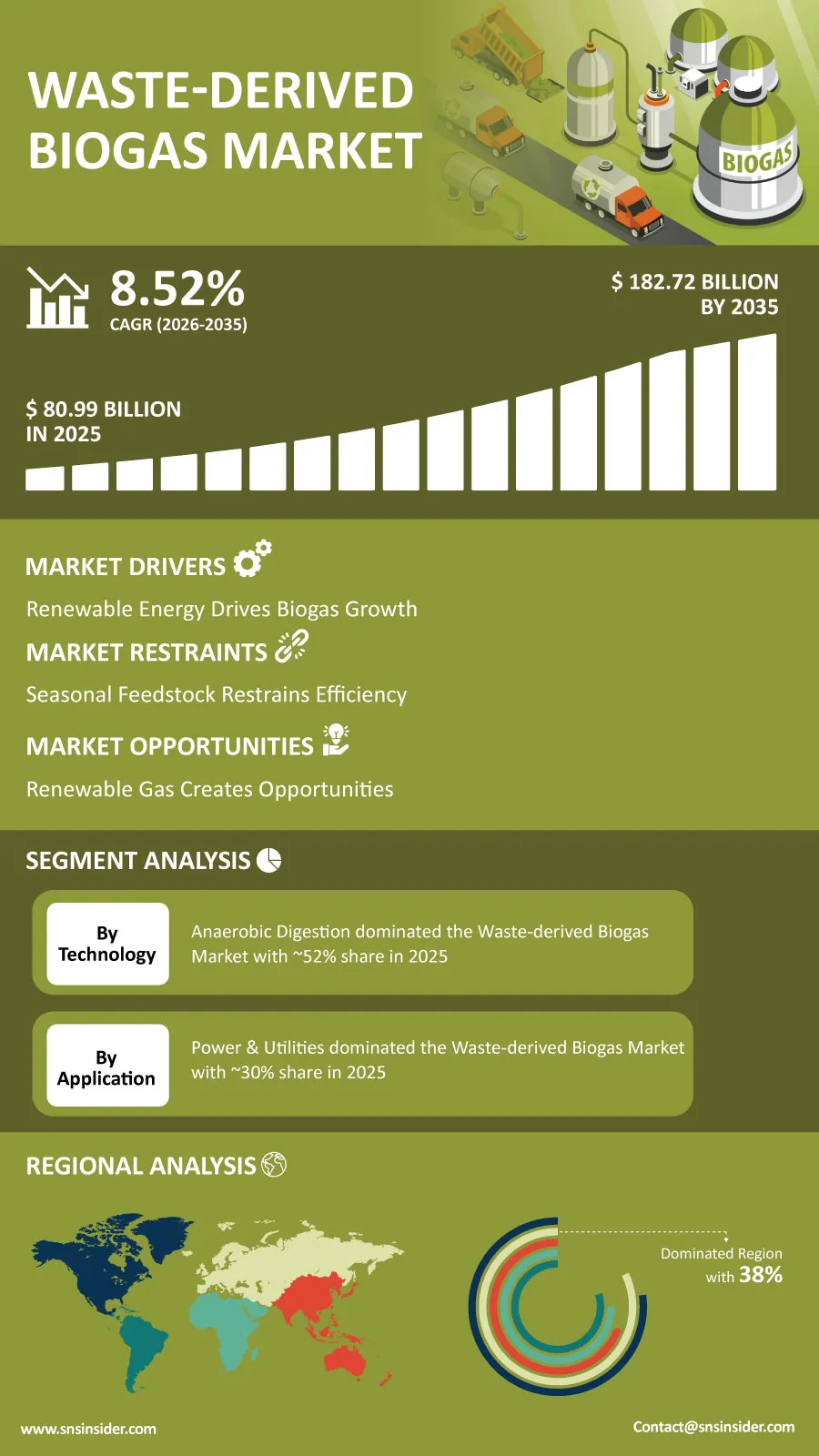
This shift towards green energy around the world has led to increased investments in those technologies that can convert waste into energy. Waste-based biogas has been identified as one such technology that will help in lowering greenhouse gases. “According to a recent study by SNS Insider, the global Waste-derived Biogas Market size valued at USD 80.99 billion in 2025, is anticipated to grow to USD 182.72 billion by 2035, registering a CAGR of 8.52% over the 2026–2035 forecast period.”
Renewable gas production is an area of particular focus for governments, municipalities, and private energy developers as countries strive to bolster energy security while curbing reliance on fossil fuels. For agriculture, municipal waste streams, industrial operations and wastewater treatment facilities organic waste is fast becoming an essential tool for generating clean electricity, renewable natural gas and sustainable transportation fuel.
Owing to consistent development of technology, the Anaerobic Digestion, gas purification booth in addition to biomethane upgrading are actually rendering commercial biogas facilities economically rewarding likewise useful for rapid execution inside both advanced as well as growing nations around the world.
To Get Detailed Insights on the Waste-derived Biogas Market – Request a Sample Report
Renewable Energy Investments Strengthen Long-Term Market Opportunities
Waste-to-energy projects benefit from global climate commitments and tightening environmental regulations. Economic policies and incentives for public funding programs on renewable energies, especially those focused on biogas production technologies such as landfills and some organic waste disposal systems to eliminate or reduce methane emissions are causing the proliferation of reliable installations that produce significant energy.
The growing infrastructure for the distribution of renewable natural gas (RNG) creates new opportunities for commercial development in transportation, industrial heating and electricity generation. Concurrently, the integrated energy systems facilitated by collaborations between waste management companies, utility companies and technology providers maximize resource utilization while minimizing reliance on landfills.
With the ongoing push for sustainability targets, waste-derived biogas is likely to feature more prominently in diversified renewable energy portfolios as industries tread this path.
Key Market Insights Highlight Evolving Industry Demand
On the basis of feedstock type, agriculture waste accounted for almost 29% revenue share in global market in 2025, which can be attributed to a robust biomass supply and existing collection systems. The strongest growth through 2035 is anticipated in municipal solid waste (MSW) as larger urban populations produce more organic waste and governments increase efforts to divert material from landfills.
Anaerobic digestion is estimated to have contributed 52% of total market revenue in 2025 by technology due to commercial reliability and operational efficiency. Simultaneously, biogas upgrading and purification technologies are projected to become the most rapidly growing section of the market with renewable natural gas being adopted more broadly throughout industrial and transportation applications.
Looking ahead, power and utilities made up approximately 30 percent of market revenue in 2025, with the transportation segment expected to provide the greatest growth going forward as demand climbs for renewable fuels that can cut down emissions from vehicles.
Half of the energy produced is used for electricity generation and in 2025 it held the largest revenue share at about 42% by end-use industry. Yet, over the upcoming years Vehicle Fuel (Bio-CNG/RNG) is anticipated to experience the fastest development as many governments are stimulating improved low-carbon mobility solutions.
Advanced Biogas Technologies Accelerate Industry Transformation
The waste-derived biogas industry continues to be defined by innovation. Equipment manufacturers are creating more effective digestion systems, dynamic process monitoring systems, and next-generation gas upgrading gear to optimize methane recovery while minimizing handling costs.
It enables digital automation, artificial intelligence and predictive analytics that enhance plant performance using feedstock optimization, enhanced energy generation and reduced operational downtime. These developments are paving the way for larger, more efficient buildings which can be used to support utility-scale renewable energy generation.
Renewable natural gas is increasingly integrated within current pipeline infrastructure to further benefit utilities, municipalities and industrial energy customers in the long run.
Europe Accounted for 38% Market Share in 2025; Asia Pacific Forecast to Register the Fastest Growth Through 2035
Europe continued to remain the dominant regional market, representing nearly 38% of global revenue in 2025. Mature waste management infrastructure, supportive environmental regulations and ambitious decarbonization targets will enable whole sets of waste-based biogas projects to be deployed throughout the region.
Asia Pacific is anticipated to be the most rapidly expanding region between 2023 and 2035, with rapid urbanization, industrial expansion, and increasing investments in renewable energy driving project development. The growing adoption of municipal waste collection schemes, large agricultural residue availability, and favorable government initiatives are likely to create more opportunities for the growth of the regional markets.
Expansion of mature waste management systems, renewable energy incentives and growing investments in renewable natural gas infrastructure are still benefitting North America while new waste-to-energy projects will expand the footprint of Latin America and Middle East & Africa at a gradual pace.
Industry Participants Expand Renewable Energy Capabilities
The level of competition in the Waste-derived Biogas Market worldwide is increasing as companies continue to invest in innovation, collaborations, infrastructure, and production of renewable gas. Companies in the industry are now working hard towards achieving efficiency and also helping countries in decarbonization efforts.
Key companies operating in the global Waste-derived Biogas Market include Veolia Environnement S.A., ENGIE SA, Cargill Inc., Siemens AG, Wärtsilä Corporation, Air Liquide S.A., Ameresco Inc., Clarke Energy Ltd., EnviTec Biogas AG, Greenlane Renewables Inc., PlanET Biogas Global GmbH, SUEZ Group, Gasum Oy, DMT Environmental Technology B.V., Hitachi Zosen Inova AG (Kanadevia Inova), BEKON GmbH, Zorg Biogas, Bioenergy DevCo, Bright Biomethane (Bright Renewables B.V.), and Green Elephant Biogas Pvt. Ltd.
An SNS Insider analyst Santosh Bhul commented, "Waste-derived biogas is becoming an increasingly important pillar of the global energy transition as governments and industries pursue sustainable waste management and carbon reduction strategies. Organizations investing in advanced biogas technologies, renewable natural gas infrastructure, and integrated circular economy solutions are expected to benefit from strong long-term market expansion as demand for clean energy continues to accelerate."
About the Author

Get in touch




