
Waste-derived Biogas Market Report Scope & Overview:
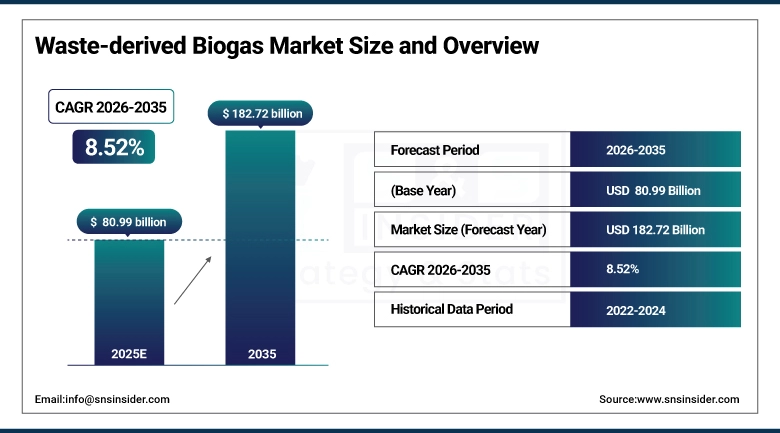
The Waste-derived Biogas Market was valued at USD 80.99 billion in 2025 and is expected to reach USD 182.72 billion by 2035, growing at a CAGR of 8.52% from 2026-2035.
The growing consumption of renewable energy, rising environmental awareness, and supportive government policies to foster sustainable waste management are the major factors that are, expected to increase the size of the global Waste-derived Biogas Market. The growing implementation of electricity, heat, and transport fuel applications, and advancements in anaerobic digestion and biogas upgrading technology drive adoption. The increasing trend of urbanization, industrialization, and drive toward circular economy initiatives is further pushing investment, which is allowing the market to expand globally and create a significant amount of revenue generation potential.
As of August 2025, the U.S. operates 589 landfill biogas facilities, up 18.5% since 2020, capturing methane from municipal solid waste landfills.
The EPA's LMOP database tracks over 2,600 MSW landfills, with 488 hosting 542 operational LFG energy projects as of September 2024, including electricity and renewable natural gas from waste.
To Get more information on Waste-derived Biogas Market - Request Free Sample Report
Waste-derived Biogas Market Trends
-
Rising focus on renewable energy generation and waste-to-energy solutions is driving the waste-derived biogas market.
-
Growing adoption across municipal, agricultural, and industrial waste management systems is boosting market growth.
-
Expansion of organic waste availability and landfill diversion initiatives is fueling biogas production.
-
Increasing focus on circular economy practices, emissions reduction, and energy security is shaping adoption trends.
-
Advancements in anaerobic digestion technology, upgrading systems, and grid injection solutions are enhancing efficiency.
-
Rising government incentives and sustainability mandates are supporting market expansion.
-
Collaborations between waste management companies, energy producers, and technology providers are accelerating innovation and global adoption.
U.S. Waste-derived Biogas Market Size Outlook:
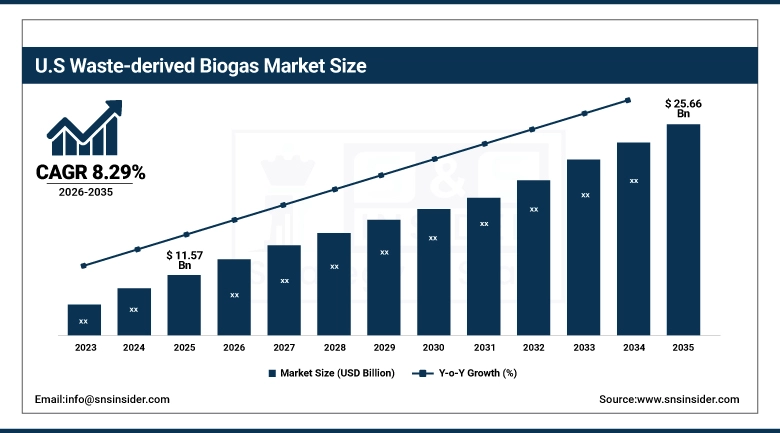
The U.S. Waste-derived Biogas Market was valued at USD 11.57 billion in 2025 and is expected to reach USD 25.66 billion by 2035, growing at a CAGR of 8.29% from 2026-2035. The U.S. Waste-derived Biogas Market is spurred by government policies and incentives, wider waste management infrastructure, surging consumption of renewable energy sources, and growing need for sustainable electricity and biofuels, spurring investment in the generation and production of biogas from municipal, agricultural, and industrial waste feeds.
EnviTec Biogas commissioned its largest U.S. plant in March 2025, the fifth of fifteen for clients, processing dairy waste into renewable natural gas (RNG) on farms, reducing carbon footprints.
PlanET Biogas, a key operator, delivered over 60 anaerobic digesters in North America in the last three years, focusing on waste-to-RNG solutions with full engineering support.
Waste-derived Biogas Market Growth Drivers:
-
Increasing demand for renewable energy and reduction of greenhouse gas emissions is fueling waste-derived biogas market growth rapidly worldwide.
The increasing international focus on sustainability and reducing carbon footprints is driving governments and industries to find renewable energy sources like biogas. Biogas from waste reduces reliance on fossil fuel by transforming organic waste from agriculture, municipal solid waste and sewage into energy. Also incentives, grants and soft policy movement for renewable energy infrastructure push investment in biogas plant. Industrial actors use biogas for electrical, thermal, and fuel applications, resulting in permanent and stable demand. The technology innovations in anaerobic digestion and biogas upgrading, leads to improvement in energy efficiency, making biogas as feasible and environmental friendly substitute for various industrial activities around the world.
The UK’s 2026 GHG emissions incorporate expanded biogas credits under planned methodology changes, emphasizing waste-to-biogas for net-zero goals.
Additionally, REPowerEU mandates biomethane from wastes only, avoiding food crops, with USD 33.77 billion of private funds pledged to meet 2030 targets.
Waste-derived Biogas Market Restraints:
-
Inconsistent feedstock supply and seasonal variability of organic waste are restraining the efficiency of waste-derived biogas production.
The supply of organic feedstock, which is the source material for waste-derived biogas, is not uniform and changes with seasons. As the volume of agricultural residues, food waste, and sewage may sometimes differ, the energy generated and the efficiency may also differ. Continuous operation of the plant is complicated as collection of biomass, transport to the plant and storage all unfolding in a chain create supply chain issues. Biogas yield is reduced and more maintenance is required if the feedstock is of low quality. That kind of volatility kills long term investment and profitability. Unpredictable supply could create uncertainty and make it difficult for industries and municipalities to say they will build large-scale projects. Feedstock availability poses challenges and must be addressed to optimize efficiency and scalability of waste-derived biogas facilities.
Waste-derived Biogas Market Opportunities:
-
Expanding infrastructure for renewable natural gas and integration of biogas in energy grids is opening new market opportunities globally.
The rising growth potential for biogas derived from waste, driven in part by the increasing demand for renewable natural gas (RNG) and biomethane. Without any further upgrading, biogas can be injected directly into existing gas grids, and used as a constant, low-carbon source of energy. Also, ongoing infrastructure development in urban and industrial regions facilitates mass adoption. Market value increases with integration in electric power generation, transport fuel and CHP applications. Even more opportunities could be afforded through private-public partnerships and investments in smart energy networks. New ambition in emerging economies with sustainable energy targets are largely underestimated. Worldwide considerable market expansion arises as industries can benefit from waste-to-energy projects that strengthen energy security whilst reduce emissions and generate revenues to the companies.
Waste-derived Biogas Market Segment Highlights
-
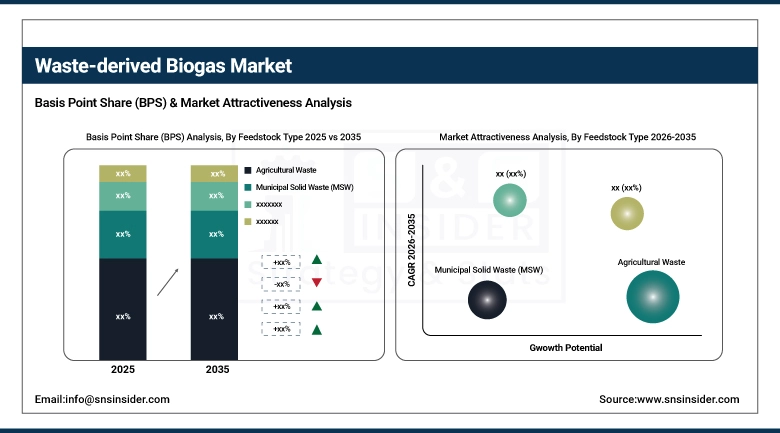
By Feedstock Type, Agricultural Waste dominated the Waste-derived Biogas Market with ~29% share in 2025; Municipal Solid Waste (MSW) fastest growing (CAGR).
-
By Technology, Anaerobic Digestion dominated the Waste-derived Biogas Market with ~52% share in 2025; Biogas Upgrading & Purification fastest growing (CAGR).
-
By Application, Power & Utilities dominated the Waste-derived Biogas Market with ~30% share in 2025; Transportation fastest growing (CAGR).
-
By End-Use Industry, Electricity Generation dominated the Waste-derived Biogas Market with ~42% share in 2025; Vehicle Fuel (Bio CNG / RNG) fastest growing (CAGR).
By Feedstock Type, Agricultural Waste segment dominates the Market, Municipal Solid Waste (MSW) expected to grow fastest
Agricultural Waste segment dominated the Waste-derived Biogas Market owing to its large availability from farming residues, lower collection cost as well as high organic content to ensure uniform biogas yield. It is preferred for efficient and sustainable biogas generation due to large-scale acceptance in rural and agricultural areas, which allows for constant feedstock supply.
Municipal Solid Waste (MSW) segment is expected to grow at the fastest CAGR from 2026-2035 because rapid urbanization and population growth are increasing waste volumes. Waste-to-energy initiatives being undertaken by various governments and municipalities are generating high demand for MSW-based biogas. The urban market is slated to grow faster, as advanced technologies permit efficient processing of mixed waste, leading to investments becoming more expensive.
By Technology, Anaerobic Digestion segment dominates the Market, Biogas Upgrading & Purification expected to grow fastest
Anaerobic Digestion segment dominated the Waste-derived Biogas Market owing to its high efficiency for different categories of organic wastes into biogas. Stable energy production, industrially mature technology, extensively deployed. Ongoing improved digester designs and operational efficiencies have made it the most robust and favored technology for biogas generation.
Biogas Upgrading & Purification segment is expected to grow at the fastest CAGR from 2026-2035 as increasing demand for biomethane and renewable natural gas is driving investment. By allowing the integration of biomass to be upgraded into the gas grids for fuelling applications and for high-value energy with private and public sector attraction supporting rapid technology uptake worldwide.
By Application, Power & Utilities segment dominates the Market, Transportation expected to grow fastest
Power & Utilities segment dominated the Waste-derived Biogas Market as the huge volume prerequisites of energy and simultaneousness with the matrix prompts steady utilization of biogas. Utilities pour money into renewable energy, helping them meet sustainability targets while using biogas to produce electricity and heat. Widespread adoption in this end-use segment is further bolstered by government incentives, energy security objectives and long-term PPA agreements.
Transportation segment is expected to grow at the fastest CAGR from 2026-2035 as rising acceptance of bio-CNG and renewable fuels are transforming the mobility sector. Increased regulatory mandates for low-emission vehicles and expanding infrastructure for low-carbon transportation fuel such as renewable natural gas (RNG) for light-, medium-, and heavy-duty buses, trucks and other commercial fleet vehicles worldwide drive rapid growth in biogas use.
By End-Use Industry, Electricity Generation segment dominates the Market, Vehicle Fuel (Bio-CNG / RNG) expected to grow fastest
Electricity Generation segment dominated the Waste-derived Biogas Market owing to the high efficiency in turning biogas into power for industrial and municipal purposes. An extensive contribution in revenue from this segment can be attributed to the benefit of reliable energy discharge, integration with combined heat and power systems, and growing demand for renewable electricity from the grid that supports widespread adoption of biogas.
Vehicle Fuel (Bio CNG / RNG) segment is expected to grow at the fastest CAGR from 2026-2035 as governments continue to encourage the development of renewable fuels towards decarbonizing transport. The market is growing due to growth in bio-CNG infrastructure, increasing uptake of commercial vehicles and increasing demand for low-carbon mobility, thereby paving the way for biogas to be used for alternative and sustainable transport fuel.
Waste-derived Biogas Market Regional Analysis
Europe Waste-derived Biogas Market Insights
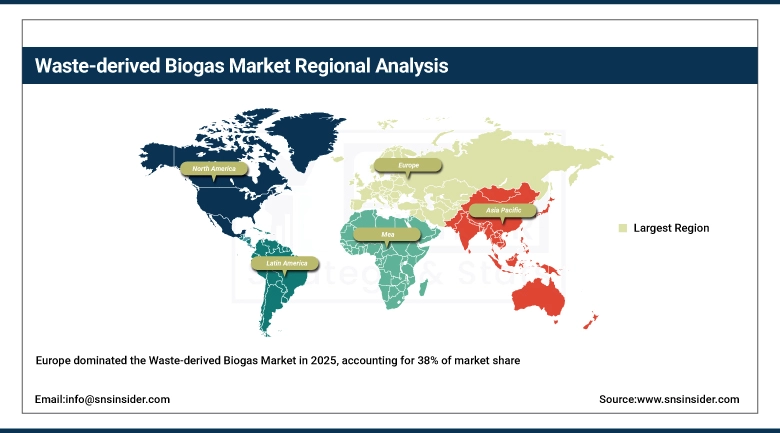
Europe dominated the Waste-derived Biogas Market with the highest revenue share of about 38% in 2025 owing to robust government policies, environmental regulations, & well-established waste disposal infrastructure. Massive deployment and high adoption of renewable energies technologies, coupled with generous biogas production incentives, supported by extensive R&D activities, led to large-scale implementation. In addition, high level of awareness regarding sustainability and circular economy initiatives among industries and municipalities is further supporting the continuous investments in the integration of waste-to-biogas, making Europe the largest regional market for waste derived biogas during this period.
Get Customized Report as per Your Business Requirement - Enquiry Now
Asia Pacific Waste-derived Biogas Market Insights
Asia Pacific segment is expected to grow at the fastest CAGR of about 9.57% from 2026-2035 owing to rapid urbanization, increasing population and industrialization. The increasing demand for energy and favourable government policies and investment in renewable energy infrastructure has been encouraging the uptake of biogas from waste. Owing to the expansion of municipal solid waste collection systems, easy availability of agricultural residue, and increasing environmental awareness are driving new opportunities in Asia Pacific, the biogas market in this region is expected to grow at the fastest rate during the forecast period.
North America Waste-derived Biogas Market Insights
Waste-derived Biogas Market in North America is one of the highest share holders owing to well-established waste management systems, extensive government support and wider adoption of renewables. Investment for biogas plants is high and thus, support for renewable energy and environmental regulation drives the market. North America maintains a steady high-volume feedstock supply for agricultural, municipal, and industrial large-scale deployment, making it a significant contributor to the world in producing and using biogas from these types of waste.
Middle East & Africa and Latin America Waste-derived Biogas Market Insights
Middle East & Africa and Latin America are emerging markets in the Waste-derived Biogas Market, owing to increasing generation of waste and growing demand for sustainable energy solution. Biogas is being propelled forward by every government supported effort, investment for infrastructure for renewable energy as well as growing awareness for environmental sustainability. In these regions, there is potential for gradual growth as limited conventional energy resources and the potential of agricultural and industrial waste are opening opportunities for biogas projects.
Waste-derived Biogas Market Competitive Landscape:
Veolia Environnement S.A.
Veolia Environnement S.A.is the global leader in optimized resource management, with a focus on water, waste, and energy management solutions. It engineers and builds innovative technology for projects that engage in recycling, circular economy, and decarbonization, including the productive use of waste and wastewater to create clean energy. Veolia's over 250 propriety and advanced treatment technologies and biogas upgrading and sustainability-driven strategies for municipal, industrial, and commercial customers world-wide. It contain energy efficiency, greenhouse gas reduction and green infrastructure development, that swings more toward a cross-sectoral environmental stewardships.
-
2025: Veolia will help transform San Francisco wastewater into renewable energy, producing pipeline-quality renewable natural gas to reduce CO₂ emissions locally.
-
2025: Veolia upgrades a historic Belgian brewery WWTP using biogas technology, producing heat and cutting annual CO₂ emissions by 548 tonnes.
-
2024: Veolia strengthens leadership in ecological transformation with SBTi validation, accelerating biogas capture at waste sites as part of GreenUp goals.
-
2024: Veolia partnered with University Area Joint Authority for anaerobic digestion converting biosolids and food waste into ~150,000 GJ/year renewable natural gas.
ENGIE SA
ENGIE is a French multinational energy company specializing in low-carbon energy generation, distributed utilities, and sustainable solutions. ENGIE - Renewable gas, Biogas and energy-from-waste projects in additive to innovative technology for decarbonization & energy efficiency Operating in electricity, natural gas, and energy services to industrial, commercial and municipal customers with a focus on circular economy and green energy transition. ENGIE is also investing in technology, startups and partnerships in order to make the production of renewable gas at scale and reductions at scale.
-
2026: ENGIE signs a 10-year biomethane supply agreement with PepsiCo UK from an anaerobic digestion plant producing 60 GWh biomethane annually.
-
2024: ENGIE acquires its first biomethane production unit in Belgium (68 GWh/year), expanding biomethane capacity toward its 10 TWh European target.
-
2024: ENGIE New Ventures invests in startup WASE to boost biogas yields up to 30% from organic waste and wastewater anaerobic digestion.
Cargill Inc.
Cargill Inc is a world leader in solutions for agribusinesses, food, and bioenergy. The company specializes in sustainable agronomy, waste valorization and circular economy projects, in particular biofuels and renewable gases production. Through handling organic waste, Wanting Cargill integrates anaerobic digestion and joint projects to deliver sustainable biomethane and reduce greenhouse gas emissions. Its operations are designed to be environmentally responsible while providing scalable solutions in food, energy, and industrial markets around the world.
-
2023: Cargill forms joint venture with Sustainable Fuel Plant Zeeland to produce sustainable biomethane from organic waste, advancing circular bioenergy and waste valorization in the Netherlands.
Waste-derived Biogas Companies are:
-
ENGIE SA
-
Cargill Inc
-
Wärtsilä Corporation
-
Air Liquide S.A
-
Ameresco Inc
-
Clarke Energy Ltd.
-
EnviTec Biogas AG
-
Greenlane Renewables Inc
-
PlanET Biogas Global GmbH
-
SUEZ Group
-
Gasum Oy
-
DMT Environmental Technology B.V
-
Hitachi Zosen Inova AG (Kanadevia Inova)
-
BEKON GmbH
-
Zorg Biogas
-
Bioenergy DevCo
-
Bright Biomethane / Bright Renewables B.V
-
Green Elephant Biogas Pvt. Ltd
| Report Attributes | Details |
|---|---|
| Market Size in 2025 | USD 80.99 Billion |
| Market Size by 2035 | USD 182.72 Billion |
| CAGR | CAGR of 8.52% From 2026 to 2035 |
| Base Year | 2025 |
| Forecast Period | 2026-2035 |
| Historical Data | 2022-2024 |
| Report Scope & Coverage | Market Size, Segments Analysis, Competitive Landscape, Regional Analysis, DROC & SWOT Analysis, Forecast Outlook |
| Key Segments | • By Feedstock Type (Agricultural Waste, Municipal Solid Waste (MSW), Food & Organic Waste, Industrial Wastewater & Sludge, Animal Manure, Sewage & Biosolids) • By Technology (Anaerobic Digestion, Landfill Gas Recovery, Biogas Upgrading & Purification, Combined Heat & Power (CHP), Biomethane Production) • By Application (Electricity Generation, Heat Generation, Combined Heat & Power (CHP), Vehicle Fuel (Bio-CNG / RNG), Gas Grid Injection) • By End-Use Industry (Power & Utilities, Transportation, Industrial, Residential & Commercial, Agriculture, Waste Management Companies) |
| Regional Analysis/Coverage | North America (US, Canada), Europe (Germany, UK, France, Italy, Spain, Russia, Poland, Rest of Europe), Asia Pacific (China, India, Japan, South Korea, Australia, ASEAN Countries, Rest of Asia Pacific), Middle East & Africa (UAE, Saudi Arabia, Qatar, South Africa, Rest of Middle East & Africa), Latin America (Brazil, Argentina, Mexico, Colombia, Rest of Latin America). |
| Company Profiles | Veolia Environnement S.A., ENGIE SA, Cargill Inc., Siemens AG, Wärtsilä Corporation, Air Liquide S.A., Ameresco Inc., Clarke Energy Ltd., EnviTec Biogas AG, Greenlane Renewables Inc., PlanET Biogas Global GmbH, SUEZ Group, Gasum Oy, DMT Environmental Technology B.V., Hitachi Zosen Inova AG (Kanadevia Inova), BEKON GmbH, Zorg Biogas, Bioenergy DevCo, Bright Biomethane / Bright Renewables B.V., Green Elephant Biogas Pvt. Ltd. |
Frequently Asked Questions
Europe dominated the Waste-derived Biogas Market in 2025.
The Agricultural Waste segment dominated the Waste-derived Biogas Market in 2025.
Increasing demand for renewable energy and reduction of greenhouse gas emissions is fueling waste-derived biogas market growth rapidly worldwide.
The Waste-derived Biogas Market was valued at USD 80.99 billion in 2025.
The Waste-derived Biogas Market is expected to grow at a CAGR of 8.52% from 2026 to 2035.
