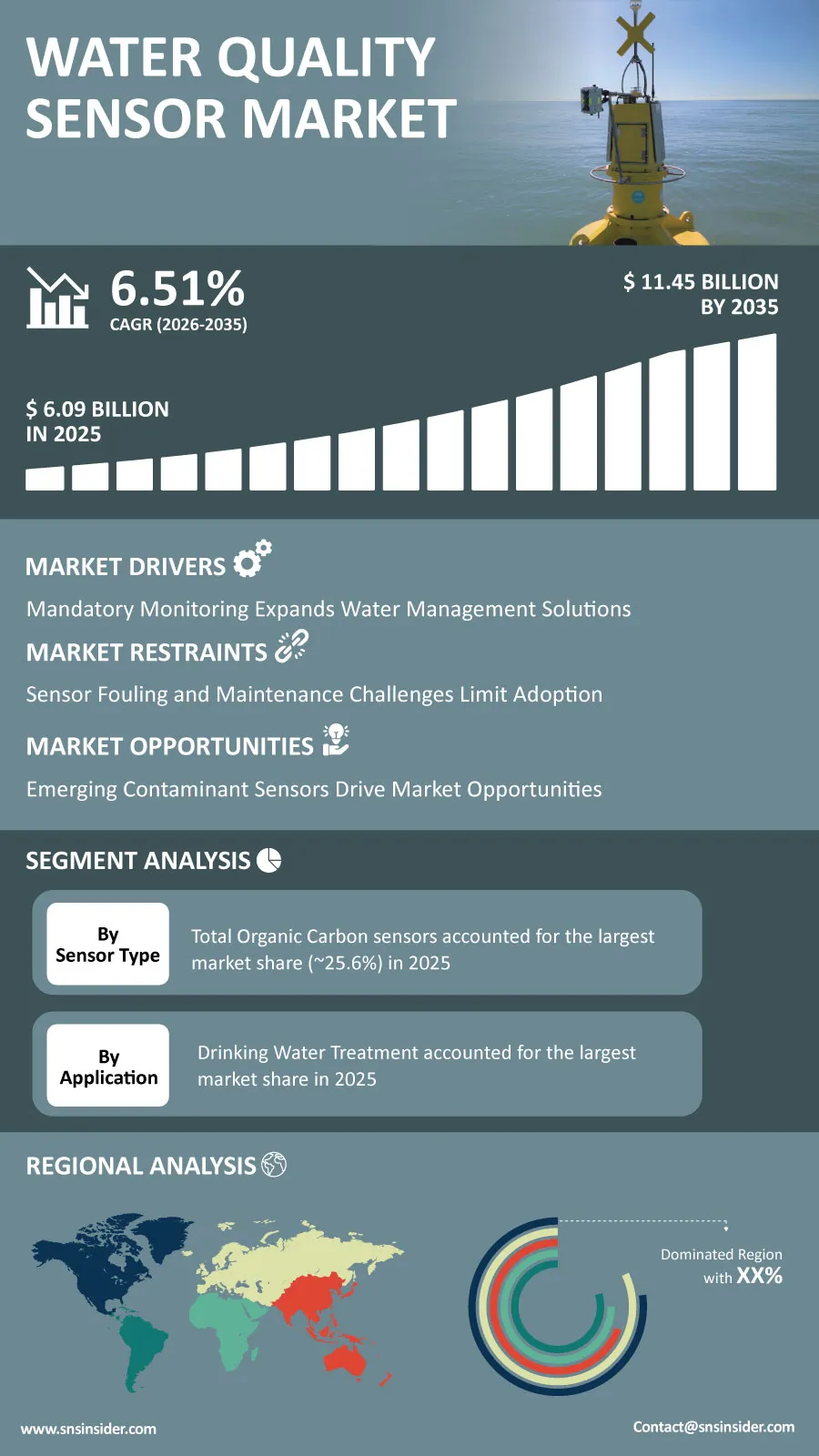
The global Water Quality Sensor Market is spanning strong momentum as the governments and utilities along with industrial organization are investing to adopt next-generation water monitoring technologies in order to enhance public health, protect natural water resources. “According to a recent study by SNS Insider, the global Water Quality Sensor Market size valued at USD 6.09 billion in 2025, is anticipated to grow to USD 11.45 billion by 2035, registering a CAGR of 6.51% over the 2026–2035 forecast period.”
Increasing freshwater scarcity, rising industrial wastewater discharge, and persistent environmental regulations will promote the ongoing monitoring of global water systems. Employing modern sensor technologies, organizations can acquire accurate information in real-time which aids in a quicker decision analysis, treatment efficacy enhancement and regulatory compliance to change in water quality standards. With growing confluence of digital infrastructure in water management, the need for smart sensing solutions is on the rise across municipal, industrial and environmental applications.
Cloud connectivity, artificial intelligence (AI) and Internet of Things (IoT) technologies are further converting traditional monitoring processes into data-enabled water management systems. These innovations allow utilities and industries to detect abnormalities earlier, schedule maintenance effectively in the timing of equipment failure, enhance operation efficiencies, and ultimately save costs over the longer term.
To Get Detailed Insights on the Water Quality Sensor Market – Request a Sample Report
Digital Water Infrastructure Creates Long-Term Growth Opportunities
There is increased investment by the governments as well as private organizations to invest in digital water infrastructure to address the supply reliability & the Environmental Sustainability. Continuous monitoring systems with cutting-edge sensors assist utilities in rapidly responding to evolving water conditions, bolstering resource efficiency across treatment facilities and distribution networks.
Account executive sectors such as manufacturing, pharmaceuticals, food processing, mining and energy are also implementing smart monitoring platforms to optimise process efficiency and enhance environmental compliance. With the growing demand to monitor emerging contaminants, combined with a focus on sustainable water management is unlocking growth opportunities for advanced sensing technologies worldwide across developed and developing economies.
The recent developments of optical sensing, multi-parameters measurement platforms and automated data analytics yield improving measurement accuracy with less frequented maintenance requirements for large scale approaches.
Key Market Insights Highlight Expanding Adoption Across Applications
By sensor type, Total Organic Carbon (TOC) Sensors accounted for an estimated ~25.6% share of the global market revenue in 2025 with wide usage in drinking water treatment, industrial process monitoring and environmental compliance. Under constant disinfection monitoring at point-of-use (POU) or throughout other points within water distribution systems, Chlorine Residual Sensors are expected to achieve the most rapid growth through 2035.
Based on application, Drinking Water Treatment dominated the share of market in 2025, which is mainly due to the expansion of regulatory requirements for continuous water quality monitoring. Rapid growth in the Wastewater Management segment over the forecast period is expected to be driven by investments in advanced treatment infrastructure from both industries and municipalities.
By end user, Municipal organizations accounted for the largest market share in 2025 in revenue attributed to their wide scale deployment across public water utilities and treatment facilities. The industrial segment, however, is expected to have the fastest growth through 2035 in large part because enterprise companies are increasingly turning towards real-time monitoring to optimize operational performance and environmental stewardship.
Advanced Sensor Technologies Reshape Water Monitoring Systems
Harnessing technical innovation to reimagine modern water quality monitoring solutions. Developments have led to the launch of multi-parameter sensing platforms that can allow for real-time measurement of several water quality characteristics at a time, reducing infrastructure complexity and improving operational efficiency for manufacturers.
Trends in water quality are now being analyzed more effectively with artificial intelligence, predictive analytics, and cloud-based monitoring platforms that facilitate a proactive response to contamination events. Advances in optical measurement technologies, higher levels of anti-fouling BoP capability, and increased automated calibration functions are prolonging sensor life and decreasing maintenance costs as well.
With the accelerated individualization of digital transformation in the water sector, advanced sensor as an emergent technology are likely become indispensable part of resilient and sustainable water system management.
North America Accounted for the Largest Market Share in 2025; Asia Pacific Forecast to Expand at the Fastest CAGR by 2035
The global Water Quality Sensor Market was led by North America in 2025. As a result of advanced water infrastructure, stringent environmental laws and widespread adoption of intelligent monitoring technologies. Solid investment into safe drinking water, industrial compliance and smart utility modernization has been further strengthening regional demand.
Asia-Pacific is projected to grow at the highest rate till 2035 as rapid urbanization, industrial growth and growing concerns about water security drive investment in digital monitoring solutions. China and India large scale water treatment capacity expansion with implementation of advanced technology for better management of the limited resource.
Europe maintains its consistent market growth with strict environmental regulations and high industrial monitoring requirements. On the other hand, Latin America and Middle East & Africa are increasing adoption of water quality monitoring technologies to counterchallenge failures in infrastructure development, industrialization and water scarcity.
Industry Participants Accelerate Innovation Through Intelligent Monitoring Solutions
The dynamics within this environment continue to be extremely high due to the fact that technology providers are concentrating on increasing the capabilities of the sensors and connectivity as well as improving analytical performance. The firms are developing research and development initiatives to develop the next generation monitoring systems.
Key companies operating in the global Water Quality Sensor Market include Xylem Inc., Thermo Fisher Scientific Inc., Danaher Corporation, HORIBA, Ltd., Yokogawa Electric Corporation, Emerson Electric Co., ABB Ltd., Siemens AG, Endress+Hauser Group, Hach Company, Honeywell International Inc., Evoqua Water Technologies, Teledyne Technologies Incorporated, Swan Analytical Instruments AG, Badger Meter, Inc., Analytical Technology, Inc. (ATI), Campbell Scientific, Inc., Pentair plc, Aqua Metrology Systems Ltd., and Real Tech Inc.
An SNS Insider analyst Santosh Bhul commented, “The growing emphasis on water sustainability, digital infrastructure modernization, and real-time environmental monitoring is creating substantial opportunities for advanced water quality sensing technologies. Organizations investing in intelligent monitoring platforms, connected analytics, and innovative sensor solutions are expected to strengthen their competitive position as global demand for safe and efficient water management continues to increase.”
About the Author

Get in touch