
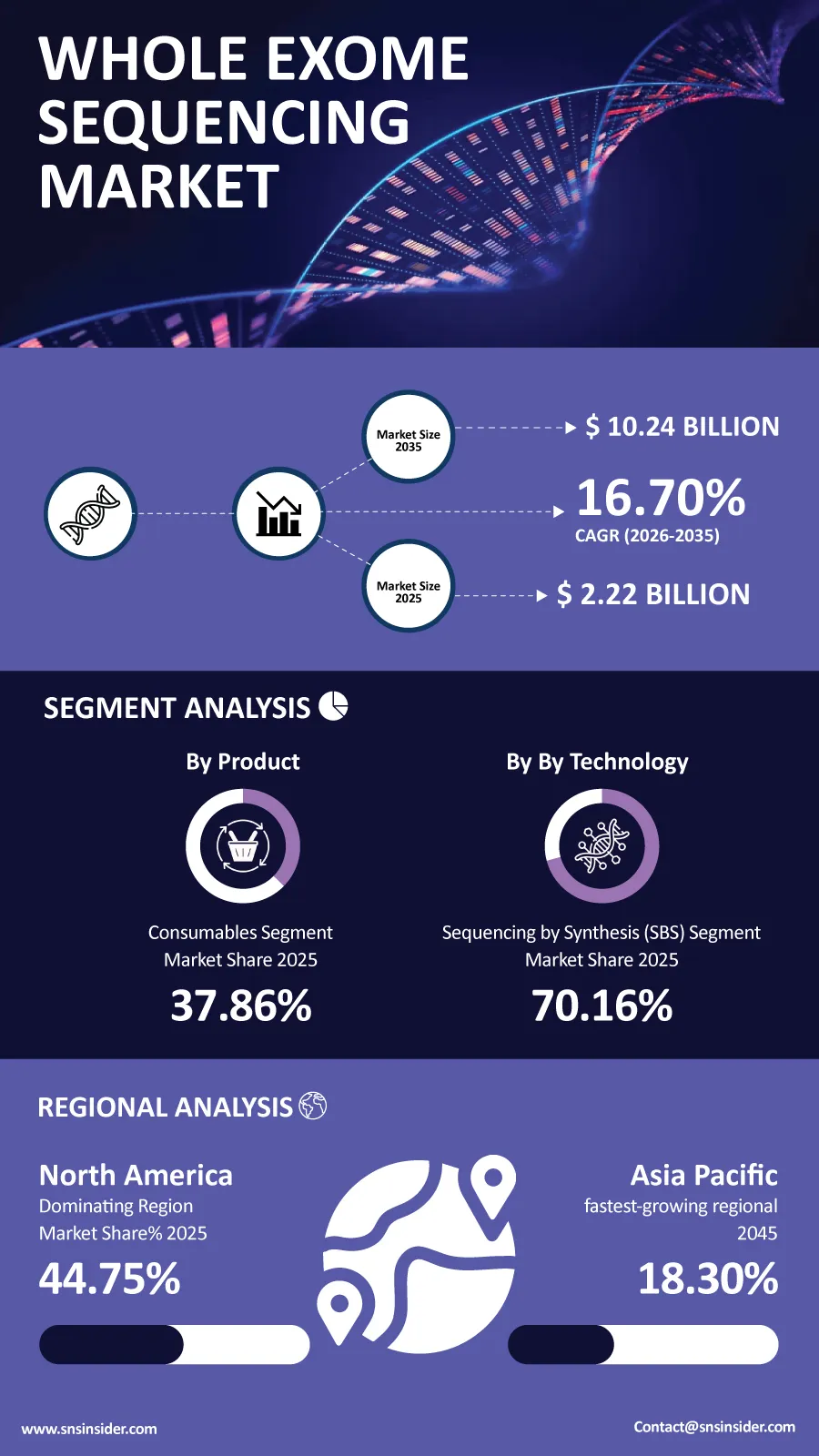
The global Whole Exome Sequencing (WES) Market is poised for exceptional growth as healthcare systems increasingly integrate genomic technologies into clinical practice, biomedical research, and personalized treatment strategies. “According to a recent study by SNS Insider, the global Whole Exome Sequencing Market size valued at USD 2.22 billion in 2025, is anticipated to grow to USD 10.24 billion by 2035, registering a CAGR of 16.70% over the 2026–2035 forecast period.”
Increasing usage of genomic medicine for the purpose of disease diagnosis and treatment planning has been revolutionizing the healthcare field on a global scale. Scientists and healthcare providers are making use of whole exome sequencing in order to derive clinically useful information related to genetics, which helps in early disease diagnosis and personalized treatment plan development.
Growing investments in genomic research, precision healthcare initiatives, and next-generation sequencing infrastructure are further strengthening adoption across hospitals, academic institutions, biotechnology companies, and specialized diagnostic laboratories.
To Get Detailed Insights on the Whole Exome Sequencing Market – Request a Sample Report
Genomic Innovation Expands Clinical Possibilities
Sequencing techniques advancements, automation in laboratories, and AI-powered genome analysis are revolutionizing the process of creation and analysis of genetic information. The development of such innovations allows healthcare specialists to provide more timely and detailed information from genomics analysis along with higher productivity of laboratories.
The rise in the use of cloud-based solutions for bioinformatics analysis is assisting in collaborative scientific researches, safe storage of genomic data, and more efficient interpretation of sequencing. With the growth of precision medicine programs in the healthcare field, whole exome sequencing will become a crucial element of genome diagnostics.
Increasing attention towards targeted treatments and personalized health care will also contribute to the growth of the use of whole exome sequencing clinically.
Key Market Findings Highlight Strong Growth Potential
Among product categories, consumables accounted for 37.86% of global market revenue in 2025, reflecting sustained demand for sequencing kits, reagents, and laboratory supplies required for routine genomic testing.
By technology, Sequencing by Synthesis (SBS) represented 70.16% of total market revenue in 2025, maintaining its leadership through broad adoption across clinical and research applications. Meanwhile, nanopore sequencing is expected to emerge as the fastest-growing technology segment through 2035, supported by increasing demand for rapid, portable, and real-time genomic analysis.
Application trends continue to evolve as genomic testing expands across healthcare. Cancer diagnostics accounted for 33.51% of market revenue in 2025, underscoring the growing importance of genomic profiling in oncology. At the same time, personalized medicine is anticipated to record the strongest growth during the forecast period, driven by increasing utilization of genomic information to support individualized treatment decisions.
On the basis of academic institutions, academic and research institutes represented 41.39% of total market revenue in 2025, supported by extensive genomics research and collaborative scientific initiatives. In addition, sequencing activities accounted for 45.45% of market revenue, highlighting their central role within the overall genomic analysis workflow.
Precision Medicine Continues to Drive Market Expansion
The world’s healthcare systems are adopting personalized techniques, which incorporate the use of genetics in order to enhance the process of disease prevention, diagnosis, and therapeutic intervention. Whole exome sequencing is increasingly becoming a valuable technique for detecting clinical genetic variations in various fields including oncology, genetic conditions, reproduction, and pharmacogenomics.
Collaboration between healthcare professionals, research organizations, biotech companies, and drug manufacturers is enhancing the pace at which genomics technologies are being adopted.
Regional Markets Present Significant Opportunities
North America was the dominant regional market for 44.75% share of revenue globally in 2025, owing to advanced healthcare systems, well-developed genomics research capacity, and widespread adoption of precision medicines. The robust efforts toward development of innovations in biotechnology and the application of next-generation sequencing are contributing to North America being the dominant regional market.
Furthermore, the Asia-Pacific region is expected to be the most rapidly growing regional market, having a CAGR of 18.30% over 2035. There will be many opportunities for the growth of the region due to increasing investment in healthcare, expansion of genomics research, development of biotechnology industry, and availability of advanced sequencing.
Industry Leaders Continue to Accelerate Innovation
Competition within the Whole Exome Sequencing market remains dynamic as leading genomics companies continue investing in sequencing platforms, bioinformatics capabilities, automation technologies, and strategic collaborations aimed at expanding clinical adoption globally.
Key companies operating in the global Whole Exome Sequencing market include Illumina, Thermo Fisher Scientific, Agilent Technologies, Roche, QIAGEN, BGI Genomics, Oxford Nanopore Technologies, Pacific Biosciences, Eurofins Genomics, and Personalis.
An SNS Insider analyst Parry Kardani commented, "The convergence of advanced sequencing technologies, artificial intelligence, and precision medicine is reshaping genomic healthcare worldwide. As clinical adoption continues to expand across oncology, rare diseases, and personalized medicine, whole exome sequencing is expected to become an increasingly valuable component of routine medical practice."
About the Author

Get in touch




