
Whole Exome Sequencing Market Report Scope & Overview:
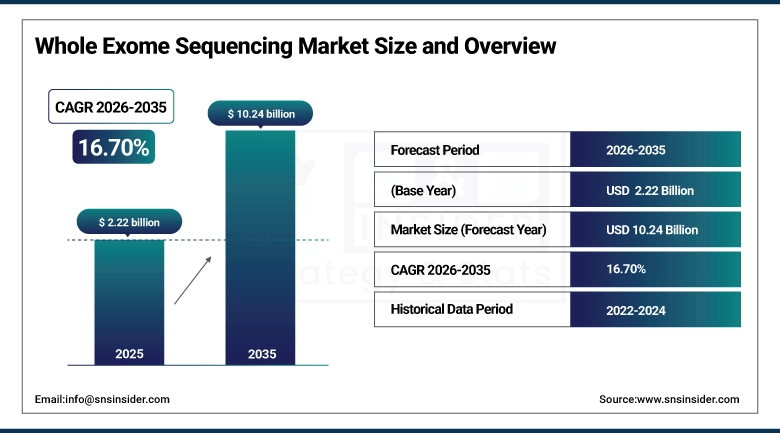
The Whole Exome Sequencing Market was valued at USD 2.22 billion in 2025 and is expected to reach USD 10.24 billion by 2035, growing at a CAGR of 16.70% from 2026-2035.
The Whole Exome Sequencing (WES) Market is experiencing considerable growth due to the rising popularity of genomic-based health care, growing use of precision medicine in clinical settings, and growing preference for cost-effective genetic tests. Innovations and breakthroughs in next-generation sequencing technologies, automation, and AI-based bioinformatics are playing a key role in enhancing sequencing efficiency and data analysis. Applications in oncology, rare genetic disorders, pharmacogenomics, and drug discovery are some of the important driving factors contributing to the growth of this market.
Supporting this trend, the increasing global burden of genetic disorders and cancer continues to accelerate demand for advanced genomic diagnostics. According to the U.S. National Cancer Institute (NCI), millions of new cancer cases are diagnosed annually, with oncology remaining one of the largest application areas for genomic sequencing-based testing.
In addition, regulatory and institutional support is strengthening the adoption of genomic medicine. The U.S. Food and Drug Administration (FDA) and global health agencies are increasingly supporting next-generation sequencing (NGS)-based diagnostic approvals and companion diagnostic frameworks, enabling faster clinical translation of genomic data.
To Get more information on Whole Exome Sequencing Market - Request Free Sample Report
Whole Exome Sequencing Market Trends:
-
Rising adoption of precision medicine is significantly increasing the use of Whole Exome Sequencing (WES) in clinical decision-making and targeted therapy selection.
-
Rapid advancements in next-generation sequencing (NGS) technologies are improving sequencing speed, accuracy, and cost efficiency, making WES more accessible.
-
Integration of AI and machine learning in bioinformatics is enhancing genomic data interpretation and accelerating diagnostic insights.
-
Expanding applications of WES in oncology, rare disease diagnosis, and pharmacogenomics are driving consistent demand growth.
-
Increasing shift from whole genome sequencing (WGS) to WES for cost-effective and clinically actionable genetic testing is strengthening market penetration.
-
Growing use of cloud-based genomic data platforms is supporting large-scale data storage, sharing, and collaborative research.
-
Rising investments in genomics research and national precision medicine initiatives are boosting clinical and academic adoption of WES.
-
Increasing regulatory support for NGS-based diagnostics is facilitating faster commercialization of exome sequencing tests.
-
Expansion of personalized healthcare and companion diagnostics is further reinforcing the clinical relevance of WES across healthcare systems.
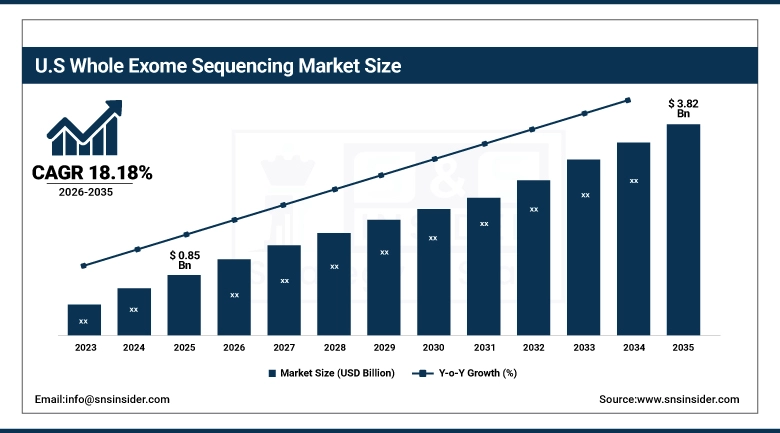
U.S. Whole Exome Sequencing Market was valued at USD 0.85 billion in 2025 and is expected to reach USD 3.82 billion by 2035, growing at a CAGR of 18.18% from 2026-2035.
The U.S. Whole Exome Sequencing Market is the biggest in the world, owing to its well-developed healthcare and biotechnology sector, well-established genomic research capabilities, and a robust market for sequencing technologies and bioinformatics companies. It enjoys substantial funding from NIH and is well known for its use of precision medicine programs and the application of genomics in clinical diagnostics in oncology and rare diseases.
Supporting this trend, the increasing prevalence of genetic disorders and cancer in the United States is significantly driving demand for Whole Exome Sequencing (WES)-based diagnostics. According to the U.S. Centers for Disease Control and Prevention (CDC), rare diseases collectively affect an estimated 25–30 million Americans, with a large proportion remaining undiagnosed without advanced genomic testing such as exome sequencing.
In addition, strong institutional and regulatory support from the U.S. Food and Drug Administration (FDA) and the Centers for Medicare & Medicaid Services (CMS) is accelerating clinical adoption of next-generation sequencing (NGS) technologies. FDA’s growing approvals of NGS-based diagnostic tests and companion diagnostics, along with expanding CMS reimbursement coverage for genetic testing in oncology and rare disease management, are reinforcing the integration of whole exome sequencing into routine clinical workflows.
Whole Exome Sequencing Market Segment Highlights:
-
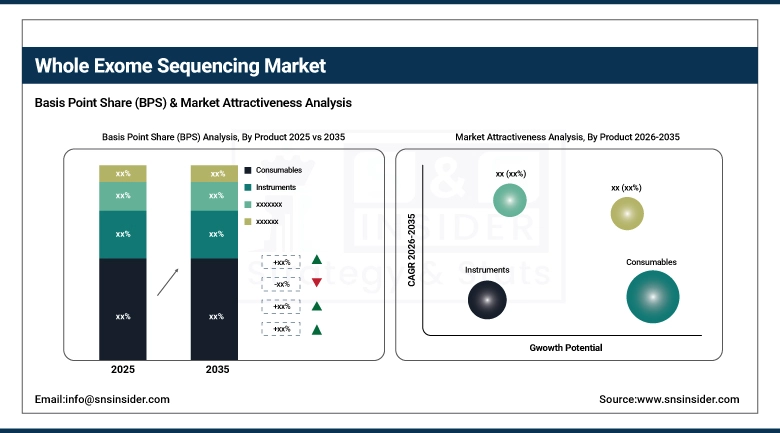
By Product, Consumables dominated the Whole Exome Sequencing Market with 37.86% share in 2025; Software & Bioinformatics Solutions Robotics fastest growing (CAGR).
-
By Technology, Sequencing by Synthesis (SBS) dominated the Whole Exome Sequencing Market with 70.16% share in 2025; Nanopore Sequencing fastest growing (CAGR).
-
By Application, Cancer Diagnostics dominated the Whole Exome Sequencing Market with 33.51% share in 2025; Personalized Medicine fastest growing (CAGR).
-
By End User, Academic & Research Institutes dominated the Whole Exome Sequencing Market with 41.39% share in 2025; Hospitals & Clinics fastest growing (CAGR).
-
By Workflow, Sequencing dominated the Whole Exome Sequencing Market with 45.45% share in 2025; Data Analysis & Interpretation fastest growing (CAGR).
Whole Exome Sequencing Market Segment Analysis:
By Product, Consumables segment dominates the Whole Exome Sequencing Market, while Software & Bioinformatics Solutions segment is expected to grow fastest
In 2025, the Consumables segment held its leading market share position in the Whole Exome Sequencing (WES) Market, contributing around 37.86% of the total market size. This segment covers sequencing kits, reagents, library preparation kits, assay panels, and other consumable supplies used in each sequencing process.
From 2026 to 2035, the Software & Bioinformatics Solutions segment is expected to experience the highest CAGR in terms of growth. The increasing need for sophisticated bioinformatics software to handle the ever-growing amount of data produced from whole exome sequencing contributes significantly to this trend.
By Technology, Sequencing by Synthesis (SBS) dominates the Whole Exome Sequencing Market, while Nanopore Sequencing is the fastest growing segment
Sequencing by Synthesis (SBS) held on to its dominant market share position in the whole exome sequencing (WES) market in 2025, with an approximate revenue market share of 70.16%. SBS technology is still the most prevalent technology in use owing to its high accuracy, scalability, and integration capabilities in terms of using established next-generation sequencing (NGS).
Between 2026 and 2035, Nanopore Sequencing will register the highest CAGR. Nanopore sequencing technology will see its adoption rate grow due to factors such as the availability of real-time sequencing, portability, and its ability to produce long reads with minimal sample preparation.
By Application, Cancer Diagnostics dominates the Whole Exome Sequencing Market, while Personalized Medicine is the fastest growing segment
In 2025, the Cancer Diagnostics application segment had the leading market share in the Whole Exome Sequencing market, contributing around 33.51% to the overall revenue pool. Factors such as the increasing deployment of exome sequencing for profiling tumors, identifying mutations, and choosing treatments in oncology are fueling the application segment's dominance in the market.
Between 2026 and 2035, Personalized Medicine will witness the highest CAGR. This can be attributed to the growing role of genetic information in devising personalized medicines and choosing medications for patients. Additionally, the growing adoption of pharmacogenomics, increasing demand for targeted therapies, and the emergence of clinical decision support systems based on artificial intelligence are boosting WES applications in personalized medicine.
By End User, Academic & Research Institutes dominate the Whole Exome Sequencing Market
In 2025, Academic & Research Institutes accounted for approximately 41.39% of total revenue, maintaining their dominant position in the WES Market. This leadership is attributed to extensive genomic research activities, government-funded initiatives, and large-scale sequencing projects focused on understanding genetic diseases and population genomics.
By Workflow, Sequencing dominates the Whole Exome Sequencing Market
The Sequencing category occupied the market leadership position in 2025, generating about 45.45% of the overall revenue. The Sequencing segment refers to the essential process in the WES pipeline, where the DNA code is broken down to produce raw genomic information. It was dominated by the increased adoption of next-generation sequencing technology due to the growing requirement for large-scale genomic sequencing studies.
Regional Analysis:
|
Region |
Major Country |
Share within Region (%) |
|---|---|---|
|
North America |
United States |
44.75% |
|
Europe |
Germany |
26.43% |
|
Asia Pacific |
China |
20.58% |
|
Middle East & Africa |
UAE |
3.47% |
|
Latin America |
Brazil |
4.77% |
North America Whole Exome Sequencing Market Insights
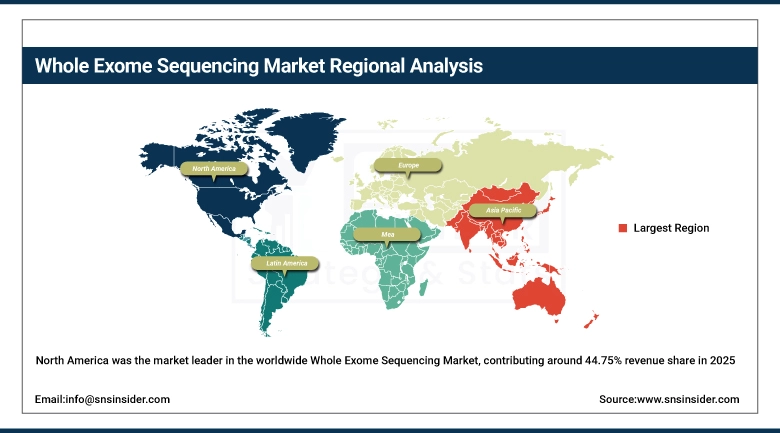
North America was the market leader in the worldwide Whole Exome Sequencing Market, contributing around 44.75% revenue share in 2025, due to the highly sophisticated genomics and healthcare ecosystem, significant contribution from major sequencing technology vendors, and widespread utilization of precision medicine in healthcare settings. North America is home to numerous academic institutions, hospitals, and biotech firms that collaborate extensively with one another and are involved in various projects involving whole exome sequencing, thereby ensuring accelerated uptake of WES.
Supporting this dominance, the U.S. Centers for Medicare & Medicaid Services (CMS) and other federal health agencies have increasingly expanded coverage for next-generation genomic testing, including Whole Exome Sequencing (WES) in oncology, rare disease diagnosis, and pediatric genetic disorders.
According to data from leading U.S.-based genomic research networks, millions of sequencing-based diagnostic tests are now being performed annually, with Whole Exome Sequencing playing a critical role in identifying rare genetic variants and guiding targeted treatment strategies. This strong institutional support and high-volume clinical adoption further solidify North America’s leadership in the global WES market.
Get Customized Report as per Your Business Requirement - Enquiry Now
Asia Pacific Whole Exome Sequencing Market Insights
The Asia-Pacific region is expected to have the highest CAGR of 18.30% for 2026 to 2035 in the global Whole Exome Sequencing (WES) market, due to growing infrastructure for genomic health care services, increasing applications of precision medicine, growing incidence of genetic disorders, and increased investments from the government for biotech and life sciences industries. Countries such as China, Japan, India, South Korea, and Australia are seen as major growth centers for the market, with China contributing around 55% of regional revenues. Other factors that aid in the growth of this region include increased demand for economic genetic diagnostics, a high number of patients, and the need for early disease diagnosis through sequencing technology.
Supporting this growth, China’s National Development and Reform Commission (NDRC) has prioritized genomics, biotechnology, and next-generation sequencing technologies under its national strategic emerging industries plan, providing significant funding for domestic innovation in genomic medicine, research infrastructure, and large-scale population sequencing initiatives.
In addition, Japan’s Ministry of Health, Labour and Welfare (MHLW) has expanded reimbursement support for genomic testing and next-generation sequencing-based diagnostics, strengthening the integration of Whole Exome Sequencing into clinical practice.
Europe Whole Exome Sequencing Market Insights
In the WES market globally, the Europe region was the second highest revenue contributor, representing about significant share. The factors supporting this were robust healthcare infrastructure, national genomics initiatives, and the adoption of precision medicine within their respective health systems. Some of the country’s leading in the adoption of the product include Germany, the UK, France, Italy, and the Netherlands, with advanced research organizations and centralized health care services and the application of NGS in areas like cancer diagnostics and population genomics studies.
In addition, national genomics programs such as the United Kingdom’s 100,000 Genomes Project, along with expanding reimbursement support for genetic testing in countries like Germany and France, are further reinforcing clinical adoption. The implementation of the EU’s stringent regulatory frameworks for in-vitro diagnostics, including the In Vitro Diagnostic Regulation (IVDR 2017/746), is also enhancing test standardization, data reliability, and clinical confidence, thereby supporting sustained market growth across the region.
Middle East & Africa and Latin America Whole Exome Sequencing Market Insights
The Middle East & Africa (MEA) and Latin America regions are witnessing steady but incremental growth in the Whole Exome Sequencing (WES) Market, supported by rising healthcare investments, expanding genomic research capabilities, improving diagnostic infrastructure, and increasing awareness of precision medicine and advanced genetic testing. Although adoption levels remain lower compared to developed regions, both markets are gradually integrating next-generation sequencing (NGS) technologies into academic research centers, tertiary hospitals, and specialized diagnostic laboratories. In Latin America, Brazil has emerged as a key hub with national genomics initiatives and growing collaborations between universities, biotech firms, and hospitals, driving adoption of WES in cancer diagnostics and rare disease research.
Supporting this development, Saudi Arabia’s Ministry of Health has launched major healthcare modernization initiatives focused on expanding specialized diagnostic services, including genetic testing and precision oncology programs across leading hospitals.
In Latin America, Brazil and Mexico are emerging as key growth markets, supported by gradual improvements in healthcare infrastructure and increasing participation in genomic research programs. Regulatory support from Brazil’s national health regulatory agency, ANVISA (Agência Nacional de Vigilância Sanitária), is facilitating the approval of advanced diagnostic technologies, including NGS-based testing solutions.
Whole Exome Sequencing Market Growth Drivers:
-
Rising adoption of precision medicine, early disease detection, and targeted diagnostics driving global demand for Whole Exome Sequencing (WES)
The fundamental shift in healthcare from symptom-based treatment toward genomics-driven precision medicine is the most powerful structural growth driver for the WES market. Clinicians and researchers are increasingly relying on whole exome sequencing to identify disease-causing genetic variants, enabling early diagnosis, personalized treatment selection, and improved patient outcomes. The growing integration of WES into oncology, rare disease diagnosis, reproductive genetics, and pharmacogenomics is significantly expanding its clinical utility. Healthcare systems are increasingly adopting genomic testing as part of routine diagnostic pathways to reduce diagnostic odyssey time and improve therapeutic accuracy.
Supporting this growth, the U.S. National Institutes of Health (NIH) through initiatives such as the All of Us Research Program is actively accelerating large-scale genomic data collection and precision medicine research, enabling broader clinical use of sequencing-based diagnostics.
In addition, the World Health Organization (WHO) recognizes that genetic disorders and cancer represent a significant and growing global health burden, with millions of patients remaining undiagnosed due to limited access to advanced genomic diagnostics.
Whole Exome Sequencing Market Restraints:
-
High costs associated with whole exome sequencing workflows and limited reimbursement coverage restricting widespread clinical adoption globally
The substantial cost burden of Whole Exome Sequencing (WES), including sequencing reagents, library preparation kits, bioinformatics infrastructure, and specialized data interpretation services, represents a key restraint on market expansion. Despite declining sequencing costs over the past decade, WES remains relatively expensive for routine diagnostic use in many healthcare systems, particularly in low- and middle-income countries. Additionally, the need for highly skilled geneticists and bioinformatics specialists further increases operational costs, limiting adoption in smaller hospitals and diagnostic laboratories.
Whole Exome Sequencing Market Opportunities:
-
Expanding adoption of AI-driven bioinformatics platforms and cloud-based genomic analytics creating significant growth opportunities for Whole Exome Sequencing (WES) market expansion
The next major growth opportunity in the WES market is centered on the rapid evolution of artificial intelligence (AI), machine learning, and cloud computing technologies that are transforming genomic data interpretation and clinical decision-making. As whole exome sequencing generates large and complex datasets, there is a growing need for advanced computational tools capable of rapidly identifying clinically actionable genetic variants. AI-powered bioinformatics platforms are significantly improving variant calling accuracy, disease association mapping, and predictive diagnostics, thereby enhancing the overall clinical utility of WES.
Recent Developments:
-
2026: Illumina expanded its next-generation sequencing (NGS) ecosystem with enhanced high-throughput sequencing platforms and upgraded bioinformatics pipelines, focusing on improving turnaround time and accuracy for clinical whole exome sequencing applications. The company also strengthened its global clinical genomics partnerships, supporting broader adoption of precision oncology and rare disease testing programs across North America, Europe, and Asia Pacific.
-
2025: Thermo Fisher Scientific advanced its genomic solutions portfolio by expanding the availability of its Ion Torrent sequencing systems and upgrading its clinical sequencing workflows for improved scalability and cost efficiency. The company also strengthened its Precision Medicine initiatives through expanded collaborations with hospitals and research institutions, supporting increased integration of whole exome sequencing into oncology and inherited disease diagnostics globally.
-
2025: Agilent Technologies enhanced its SureSelect portfolio with improved exome capture kits and expanded NGS target enrichment solutions designed for higher accuracy and lower input DNA requirements. The company also strengthened its clinical genomics offerings through expanded partnerships with diagnostic laboratories, enabling faster and more efficient whole exome sequencing workflows in cancer and rare disease research applications.
-
2025: Roche advanced its sequencing and diagnostics ecosystem through continued development of its Roche Sequencing Solutions portfolio, focusing on improved sample preparation, automation, and integrated bioinformatics solutions. The company also expanded its presence in clinical genomics by supporting large-scale precision medicine initiatives and strengthening collaborations with healthcare providers to accelerate adoption of next-generation sequencing (NGS)-based diagnostics, including whole exome sequencing for oncology and genetic disease applications.
Whole Exome Sequencing Market Key Players:
-
Thermo Fisher Scientific
-
Roche
-
BGI Genomics
-
PerkinElmer
-
Macrogen
-
Eurofins Genomics
-
Oxford Nanopore Technologies
-
Pacific Biosciences
-
Bio-Rad Laboratories
-
Integrated DNA Technologies
-
Twist Bioscience
-
GATC Biotech
-
Novogene
-
PierianDx
-
WuXi AppTec
-
Genewiz (Azenta Life Sciences)
-
Personalis
Whole Exome Sequencing Market Report Scope:
| Report Attributes | Details |
|---|---|
| Market Size in 2025 | USD 2.22 Billion |
| Market Size by 2035 | USD 10.24 Billion |
| CAGR | CAGR of 16.70% From 2026 to 2035 |
| Base Year | 2025 |
| Forecast Period | 2026-2035 |
| Historical Data | 2022-2024 |
| Report Scope & Coverage | Market Size, Segments Analysis, Competitive Landscape, Regional Analysis, DROC & SWOT Analysis, Forecast Outlook |
| Key Segments | • By Product (Consumables, Instruments, Services, Software & Bioinformatics Solutions, Others), • By Technology (Sequencing by Synthesis (SBS), Ion Semiconductor Sequencing, Nanopore Sequencing, SMRT Sequencing, Others), • By Application (Cancer Diagnostics, Rare Disease Diagnosis, Personalized Medicine, Drug Discovery & Development, Others), • By End User (Academic & Research Institutes, Hospitals & Clinics, Pharmaceutical & Biotechnology Companies, Diagnostic Laboratories, Others), • By Workflow (Sequencing, Sample Preparation, Library Preparation, Data Analysis & Interpretation, Others) |
| Regional Analysis/Coverage | North America (US, Canada), Europe (Germany, UK, France, Italy, Spain, Russia, Poland, Rest of Europe), Asia Pacific (China, India, Japan, South Korea, Australia, ASEAN Countries, Rest of Asia Pacific), Middle East & Africa (UAE, Saudi Arabia, Qatar, South Africa, Rest of Middle East & Africa), Latin America (Brazil, Argentina, Mexico, Colombia, Rest of Latin America). |
| Company Profiles | Illumina, Thermo Fisher Scientific, Agilent Technologies, Roche, QIAGEN, BGI Genomics, PerkinElmer, Macrogen, Eurofins Genomics, Oxford Nanopore Technologies, Pacific Biosciences (PacBio), Bio-Rad Laboratories, Integrated DNA Technologies (IDT), Twist Bioscience, GATC Biotech (Eurofins), Novogene, PierianDx, WuXi AppTec, Genewiz (Azenta Life Sciences), Personalis. |
Frequently Asked Questions
North America dominated the Whole Exome Sequencing Market in 2025.
The Sequencing segment dominated the Whole Exome Sequencing Market in 2025.
The major growth factor driving the market is the rising demand for precision medicine, targeted diagnostics, provides comprehensive genetic insights at lower cost compared to whole genome sequencing.
The Whole Exome Sequencing Market was valued at USD 2.22 billion in 2025.
The Whole Exome Sequencing Market is expected to grow at a CAGR of 16.70% from 2026 to 2035.
