
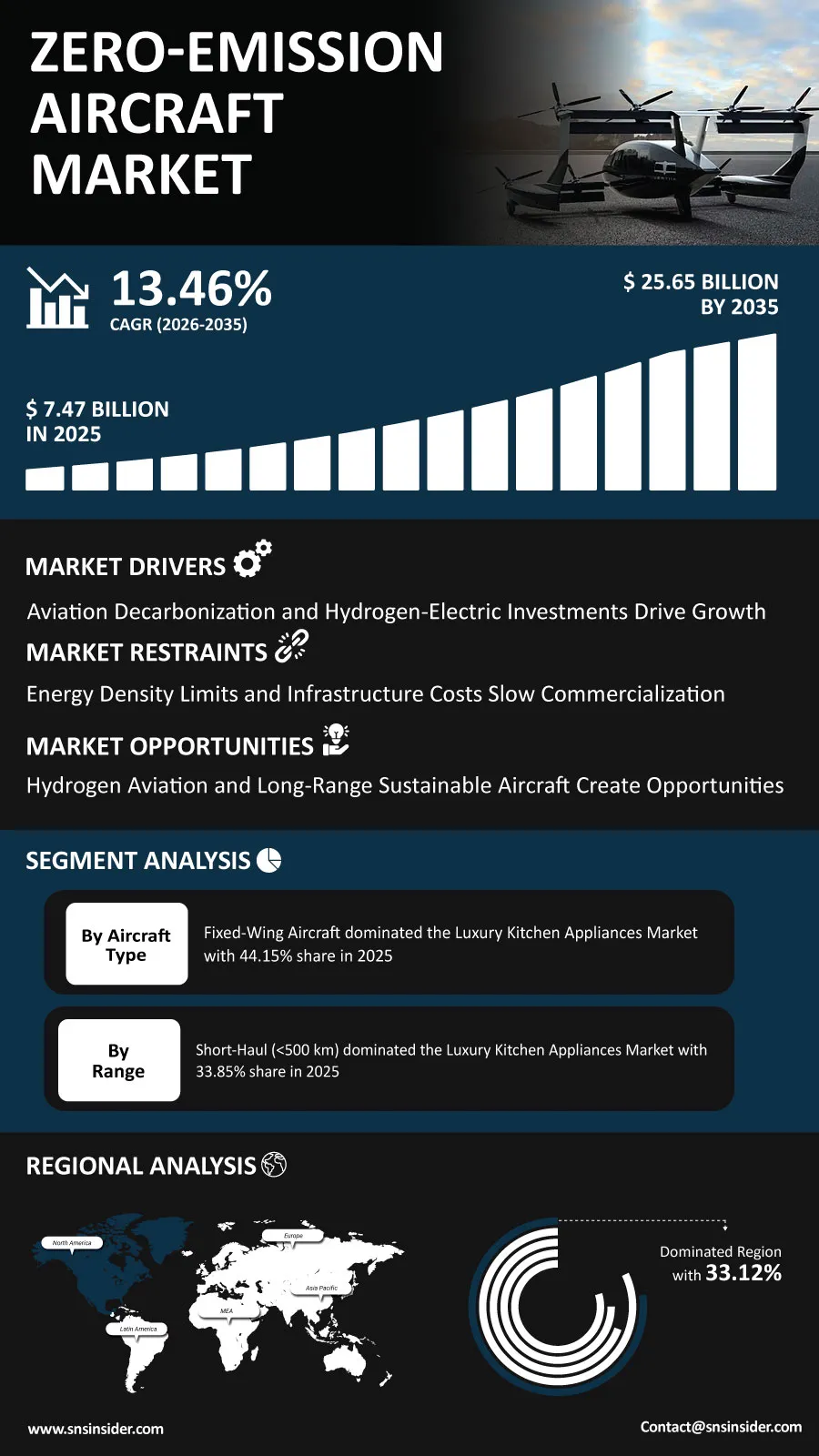
The global Zero-emission Aircraft Market is moving toward a major transformation as aerospace companies, airlines, governments, and technology developers accelerate efforts to reduce aviation-related emissions. “According to a recent study by SNS Insider, the global Zero-emission Aircraft Market size valued at USD 7.47 Billion in 2025, is anticipated to grow to USD 25.65 Billion by 2035, registering a CAGR of 13.46% over the 2026–2035 forecast period.”
The aviation sector is becoming more inclined to invest in propulsion technologies that have the capability to either mitigate or completely eliminate any direct emissions during the flight. The battery-powered electric planes are slowly getting into action, especially when flying within shorter distances, and on the other hand, hydrogen-powered propulsion technologies are being designed to tackle the issue of limited ranges presented by the current batteries.
There is also investment taking place that goes beyond just the design of aircrafts. There are airports and aviation authorities who are readying themselves for providing a network for charging, hydrogen storage capacity, and other forms of energy infrastructure that are needed for future commercial purposes.
To Get Detailed Insights on the Zero-emission Aircraft Market – Request a Sample Report
Decarbonization Investments Create New Commercial Opportunities
Pressure from around the globe to minimize carbon footprint in the skies has created several prospects in the long run for aircraft manufacturers and propulsion technology firms. There is growing interest among governments in funding programs that would demonstrate the potential of developing clean aviation networks.
In particular, battery propulsion is very appealing for aircraft that travel relatively short distances and require less power. In turn, hydrogen technology may be viewed as one avenue to expand the capabilities of zero emissions flights further and achieve longer regional flights as the technology improves.
The rise of the advanced air mobility has added yet another aspect to the market. Electric VTOLs are being developed for various purposes including air transportation, airport connections, and city mobility.
Key Market Insights Highlight Shifting Aircraft Technology Demand
By propulsion technology, Battery Electric Aircraft accounted for 38.34% of market revenue in 2025, supported by early commercialization efforts and applications involving shorter missions. Hydrogen Fuel Cell Aircraft are expected to record the fastest growth through 2035 as manufacturers pursue greater range and operating flexibility.
By aircraft type, Fixed-Wing Aircraft represented 44.15% of market revenue in 2025. Meanwhile, Urban Air Mobility (eVTOL) Aircraft is projected to achieve the fastest growth as investments in electric air taxis and supporting mobility infrastructure increase.
Based on range, Short-Haul Aircraft below 500 km held a 33.85% share in 2025. The Medium-Haul 1,500–3,000 km category is anticipated to expand at the fastest pace as propulsion efficiency and hydrogen technologies advance.
By application, Commercial Passenger Transport captured 41.30% of market revenue in 2025, while Urban Air Mobility is expected to experience the strongest growth through 2035.
Hydrogen and Electric Propulsion Accelerate Aviation Transformation
The advancement of technology continues to be key for the commercialization of zero emission aviation. Technological advancements in fuel cell systems, electric motors, power management systems, battery technology, and light-weight materials have aided in improving aircraft capabilities while lowering energy use.
Hydrogen has received notable interest due to its ability to extend the flight range more so than existing battery-electric aircraft platforms. Yet, the success of this technology will need coordinated development of hydrogen production, transport, storage, refueling at airports, and integration on aircraft.
Digital engineering, simulation, autonomy, and advanced manufacturing have also allowed aerospace companies to accelerate aircraft architecture design processes.
North America Accounted for 33.12% Market Share in 2025; Asia Pacific Forecast to Expand at a 14.44% CAGR by 2035
North America held 33.12% of the total global market revenue share in 2025 due to existing aerospace capabilities, research, and growing spending on electric and hydrogen propulsion systems. The United States is still the leading market within North America and there are companies, startups, technology providers and governmental organizations that contribute towards creating sustainable aviation solutions.
Asia Pacific will be showing rapid growth and is projected to grow at a CAGR of 14.44% till 2035. There are countries, such as China, Japan, India, South Korea, Singapore, and Australia that are increasing their spending on advanced mobility, aerospace research, hydrogen technologies and aviation facilities.
The contribution of Europe is very high due to environmental goals set by the governments and the existence of aerospace research. Latin America and Middle East & Africa regions are also growing due to airport renovations and clean energy spending.
Industry Participants Advance Next-generation Aircraft Programs
The competitive landscape is becoming increasingly dynamic as aerospace firms and tech companies seek to engage in partnerships, conduct flight tests, certify and build infrastructure. Companies are focusing on optimizing their engines for fuel efficiency, range, weight savings and commercialization.
Key companies operating in the global Zero-emission Aircraft Market include Airbus SE, Boeing Company, Embraer S.A., ZeroAvia Inc., Universal Hydrogen Co., Joby Aviation Inc., Archer Aviation Inc., Eviation Aircraft Inc., Heart Aerospace AB, Lilium GmbH, H2FLY GmbH, Pipistrel Aircraft (Textron Inc.), magniX Ltd., Rolls-Royce Electrical, Honeywell Aerospace Technologies, Safran S.A., GKN Aerospace, Collins Aerospace, BAE Systems plc, and Vertical Aerospace Ltd.
An SNS Insider analyst Santosh Bhul commented, “The convergence of aviation decarbonization policies, electric propulsion advances, and emerging hydrogen ecosystems is creating a significant opportunity for zero-emission aircraft. Continued progress in aircraft certification, airport infrastructure, and energy technologies will be critical to transforming promising prototypes into scalable commercial aviation solutions.”
About the Author

Get in touch




