
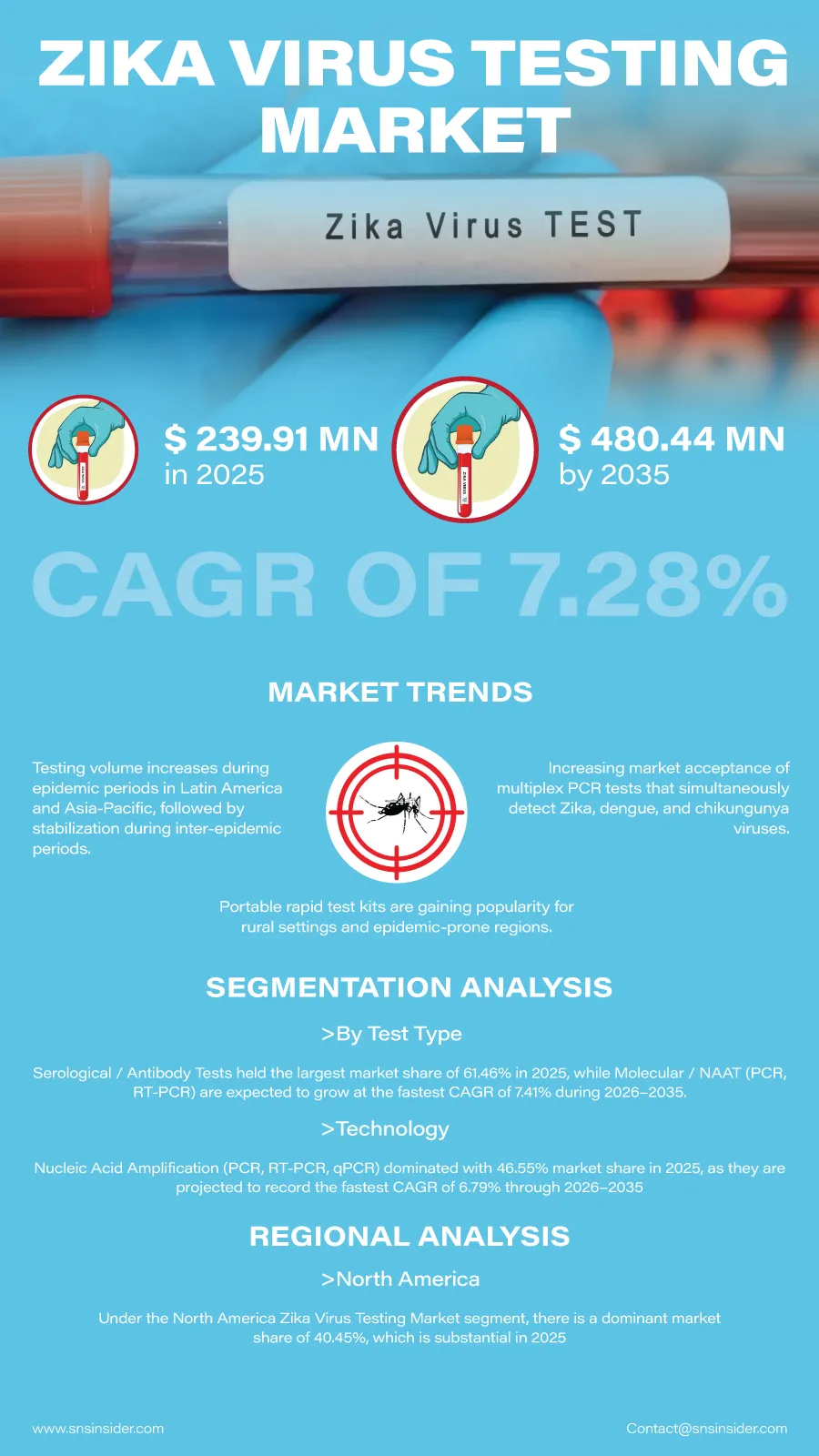
The global Zika Virus Testing Market is expected to witness sustained growth over the coming decade as governments, healthcare providers, and public health organizations strengthen infectious disease surveillance and outbreak preparedness programs. “According to a recent study by SNS Insider, the global Zika Virus Testing Market size valued at USD 239.91 million in 2025, is anticipated to grow to USD 480.44 million by 2035, registering a CAGR of 7.28% over the 2026–2035 forecast period.”
The rising prevalence of diseases transmitted through mosquitoes, as well as advancements made in laboratory facilities and emergency response measures, is propelling the need for state-of-the-art diagnostic methods globally. Health-care organizations have been focusing more on the detection and prevention of such diseases through monitoring programs and quick intervention techniques.
Technological improvements in molecular diagnostics, portable diagnostic devices, and disease surveillance systems are also facilitating the widespread use of next generation test kits in hospitals, diagnostic centers, and public health organizations.
Diagnostic Innovation Strengthens Global Outbreak Preparedness:
The healthcare sector keeps improving their ability to diagnose patients through advanced molecular testing, portable lab facilities, and automated reporting system. This allows for rapid diagnosis of infections while facilitating the coordinated response in case of an outbreak.
The use of field-based diagnostic devices has made testing more accessible in remote and limited-resource settings, enabling medical practitioners to provide accurate test results in areas that are prone to vector-borne diseases. In addition, laboratory information being increasingly integrated into the country’s surveillance system has further enhanced disease monitoring and control measures.
As maternal and neonatal healthcare programs expand worldwide, infectious disease screening is becoming an increasingly important component of preventive healthcare initiatives.
Key Market Findings Highlight Emerging Opportunities:
Among different test types, serology and antibody tests accounted for 61.46% of revenue in 2025 due to their extensive use in routine screening and public health programs.
Simultaneously, molecular and nucleic acid amplification tests (NAATs), such as PCR and RT-PCR tests, are expected to show the fastest growth rate until 2035 and generate a CAGR of 7.41% due to rising demand for precision laboratory testing.
The analysis from a technological perspective shows that the segment of nucleic acid amplification technologies constituted 46.55% of market revenue in 2025 and is also likely to grow fast during the forecast period, showing the CAGR of 6.79% thanks to adoption of advanced molecular diagnostic systems.
Applications analysis suggests that clinical diagnosis was the source of 49.12% of market revenue in 2025, while public health and epidemic surveillance will be the application segments that will show the fastest growth at a CAGR of 6.71%.
Finally, among different end users, hospitals and clinics have taken the lead with 47.72% of revenue in 2025, while diagnostic laboratories will be the ones that will show the highest growth rate at a CAGR of 6.82%.
Public Health Investments Continue to Drive Market Expansion:
Healthcare administrators of various nations are ensuring that preparations for potential infectious diseases are increased by way of better laboratory facilities, disease surveillance systems, and screening programs. This will facilitate easier diagnostic testing while helping deal with health hazards.
Increased cooperation among government bodies, hospitals, and international public health organizations will ensure more advances in disease surveillance, laboratory capabilities, and emergency response planning. Increased efforts on maternal health care, traveler screenings, and infectious disease surveillance are expected to offer many future opportunities to the diagnostic technology industry.
Regional Markets Present Strong Growth Potential:
The North American share of the market was valued at 40.45% in 2025, due to factors such as advanced diagnostic infrastructure, robust public health preparedness initiatives, and increased use of molecular testing platforms. Continuous efforts towards upgrading laboratory facilities and monitoring infectious diseases are some of the major factors driving the market.
Meanwhile, the Asia Pacific region is anticipated to lead the growth rate, with a CAGR of 8.84%, from 2025 to 2035. The region presents ample opportunities for growth, owing to rising investment in healthcare, outbreak preparedness efforts, increased diagnostic facility, and increasing usage of molecular testing systems.
Leading Companies Expand Diagnostic Innovation:
Competition within the Zika virus testing market continues to evolve as manufacturers invest in molecular diagnostics, rapid testing technologies, laboratory automation, and strategic collaborations aimed at improving outbreak response capabilities.
Key companies operating in the global Zika Virus Testing Market include Roche, Abbott Laboratories, Thermo Fisher Scientific, Quest Diagnostics, Eurofins Scientific, Hologic, QIAGEN, bioMérieux, Bio-Rad Laboratories, and Becton Dickinson.
An SNS Insider analyst Parry Kardani commented, "Growing emphasis on infectious disease preparedness, maternal healthcare, and rapid molecular diagnostics is reshaping the global testing landscape. Continued innovation in portable testing platforms and integrated surveillance technologies is expected to support sustained market growth over the coming decade."
About the Author

Get in touch




