
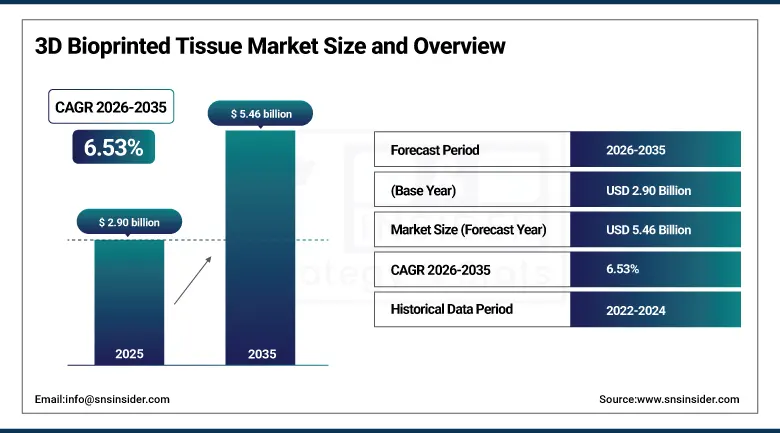
As per the SNS Insider Report titled, 3D Bioprinted Tissue Market By Component, By Technology, By Application, By End User, By Region, And Global Forecast 2026–2035, “The global 3D Bioprinted Tissue Market size valued at USD 2.90 billion in 2025, is anticipated to grow to USD 5.46 billion by 2035, registering a CAGR of 6.53% over the 2026–2035 forecast period.”
Key Takeaways:
- The bioinks component category is anticipated to hold the largest share of nearly 39% in the global market in 2025, owing to their importance in tissue fabrication and scaffolding process.
- The cells category is estimated to experience the fastest growth rate from 2026 to 2035 due to the rapid advancements being made in the field of stem cell technology.
- The extrusion-based technology dominated the technology category, with a 46% share in 2025, on account of their ability to work with multiple materials as well as low-cost nature.
- The laser-assisted bioprinting technology is estimated to record the fastest growth rate over the forecast period due to its high level of precision and improved cell viability.
- The drug discovery & toxicology testing category accounted for nearly 41% share of the global market in 2025, with increasing usage of 3D tissues for improving preclinical study results.
- The regenerative medicine category is projected to be the fastest-growing application area from 2026 to 2035, due to increased research into repairing damaged organs.
- The pharmaceutical and biotechnology companies are anticipated to dominate the end-user category with a market share of nearly 49%, owing to increasing focus on drug screening.
- North America holds the largest regional share of nearly 42.8% in 2025, followed by Asia-Pacific, which is projected to have the highest CAGR during 2026-2035.
Why 3D Bioprinted Tissue Market is Growing?
The 3D bioprinted tissue market is experiencing tremendous growth due to high demands for tissue engineering technologies, increased concerns for alternative methods for animal testing, and increased acceptance of personalized medicine practices. In particular, pharmaceutical organizations have started employing 3D bioprinted tissues as models for conducting drug screening and assessing their potential toxicity in order to increase prediction accuracy and minimize risks of failing clinical trials.
Chronic conditions along with cases of organ damage and failure have led to an increased demand for regenerative medicine techniques and artificial tissues. Furthermore, innovations in the development of new bioinks, advances in stem cells' research, and hardware upgrades have provided more room for innovations within the sector. Universities and organizations focused on biotechnology are increasingly investing in developing and designing tissue models for healing wounds, transplants, and disease simulation.
3D Bioprinted Tissue Market Statistics:
- Over 100,000 patients continue to be on the national transplant waiting list each year according to the U.S. Health Resources & Services Administration, which reflects the increasing demand for alternative tissue engineering approaches.
- The U.S. Food and Drug Administration keeps pushing for alternative preclinical testing strategies to promote drug development processes and minimize the use of animal testing.
- National Institutes of Health reports show that 3D tissue models can provide much higher physiological relevancy than conventional 2D cell cultures.
- Bioprinting is being applied to oncology more frequently, helping to establish tumor models and advance personalized treatments.
- Collaborative work in regenerative medicine research between academic institutions and businesses has been increasing greatly during the last five years, driving innovations in scaffold-free tissue fabrication.
- Increased number of investments in startups developing technologies of bioprinting and organs on a chip has been observed recently.
Emerging Trends:
One significant trend impacting the global market for 3D printed tissue is the use of AI and automation in the process of bioprinting to increase accuracy and consistency. In addition, many companies have begun focusing on the development of advanced bioinks that have high levels of compatibility and vascularization.
Moreover, there is an increased level of focus on personalized tissue constructs made from patient-derived tissues for applications in oncology and regenerative medicine. Moreover, hybrid printing methods are becoming increasingly popular as a means to fabricate complex structures through the combination of various printing processes. Growth in collaborations between industry players and academics, as well as increased organ printing studies, can be expected throughout the forecast period.
Top 10 Companies:
- Organovo Holdings Inc.
- CELLINK
- RegenHU
- Allevi Inc.
- Cyfuse Biomedical K.K.
- Poietis
- EnvisionTEC Inc.
- Aspect Biosystems
- 3D Systems Corporation
- CollPlant Biotechnologies Ltd.
About the Author

Get in touch




