
3D Bioprinted Tissue Market Report Scope & Overview:
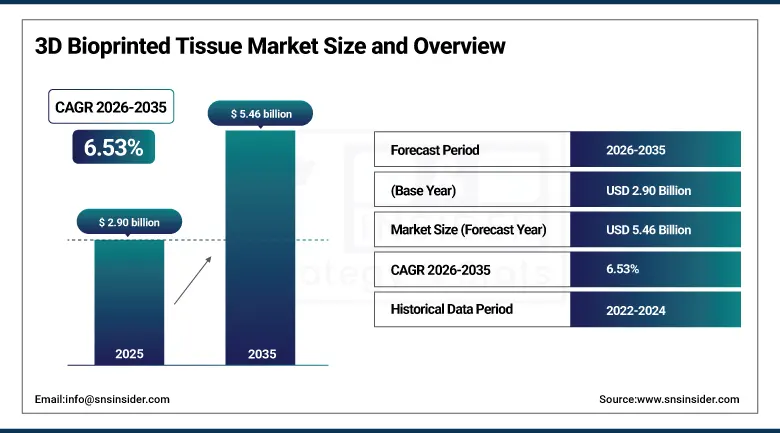
The 3D Bioprinted Tissue Market was valued at USD 2.90 billion in 2025 and is expected to reach USD 5.46 billion by 2035, growing at a CAGR 6.53% from 2026-2035.
The market of 3D bioprinted tissue is advancing at a high pace due to the progress in technology, bioinks and stem cell research. It allows the generation of realistic human tissues for testing drugs, modelling diseases and tissue regeneration. Increased demand for patient-specific treatment, organ substitutes and enhanced preclinical models is driving adoption within a diverse group of pharmaceutical, biotechnology and academic research entities worldwide.
It is expected that by 2025 around 43% of preclinical drug tests and tissue models will be conducted using 3D bioprinted tissues around the world.
3D Bioprinted Tissue Market Size and Forecast
-
Market Size in 2025: USD 2.90 Billion
-
Market Size by 2035: USD 5.46 Billion
-
CAGR: 6.53%
-
Base Year: 2025
-
Forecast Period: 2026-2035
-
Historical Data: 2022-2024
To Get more information on 3D Bioprinted Tissue Market - Request Free Sample Report
Key Trends in the 3D Bioprinted Tissue Market
-
Focus is shifting toward vascularized and functional tissue constructs for more realistic models.
-
AI and automation are improving precision, scalability, and reproducibility in bioprinting.
-
Tissue-specific bioinks are being developed to enhance cell viability and functionality.
-
3D bioprinted tissues are increasingly used for drug discovery and toxicology testing.
-
Strategic collaborations are driving co-development and commercialization of advanced tissue models.
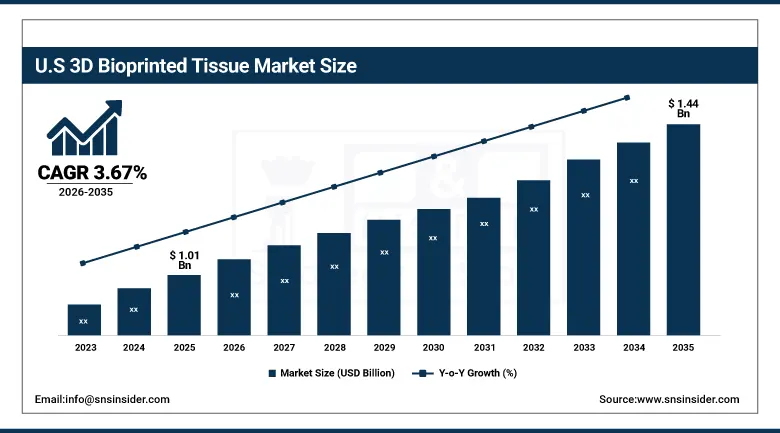
The U.S. 3D Bioprinted Tissue Market is projected to grow from USD 1.01 Billion in 2025 to USD 1.44 Billion by 2035, at a CAGR of 3.67%. Growth is primarily due to the growing adoption of bioprinted tissues in drug discovery, regenerative medicine and as substitutes in personalised medicines.The factors reducing the growth of the bioprinted tissues market are stringent regulations by various government bodies for producing these materials and high R&D cost.
3D Bioprinted Tissue Market Growth Drivers:
-
Rising Demand for Regenerative Medicine and Advanced Drug Testing
Growing need for alternatives to organ transplantation and limitations of conventional 2D cell cultures are major drivers of the 3D bioprinted tissue market. Bioprinted tissues provide physiologically relevant human models that improve drug screening accuracy, reduce failure rates in clinical trials, and minimize reliance on animal testing. Increasing prevalence of chronic diseases, rising investments in regenerative medicine, and expanding pharmaceutical R&D spending are accelerating adoption across research and preclinical applications.
3D Bioprinted Tissue Market Restraints:
-
High Costs, Technical Complexity, and Regulatory Challenges
Need for huge capitals to invest for bioprinters, bioinks and cell sourcing along with the complexities involved in manufacturing of tissues limits market growth. Vascularization, long-term tissue viability and repeatability are still technically challenging. Moreover, the absence of stringent regulatory guidelines along with long approval times for clinical applications prevents rapid commercialization especially towards therapeutic and implantable tissue utilization.
3D Bioprinted Tissue Market Opportunities:
-
Progress in Bioinks, Stem Cells, and Personalized Health care
There are numerous possibilities in the advancement of novel bioinks, stem cell derived formulations and also patient specific tissue constructs. Increasing attention on personalized medicine AI-based bioprinting and vascularized tissues models, is opening clinical and research uses. These strategic partnerships including bioprinting companies partnering with pharmaceuticals and research centres, growing government funding for tissue engineering, etc., are anticipated to open doors for revenue generation in drug discovery, disease models as well as regenerative treatments.
3D Bioprinted Tissue Market Segment Analysis:
-
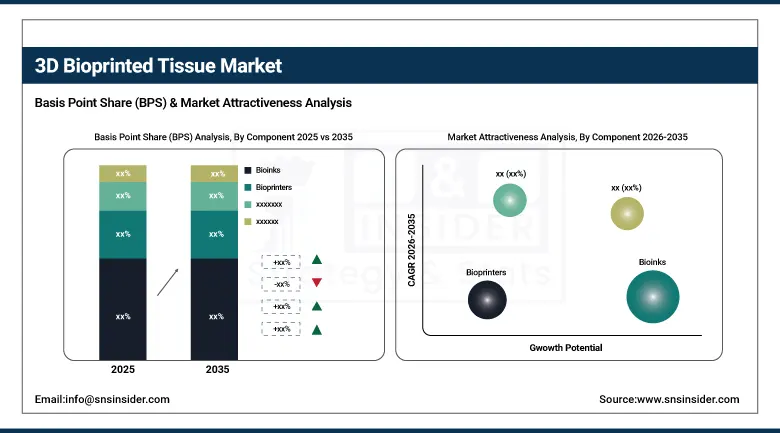
By Component: In 2025, Bioinks dominated with 39% share; Cells fastest growing segment during 2026-2035
-
By Technology: In 2025, Extrusion-based bioprinting dominated with 46% share; Laser-assisted bioprinting fastest growing segment during 2026-2035
-
By Application: In 2025, Drug Discovery & Toxicology Testing dominated with 41% share; Regenerative Medicine fastest growing segment during 2026-2035
-
By End User: In 2025, Pharmaceutical & Biotechnology Companies dominated with 49% share; Hospitals & Clinics fastest growing segment during 2026-2035
By Component: Bioinks Dominate, Cells Fastest-Growing
Bioinks dominate the component segment due to their recurring consumption, critical role in maintaining cell viability, and continuous innovation in natural and synthetic hydrogel formulations. Bioinks support accurate cell positioning, mechanical integrity, and biological function which is vital for drug screening, tissue manipulation and regenerative studies. They are highly compatible: offering versatile solutions by being applicable to a number of bioprinting technologies and increasingly finely-tailored for specific tissue types, they are the most relevant on the global market.
Cells is the most rapidly growing type of component segment owing to the escalating use of stem cells, induced pluripotent stem cells (iPSCs), and primary human cells in personalized medicine and disease modeling. Improvements in cell sourcing, expansion strategies, and ethical approval are fuelling this demand, particularly for patient-specific and genetically tailored tissue constructs.
By Technology: Extrusion-Based Bioprinting Dominates, Laser-Assisted Bioprinting Fastest-Growing
Extrusion-based are versatile, inexpensive, and adopted for high viscosity bioinks printing with high amount of cells. The technology finds extensive use in academia, pharmaceutical screening and early-stage clinical applications due to its scalability and compatibility with a large variety of biomaterials.
Laser-assisted biofabrication is the most rapidly growing one due to its high resolution and cell viability as well as nozzle-free based working which avoids clogging and contamination. The increasing need of complex tissue architectures such as vascularized and neural ones is boosting its use in advanced research and niche biomedical applications.
By Application: Drug Discovery & Toxicology Testing Dominate, Regenerative Medicine Fastest-Growing
Drug discovery and toxicology testing dominate the application segment as bioprinted tissues provide more human relevant tissue models compared to conventional 2D cell cultures and animal testing. Drug companies use the models to reduce development time and costs by increasing predictive accuracy, so this is the most commercially developed and adopted segment.
Regenerative medicine is the fastest-growing application, which derives traction from increasing prevalence of chronic diseases, urgent need of organ transplantation and rising investment on various tissue repair and replacement treatment. Advancements in vascularization, scaffold design and incorporation of stem cells are moving bio-printed tissues from the laboratory toward therapeutic and clinical application.
By End User: Pharmaceutical & Biotechnology Companies Dominate, Hospitals & Clinics Fastest-Growing
Pharmaceutical and biotechnology companies dominate the end-use segment due to their extensive use of bioprinted tissues in preclinical testing, drug screening, and disease modeling. High R&D budgets, partnerships with bioprinting companies and the necessity to have more predictive human-relevant models are still the main demand drivers from this industry.
Hospitals and clinics represent the fastest-growing end-use segment, due to growing clinical research, usage of personalized tissue constructs, and awareness about point-of-care bioprinting among healthcare professionals. With the continued development of regulatory frameworks, and an improved clinical validation, health sector workers are expected to have a more important role in therapeutic and reconstructive applications.
Regional Analysis
North America 3D Bioprinted Tissue Market Insights:
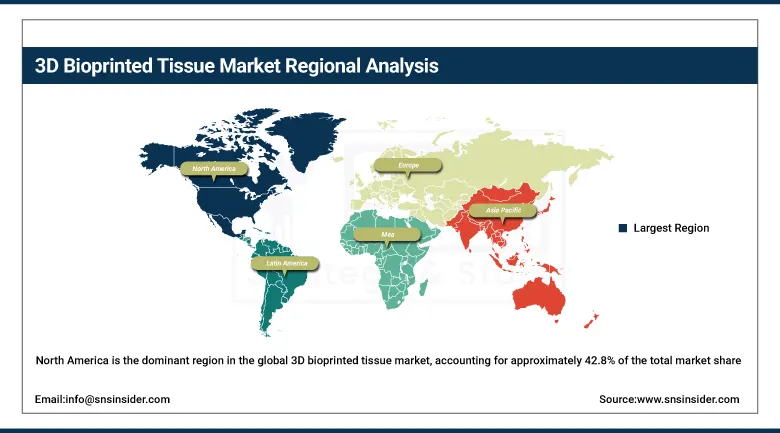
North America is the dominant region in the global 3D bioprinted tissue market, accounting for approximately 42.8% of the total market share. The region’s leadership is driven by strong biomedical research infrastructure, high pharmaceutical and biotechnology R&D spending, early adoption of bioprinting technologies, and the presence of key market players and academic institutions. Supportive government funding, favorable regulatory progress for preclinical applications, and increasing use of bioprinted tissues in drug discovery and toxicology testing further reinforce North America’s dominant position in the market.
Get Customized Report as per Your Business Requirement - Enquiry Now
Europe 3D Bioprinted Tissue Market Insights:
Europe holds a significant position in the 3D bioprinted tissue market, driven by advanced research infrastructure, strong academic collaborations, and the presence of leading biotechnology companies. The sector is supported by government efforts to promote regenerative medicine, tissue engineering and personalized health care. The growing adoption of bioprinted tissues for drug discovery, disease modeling and preclinical testing, as well as continued investments in stem cell research and bioink development are some of the factors driving Europe’s position in the global 3D bioprinted tissue market.
Asia-Pacific 3D Bioprinted Tissue Market Insights:
Asia-Pacific is the fastest-growing region in the 3D bioprinted tissue market, registering a CAGR of 12.95%. Rapid growth is driven by increasing investments in biotechnology and regenerative medicine, expanding academic and industrial research hubs in China, Japan, South Korea, and India, and rising adoption of bioprinting technologies for drug discovery and tissue engineering. Supportive government initiatives, growing healthcare infrastructure, and a focus on personalized medicine and organ replacement research are further accelerating market expansion in the region.
Latin America 3D Bioprinted Tissue Market Insights:
3D bioprinted tissue market in Latin America is growing due to healing of infrastructure healthcare through investments, regenerative medicine gaining more attention and advancement of research such as Brazil, Mexico etc. There is slow acceptance of bioprinting techniques in drug discovery, tissue engineering and academic applications in the region. Collaborative initiatives between local universities, university spinouts and large multinationals are enabling development of technical know-how as well as the increasing awareness of bioprinted tissues around the region.
Middle East & Africa 3D Bioprinted Tissue Market Insights:
The Middle East & Africa (MEA) region is gradually emerging in the 3D bioprinted tissue market, driven by growing investments in advanced healthcare technologies, expanding biomedical research centers, and increasing collaborations with global bioprinting companies. Adoption is mostly focused in countries with good healthcare infrastructure such as UAE and KSA. Promotional efforts toward regenerative medicine, academic research in tissue engineering etc., and pilot projects for drug testing and organ modeling have supported increasing market awareness as well as capability development to ensure steady growth of the market in the region.
3D Bioprinted Tissue Market Competitive Landscape:
Organovo Holdings, Inc., headquartered in San Diego, California, is a leading innovator in the 3D bioprinted tissue market, specializing in the development of functional human tissues for drug discovery, disease modeling, and regenerative medicine. The company leverages proprietary 3D bioprinting technology to create multicellular, physiologically relevant tissue models, particularly liver and therapeutic tissue constructs, that closely mimic native human biology. Organovo’s focus on precision tissue architecture, long term cell viability, and clinically relevant performance positions it as a key player in advancing predictive preclinical testing and personalized therapeutic solutions.
-
In March 2025: Organovo advanced its next-generation bioprinted liver tissue platform to support enhanced drug toxicity screening and fibrosis research for pharmaceutical partners.
CELLINK (BICO Group), headquartered in Gothenburg, Sweden, is a prominent global player in the 3D bioprinting ecosystem, offering a comprehensive portfolio of bioprinters, bioinks, and tissue engineering solutions. As part of the BICO Group, CELLINK focuses on enabling scalable and reproducible bioprinting workflows for academic researchers, biotechnology companies, and pharmaceutical organizations. The company emphasizes versatility, automation, and compatibility with a wide range of biomaterials and cell types, supporting applications across drug discovery, regenerative medicine, and advanced biological research.
-
In January 2025: CELLINK expanded its advanced bioink portfolio with new tissue-specific formulations designed to improve cell viability and structural fidelity in complex 3D tissue models.
3D Bioprinted Tissue Market Key Players
-
Organovo Holdings, Inc.
-
CELLINK (BICO Group)
-
3D Systems Corporation
-
Stratasys Ltd.
-
Allevi, Inc. (3D Systems)
-
RegenHU Ltd.
-
Aspect Biosystems Ltd.
-
EnvisionTEC (Desktop Metal)
-
Poietis
-
Cyfuse Biomedical K.K.
-
Inventia Life Science
-
Advanced BioMatrix, Inc.
-
Kenzan / Cyfuse Technology
-
Nano3D Biosciences
-
Ourobionics (Tissue Labs)
-
VIVAX Bio
-
Prellis Biologics
-
CollPlant Biotechnologies Ltd.
-
Axolotl Biosciences
-
BiomimX SRL
| Report Attributes | Details |
|---|---|
| Market Size in 2025 | USD 2.90 Billion |
| Market Size by 2035 | USD 5.46 Billion |
| CAGR | CAGR of 6.53% From 2026 to 2035 |
| Base Year | 2025 |
| Forecast Period | 2026-2035 |
| Historical Data | 2022-2024 |
| Report Scope & Coverage | Market Size, Segments Analysis, Competitive Landscape, Regional Analysis, DROC & SWOT Analysis, Forecast Outlook |
| Key Segments | • By Component: (Bioprinters, Bioinks, Cells, Biomaterials) • By Technology: (Extrusion-based Bioprinting, Inkjet-based Bioprinting, Laser-assisted Bioprinting, Stereolithography) • By Application: (Drug Discovery & Toxicology Testing, Regenerative Medicine, Tissue Engineering, Disease Modeling) • By End User: (Pharmaceutical & Biotechnology Companies, Academic & Research Institutes, Hospitals & Clinics) |
| Regional Analysis/Coverage | North America (US, Canada), Europe (Germany, UK, France, Italy, Spain, Russia, Poland, Rest of Europe), Asia Pacific (China, India, Japan, South Korea, Australia, ASEAN Countries, Rest of Asia Pacific), Middle East & Africa (UAE, Saudi Arabia, Qatar, South Africa, Rest of Middle East & Africa), Latin America (Brazil, Argentina, Mexico, Colombia, Rest of Latin America). |
| Company Profiles | Organovo Holdings, CELLINK (BICO Group), 3D Systems Corporation, Stratasys Ltd., Allevi (3D Systems), RegenHU, Aspect Biosystems, EnvisionTEC (Desktop Metal), Poietis, Cyfuse Biomedical, Inventia Life Science, Advanced BioMatrix, Kenzan (Cyfuse Technology), Nano3D Biosciences, Ourobionics (Tissue Labs), VIVAX Bio, Prellis Biologics, CollPlant Biotechnologies, Axolotl Biosciences, BiomimX |
Frequently Asked Questions
The 3D Bioprinted Tissue Market is expected to grow at a CAGR of 6.53% during 2026–2035.
The market was valued at USD 2.90 Billion in 2025 and is projected to reach USD 5.46 Billion by 2035.
The key drivers of the 3D Bioprinted Tissue market include rising adoption in drug discovery, disease modeling, regenerative medicine, and personalized therapies, supported by advances in bioprinting technology, bioinks, and strong R&D investments.
The “Drug Discovery & Toxicology Testing” segment dominated during the projected period.
North America dominated the 3D Bioprinted Tissue Market in 2025.
Get in Touch
