
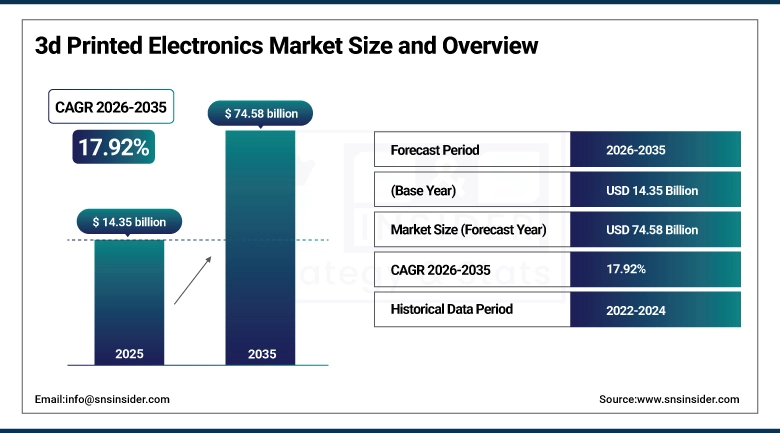
As per the SNS Insider Report titled, 3D Printed Electronics Market by Printing Technology, by Material, by Application, by End-User, and Region | Global Forecast 2026-2035, “The global 3D Printed Electronics Market size valued at USD 14.35 billion in 2025, is anticipated to grow to USD 74.58 billion by 2035, registering a CAGR of 17.92% over the 2026–2035 forecast period.”
Key Takeaways
-
Screen Printing accounted for nearly 36.30% of the market share in 2025, driven by its cost-effectiveness, scalability, and widespread deployment in printed electronic manufacturing applications.
-
Inkjet Printing is projected to witness the fastest growth during 2026–2035 due to increasing demand for high-resolution, flexible, and customizable printed electronic components.
-
Inks dominated the material segment with a 77.00% revenue share in 2025 owing to growing usage of conductive, dielectric, and functional inks across printed electronics production.
-
Polymers are expected to register the fastest growth through 2035 as manufacturers increasingly adopt lightweight, flexible, and durable materials for advanced electronic applications.
-
Displays held approximately 29.60% share in 2025, supported by rising demand for flexible displays, OLED technologies, and lightweight consumer electronic devices.
-
Photovoltaic Cells are anticipated to emerge as the fastest-growing application segment during the forecast period due to increasing investments in printed solar technologies and renewable energy systems.
-
Automotive & Transportation represented nearly 22.20% of the market revenue in 2025 owing to growing integration of printed electronics into connected vehicles, smart dashboards, and lightweight automotive systems.
-
Consumer Electronics is projected to record the fastest growth from 2026 to 2035 driven by increasing adoption of wearable electronics, flexible devices, and compact smart technologies.
-
Asia-Pacific captured around 40.00% of total market revenue in 2025 and is expected to strengthen its market position further through 2035 supported by strong electronics manufacturing capabilities and expanding industrial automation.
-
North America accounted for approximately 25.18% of the global market share in 2025 driven by increasing investments in advanced manufacturing technologies and printed electronics innovation.
Why 3D Printed Electronics Market is Growing?
3D Printed Electronics Market has witnessed rapid growth in recent years owing to the rise in demand for lightweight, flexible, and customized electronic components from various industries such as automotive, healthcare, consumer electronics, and energy. Technologies related to 3D printed electronics have allowed companies to achieve faster prototyping and production of complex and advanced electronic systems.
The increasing popularity of wearable electronic devices, flexible screens, smart sensors, and IoT technology-based devices has been the main factor contributing to the growth of this market. Companies have increasingly adopted additive manufacturing to develop smaller and highly functional electronic components.
Rising demand for sustainable manufacturing practices, coupled with low wastage and increased efficiency, is boosting the adoption of 3D printed electronics technologies. Compared to other conventional electronic systems, additive manufacturing ensures reduced wastage of materials and effective manufacturing processes.
Advancements in the technology related to conductive inks, polymers, nanomaterials, and multi-material printing have also been instrumental in fueling market growth.
3D Printed Electronics Market Statistics
-
The usage of flexible electronics and wearables is expected to accelerate the growth rate of printed electronics manufacturing technology on a global basis.
-
Conductive ink continues to hold a dominant position in the materials category owing to its wide application in the manufacture of circuitry as well as displays.
-
Technologies involving inkjet printing are growing at a rapid pace thanks to resolution-based customization in electronic manufacturing.
-
The automotive industry is adopting printed electronics for various applications such as dashboards, sensors, lighting, etc.
-
Printed photovoltaics have emerged as a promising technology area within renewable energy.
-
Companies specializing in consumer electronics are turning to printed electronics technology to make smaller components.
-
Asia Pacific leads the pack when it comes to regional markets for printed electronics.
Emerging Trends
Some of the trends that can be seen in the 3D Printed Electronics Market include the rising use of flexible and stretchable electronic systems for wearables and healthcare devices. Manufacturers are emphasizing on increasing printing precision and conductivity along with the ability to print multiple layers for higher electronic functionality.
Growth in terms of the use of printed photovoltaic cells and energy harvesting technology is likely to be one of the key trends in the market. Investments in sustainable technologies and renewable energy technology are also leading to the growth of inkjet and aerosol jet printing technologies in the market.
Moreover, artificial intelligence, IoT technology, and smart sensors will also see rising adoption in the ecosystem of printed electronics. The development of nanomaterials, semiconductor material, and hybrid additive manufacturing techniques are anticipated to boost growth in the coming years.
Top 10 Companies
-
Nano Dimension Ltd.
-
Optomec Inc.
-
DuPont de Nemours Inc.
-
Xerox Corporation
-
Samsung Electronics Co., Ltd.
-
Molex LLC
-
Enfucell Oy
-
Voxel8 Inc.
-
BASF SE
-
NovaCentrix
About the Author

Get in touch




