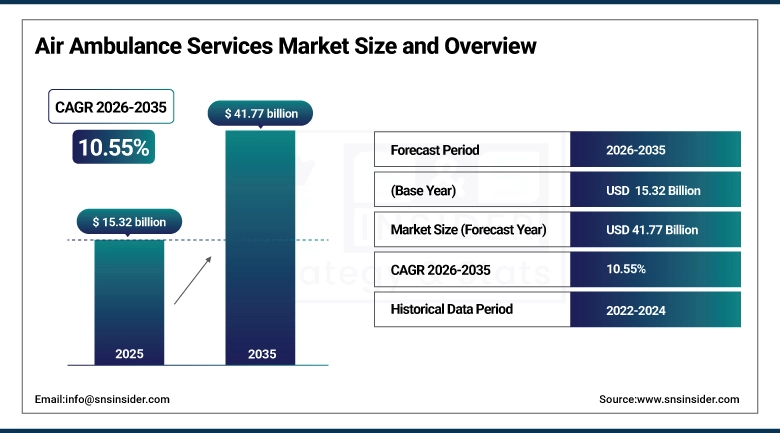
As per the SNS Insider Report titled, Air Ambulance Services Market by Service Type, by Platform Type, by End-User, by Payment Type, by Medical Specialization, and Region, Global Forecast 2026–2035, “The global Air Ambulance Services Market size was estimated at USD 15.32 billion in 2025, is anticipated to grow to USD 41.77 billion by 2035, registering a CAGR of 10.55% during the forecast period 2026–2035.”
Key Takeaways
-
Emergency Transport dominated the market with a 52.40% share in 2025, driven by the growing need for rapid medical response and critical patient transfers during emergencies.
-
Neonatal Transport is projected to register the fastest growth during 2026–2035 owing to increasing demand for specialized care and transportation of high-risk newborns.
-
Helicopters held the largest platform type share of 61.80% in 2025 due to their ability to provide rapid access to remote and urban emergency locations.
-
Fixed-Wing Aircraft are expected to witness the fastest growth during the forecast period, supported by increasing long-distance medical transportation requirements.
-
Hospitals accounted for the largest end-user share of 47.20% in 2025 as healthcare facilities increasingly rely on air ambulance services for critical patient transfers.
-
Private Patients recorded the fastest growth owing to rising awareness of advanced emergency transportation services and growing access to private healthcare coverage.
-
Insurance-Based services led the payment type segment with a 58.50% market share in 2025, reflecting broader insurance reimbursement coverage for emergency medical transport.
-
Government-Funded services are anticipated to expand at the fastest rate due to increasing public healthcare investments and emergency response initiatives.
-
Critical Care represented the leading medical specialization segment with a 49.70% share in 2025 because of the high demand for intensive medical transportation services.
-
Pediatric Care is expected to experience the fastest growth through 2035, supported by increasing focus on specialized pediatric emergency and transport services.
-
North America accounted for 41.28% of total market revenue in 2025, while Asia-Pacific is projected to record the fastest CAGR of 11.15% during 2026–2035.
Why Air Ambulance Services Market is Growing?
The Air Ambulance Services Market is witnessing rapid expansion owing to the rising occurrence of medical emergencies, traumas, cardiovascular disorders, and critical care patients who need immediate evacuation. The use of air ambulances helps significantly in providing fast treatment, especially in areas where geography poses certain difficulties.
Investment in infrastructure development and emergency medical services is another important driver propelling the market forward. Healthcare facilities have started utilizing air ambulances to reach their locations and provide patients with better health care facilities.
There is a large scope of opportunity for market players due to the prevalence of chronic illnesses, aging population, and inter-facility transportations. In addition, the advancement in technology has enabled efficient and reliable transportation in the air.
Moreover, favorable reimbursement policies and growing insurance coverage are likely to continue contributing towards increased demand from both emerging and developed countries.
Air Ambulance Services Market Statistics
-
Cardiovascular diseases remain one of the leading causes of emergency hospital admissions worldwide, increasing demand for rapid medical transportation services.
-
The growing number of trauma incidents and road accidents globally is driving the need for advanced emergency response and patient evacuation systems.
-
Aging populations across developed countries are contributing to increased utilization of critical care transport services.
-
Expanding healthcare access in rural and underserved regions is encouraging greater deployment of air ambulance networks.
-
Governments worldwide are increasing investments in emergency medical infrastructure and disaster response preparedness.
-
Technological advancements in onboard monitoring systems, telemedicine integration, and life-support equipment are improving patient care during transport.
-
Rising awareness regarding the benefits of rapid medical evacuation is encouraging broader adoption among healthcare providers and patients.
Emerging Trends
There are several innovations in the Air Ambulance Services Market that can be seen today. First of all, more providers begin implementing advanced systems of life support as well as technologies which allow for monitoring of patients' condition and remote assistance through telemedicine.
The adoption of advanced digital communication tools as well as AI-powered ambulance dispatch systems improves coordination among rescue units, hospitals, and ambulance services, allowing providers to reduce response time and optimize the use of flights for patient transportation.
Another prominent innovation in this field includes the launch of specialized services for children and babies as well as increased adoption of fixed-wing air ambulances for long distance and overseas patient transportations. These ambulances have shown their high efficacy and low cost in international transportation.
Finally, development of PPP projects, extension of regional air networks, and investments in advanced air infrastructure might drive further growth of the industry during the forecast period.
Top 10 Companies
-
Air Methods Corporation
-
Global Medical Response
-
REVA Air Ambulance
-
Acadian Air Med
-
PHI Air Medical
-
Babcock International Group
-
Med-Trans Corporation
-
Guardian Flight
-
DRF Luftrettung
-
Scandinavian Air Ambulance
About the Author

Get in touch