
The global artificial intelligence (AI) in medical imaging market is experiencing rapid expansion as healthcare providers increasingly rely on intelligent diagnostic software to improve clinical efficiency, accelerate image interpretation, and manage growing examination volumes. Advances in deep learning, automated image analysis, and cloud-based radiology platforms are transforming how hospitals and diagnostic centers deliver imaging services.
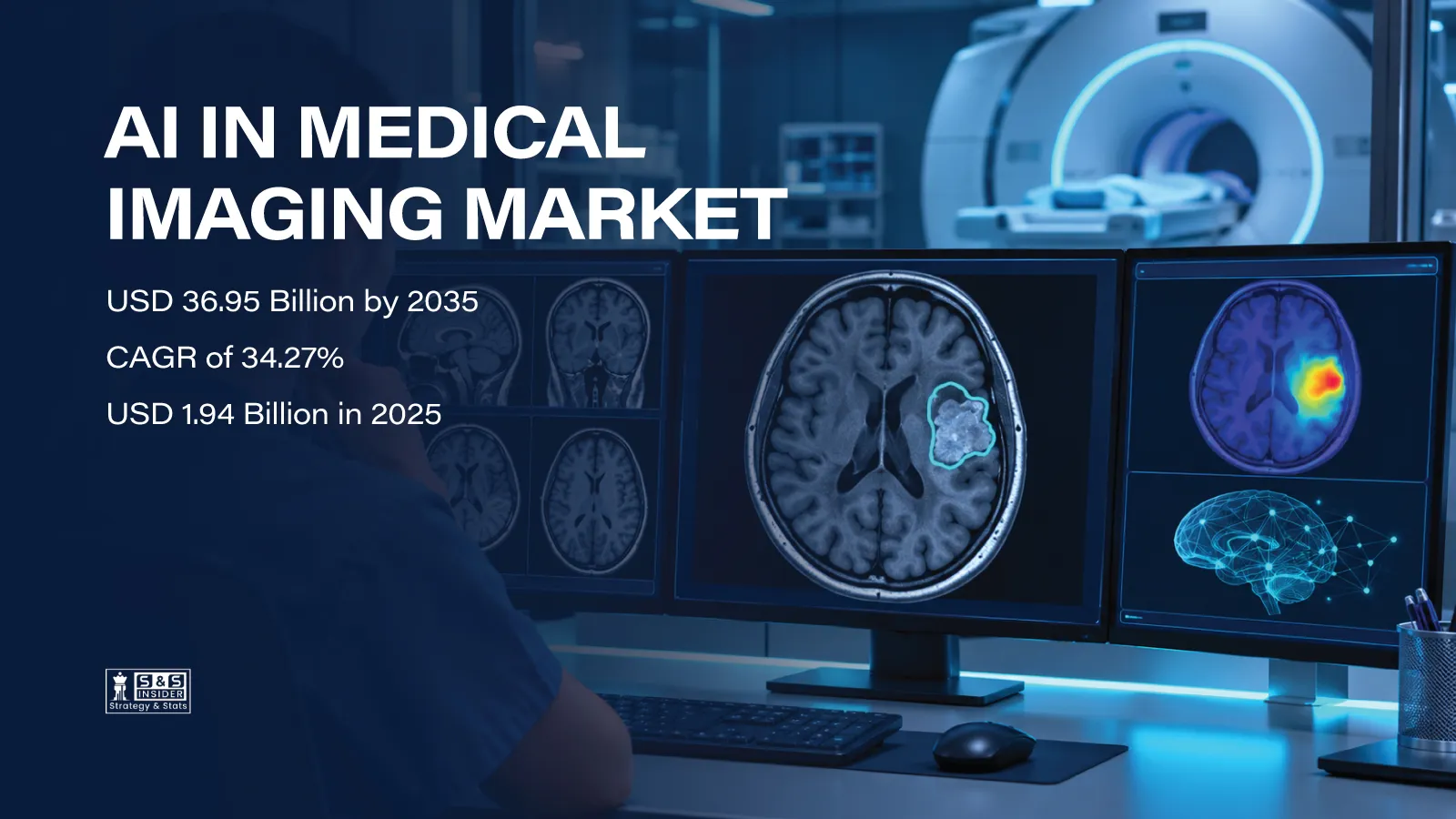
According to SNS Insider, the global AI in medical imaging market was valued at USD 1.94 Billion in 2025, with revenue estimated at USD 2.60 Billion in 2026. The market is forecast to reach USD 36.95 Billion by 2035, registering a CAGR of 34.27% during 2026–2035.
Rising demand for early disease detection, shortages of qualified radiologists, and technological improvements in AI-assisted diagnostics are encouraging healthcare organizations to modernize imaging workflows. Software capable of prioritizing urgent scans, identifying suspicious abnormalities, and assisting with clinical documentation is becoming increasingly important in routine practice.
North America remains the largest regional market, while Asia-Pacific is expected to deliver the fastest growth as healthcare digitization and diagnostic infrastructure investments accelerate.
To Get Detailed Insights on the AI In Medical Imaging Market – Request a Sample Report
Market Size and Forecast
| Market Indicator | Value |
|---|---|
| Global Market Size, 2025 | USD 1.94 Billion |
| Estimated Market Size, 2026 | USD 2.60 Billion |
| Market Forecast, 2035 | USD 36.95 Billion |
| CAGR, 2026–2035 | 34.27% |
| U.S. Market Size, 2025 | USD 676.20 Million |
| Leading Region, 2025 | North America (41.86%) |
| Fastest-Growing Region | Asia-Pacific (37.58% CAGR) |
The forecast reflects a fundamental change in medical imaging economics. Healthcare providers are evaluating artificial intelligence not merely as an additional diagnostic feature but as infrastructure that can improve reporting capacity, support specialists, and increase the productivity of existing imaging equipment.
Commercial opportunities extend across standalone diagnostic applications, enterprise imaging platforms, cloud-based analysis services, and integrated clinical workflow solutions.
Demand Drivers and Constraints
Primary Demand Drivers
-
Increasing diagnostic imaging volumes: Aging populations, chronic disease prevalence, and expanding screening programs are increasing workloads across radiology departments, creating demand for automated image interpretation and prioritization.
- Shortages of radiology professionals: Hospitals are adopting AI-assisted reporting and triage tools to manage examination backlogs and improve the allocation of specialist resources.
- Growing demand for early disease detection: AI-supported analysis of neurological conditions, cancers, and cardiovascular abnormalities can help clinicians identify suspicious findings and prioritize further assessment.
- Advances in deep learning: Improvements in image recognition, segmentation, and multimodal analysis are supporting applications across CT, MRI, X-ray, and ultrasound examinations.
- Cloud-based imaging integration: Compatibility with picture archiving and communication systems (PACS) and radiology information systems is making AI applications easier to deploy across multiple healthcare facilities.
- Expanding regulatory authorization: Increasing availability of authorized AI-enabled medical devices is helping healthcare organizations evaluate commercially available diagnostic technologies.
Potential Growth Constraints
Despite considerable commercial potential, adoption continues to face implementation barriers.
Healthcare providers must consider software licensing expenses, integration costs, cybersecurity requirements, clinical validation, and employee training before introducing AI into established diagnostic workflows.
Algorithm performance can also vary across imaging equipment, clinical protocols, and patient populations. Consequently, medical institutions require reliable performance evidence and ongoing monitoring.
Uncertainty surrounding reimbursement and the financial benefits of certain AI applications may further extend procurement decisions, particularly among smaller hospitals and independent diagnostic providers.
Demand Structure by Technology
Deep Learning (2025 Market Share: 52.31%)
Deep learning represented the largest technology segment, accounting for 52.31% of global market revenue in 2025.
Its commercial significance comes from the ability of neural networks to examine complex imaging information and recognize patterns associated with medical abnormalities.
Deep learning applications support tumor identification, anatomical segmentation, emergency triage, and image reconstruction across multiple imaging modalities.
Healthcare providers increasingly prefer solutions that integrate these capabilities directly into existing diagnostic systems, reducing the need for separate image-processing procedures.
Current trend: Increasing deployment of advanced neural networks and multipurpose imaging algorithms.
Natural Language Processing (Forecast CAGR: 38.72%)
Natural language processing is projected to be the fastest-growing technology segment, registering a 38.72% CAGR from 2026 to 2035.
NLP applications can organize clinical documentation, extract relevant findings from radiology reports, and support automated drafting of diagnostic summaries.
The emergence of generative AI is broadening commercial interest in solutions connecting medical images with historical patient information and structured clinical records.
Current trend: Growing integration of language models into reporting, clinical documentation, and radiology workflow automation.
Demand Structure by Application
Neurology (2025 Market Share: 34.76%)
Neurology accounted for 34.76% of the market in 2025, making it the leading application segment.
Neurological emergencies frequently require rapid interpretation of CT and MRI examinations. AI-assisted solutions can identify suspected intracranial hemorrhage, support stroke triage, and highlight imaging abnormalities requiring urgent specialist attention.
The integration of automated alerts into stroke care networks is strengthening demand for imaging software that supports time-sensitive clinical decisions.
Beyond emergency applications, AI is gaining relevance in brain structure analysis and the monitoring of neurological disorders.
Current trend: Expanding use of AI-supported neuroimaging and emergency diagnostic prioritization.
Breast Screening (Forecast CAGR: 38.14%)
Breast screening is anticipated to record the fastest application growth, with a 38.14% CAGR during 2026–2035.
Demand is supported by the increasing importance of early cancer detection and the need to improve productivity within mammography screening programs.
AI applications can assist radiologists in reviewing mammograms, highlighting suspicious areas, and evaluating screening examinations.
Healthcare systems are increasingly assessing automated second-reader technologies to improve screening efficiency while maintaining clinical oversight.
Current trend: Increased evaluation of AI-assisted mammography interpretation and breast cancer screening tools.
Demand Structure by Imaging Modality
Computed Tomography (2025 Market Share: 35.88%)
Computed tomography accounted for 35.88% of revenue in 2025, maintaining the largest share among imaging modalities.
CT examinations generate extensive image datasets, creating opportunities for automated analysis in emergency medicine, oncology, cardiovascular diagnostics, and pulmonary screening.
Applications that flag suspected stroke, pulmonary embolism, and other urgent findings are particularly relevant for hospitals managing high examination volumes.
Current trend: Increasing adoption of automated CT interpretation and emergency imaging triage.
Ultrasound (Forecast CAGR: 38.07%)
Ultrasound is expected to be the fastest-growing modality, expanding at a 38.07% CAGR through 2035.
AI-enabled ultrasound software can support image acquisition, anatomical measurements, and examination guidance, making diagnostic procedures more accessible across different clinical environments.
The expansion of portable ultrasound systems is creating additional opportunities in emergency departments, outpatient clinics, and healthcare facilities with limited specialist availability.
Current trend: Growing adoption of intelligent ultrasound guidance and automated measurement technologies.
Demand Structure by End User
Hospitals (2025 Market Share: 50.43%)
Hospitals dominated the market with a 50.43% revenue share in 2025.
Their leadership reflects substantial imaging infrastructure, high patient volumes, and strong requirements for emergency diagnostic support.
Large hospital networks are increasingly evaluating enterprise AI platforms that connect multiple diagnostic applications through centralized infrastructure.
Diagnostic Imaging Centers (Forecast CAGR: 36.84%)
Diagnostic imaging centers are projected to expand at a 36.84% CAGR from 2026 to 2035.
Independent imaging providers and outpatient diagnostic networks are adopting automation to improve examination throughput, standardize reporting, and maintain service consistency across locations.
Cloud delivery, centralized image interpretation, and subscription-based software models are creating additional opportunities for diagnostic imaging operators.
Regional Market Dynamics
North America (2025 Market Share: 41.86%)
North America accounted for 41.86% of global revenue in 2025, establishing its position as the leading regional market.
The region benefits from an advanced healthcare ecosystem, extensive clinical research, established imaging technology developers, and strong demand for diagnostic automation.
The United States generated USD 676.20 Million in 2025, representing the largest national contribution within North America.
Growing investment in enterprise imaging platforms, clinical validation, and AI-assisted radiology workflows is expected to support continued expansion.
Direction: Established market leadership supported by commercial adoption and technological innovation.
Europe — Expanding Healthcare AI Adoption
Europe represents the second-largest regional market, supported by organized screening programs, hospital digitization, and established medical technology industries.
Germany, the United Kingdom, and France remain important markets for AI-assisted diagnostics.
Compliance with medical device regulations, data protection requirements, and clinical validation standards continues to influence procurement and commercialization.
Direction: Continued expansion through healthcare modernization and regulated technology adoption.
Asia-Pacific (Forecast CAGR: 37.58%)
Asia-Pacific is projected to experience the fastest regional growth, registering a 37.58% CAGR during 2026–2035.
China, India, Japan, and South Korea are expanding digital healthcare capabilities, imaging infrastructure, and AI-based diagnostic applications.
Increasing demand for cancer screening, improving access to diagnostic services, and investment in locally developed imaging software are supporting growth.
The region also presents opportunities for cost-effective AI platforms that assist healthcare facilities facing specialist shortages.
Direction: Rapid growth driven by healthcare digitization and expanding diagnostic accessibility.
Latin America and Middle East & Africa
Latin America and the Middle East & Africa represent emerging opportunities for AI-enabled imaging solutions.
Brazil, Mexico, Saudi Arabia, and the UAE are important markets where hospital modernization and private healthcare investment support adoption.
Cloud-based diagnostic services, teleradiology, and automated screening applications may help providers extend diagnostic capabilities beyond major urban hospitals.
Direction: Gradual market development supported by infrastructure investment and accessible AI solutions.
Competitive Landscape
The global AI in medical imaging market includes established equipment manufacturers, specialized software developers, and healthcare technology companies.
Major participants include GE HealthCare, Siemens Healthineers, Aidoc, Viz.ai, Lunit, Qure.ai, RapidAI, Harrison.ai, HeartFlow, Subtle Medical, Rad AI, DeepHealth, Therapixel, Oxipit, and Tempus AI.
Competition increasingly focuses on clinical performance, regulatory clearances, workflow interoperability, and the ability to support multiple diagnostic applications.
Recent industry developments illustrate this transformation. In January 2026, Aidoc received FDA clearance for a multi-condition CT triage solution built on its CARE foundation model. In February 2026, Qure.ai announced six additional FDA-cleared indications for its chest X-ray software.
These developments highlight growing commercial interest in broader diagnostic platforms capable of addressing multiple clinical requirements.
Market Outlook (2026–2035)
The global AI in medical imaging market is forecast to reach USD 36.95 Billion by 2035, supported by accelerating diagnostic automation, expanding clinical applications, and increasing integration of intelligent software into healthcare infrastructure.
Growth opportunities are expected to emerge from multimodal AI, cloud-based diagnostic platforms, automated reporting, and technologies that assist healthcare professionals in managing complex imaging workloads.
Demand will increasingly depend on practical improvements in clinical workflow, reliable diagnostic performance, regulatory compliance, and the financial value delivered to healthcare providers.
North America is expected to retain its leading market position, while Asia-Pacific offers the strongest regional growth prospects.
Overall, AI in medical imaging is transitioning from specialized diagnostic assistance toward an integrated component of healthcare delivery, creating substantial opportunities for software developers, imaging equipment manufacturers, and diagnostic service providers through 2035
About the Author

Get in touch




