
The global tele-intensive care unit (Tele-ICU) market is experiencing substantial expansion as healthcare providers seek more efficient ways to deliver specialized critical care across hospitals and underserved communities. Intensivist shortages, increasing intensive care admissions, and growing investment in digital healthcare infrastructure are encouraging hospitals to adopt centralized monitoring platforms and remotely staffed critical care networks.
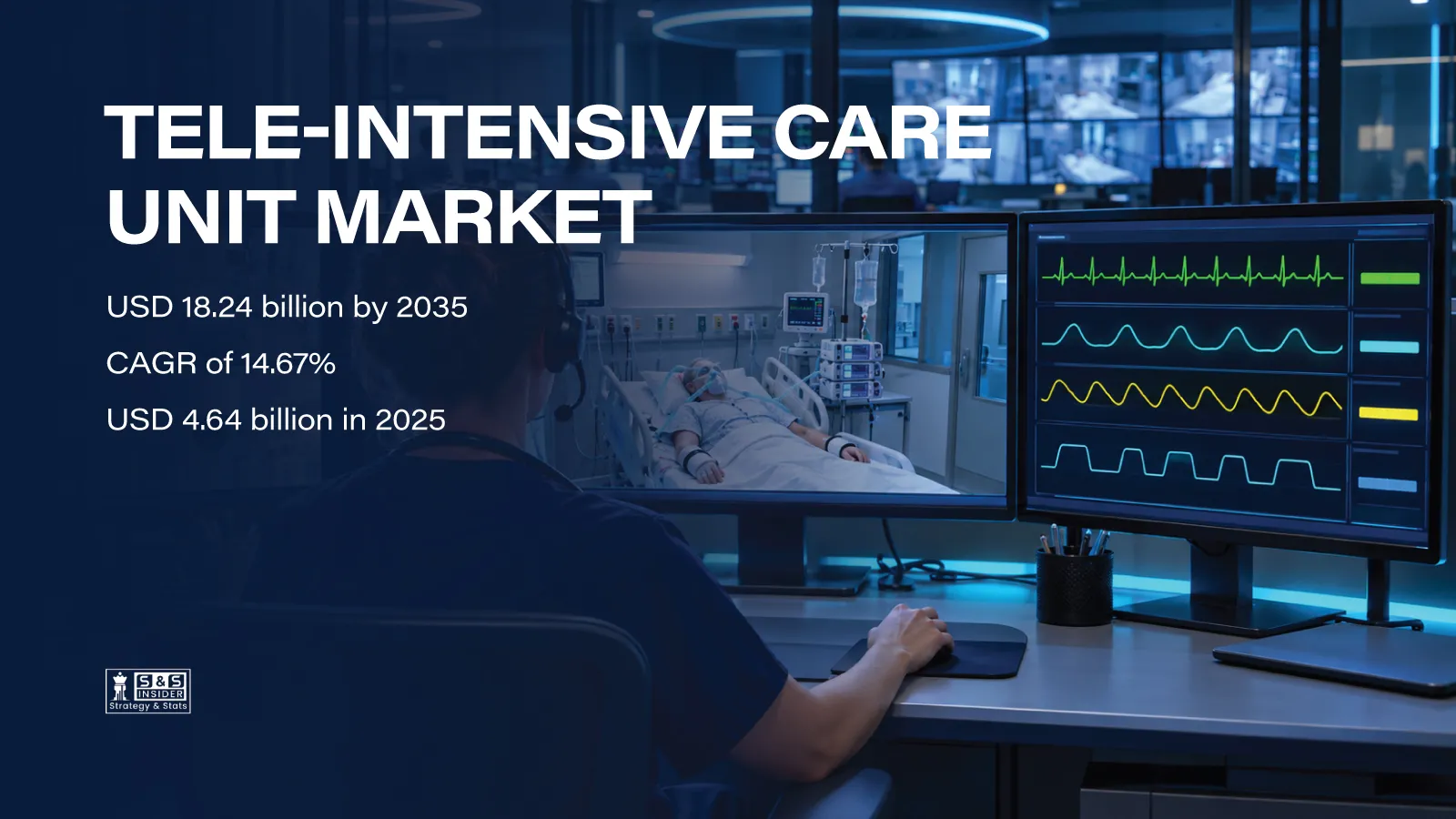
According to SNS Insider, the global Tele-intensive Care Unit Market was valued at USD 4.64 billion in 2025, is estimated to reach USD 5.32 billion in 2026, and is projected to expand to USD 18.24 billion by 2035, registering a CAGR of 14.67% during 2026–2035.
The market is shifting toward integrated virtual critical care models that combine continuous physiological monitoring, artificial intelligence, secure audiovisual communication, and remote intensivist support. These systems enable specialist teams to oversee multiple intensive care units while supporting bedside clinicians with timely consultations and clinical decision-making.
North America remains the largest regional market, while Asia-Pacific is expected to register the fastest growth as hospital networks expand telemedicine capabilities and improve access to critical care expertise.
To Get Detailed Insights on the Tele-intensive Care Unit Market – Request a Sample Report
Market Size and Forecast
| Market Indicator | Value |
|---|---|
| Global Market Size, 2025 | USD 4.64 Billion |
| Market Size, 2026 | USD 5.32 Billion |
| Global Market Forecast, 2035 | USD 18.24 Billion |
| CAGR, 2026–2035 | 14.67% |
| U.S. Market Size, 2025 | USD 1.71 Billion |
| North America Market Share, 2025 | 42.73% |
| Fastest-Growing Region | Asia-Pacific (16.81% CAGR) |
The market's growth trajectory reflects a fundamental change in hospital staffing strategies. Rather than depending entirely on on-site critical care specialists, healthcare systems are developing networks that allow experienced intensivists to provide clinical supervision across multiple locations.
Demand Drivers and Constraints
Primary Demand Drivers
- Critical care specialist shortages: Limited availability of qualified intensivists, particularly in rural and community hospitals, is accelerating demand for remote specialist coverage and continuous patient supervision.
- Increasing ICU workload: Aging populations and the growing prevalence of complex cardiovascular and respiratory conditions are increasing pressure on hospital critical care resources.
- AI-enabled clinical monitoring: Predictive analytics, automated alerts, and integrated patient monitoring platforms help clinicians identify possible deterioration and prioritize high-risk cases.
- Expansion of connected hospital networks: Multihospital healthcare organizations are investing in centralized command centers that coordinate specialist support across geographically dispersed facilities.
- Public healthcare investment: Government-supported digital health initiatives and remote care programs are improving access to critical care services in underserved locations.
Potential Growth Constraints
High implementation costs remain a significant challenge, particularly for smaller hospitals that cannot independently finance monitoring equipment, secure networks, and round-the-clock specialist staffing.
Additional barriers include inconsistent reimbursement policies, electronic health record interoperability, cybersecurity risks, and resistance to changes in established clinical workflows.
Successful deployment requires clear responsibilities between bedside professionals and remote intensivists, reliable communication infrastructure, and appropriate clinical governance.
Demand Structure by Component
Hardware (2025 Market Share: 61.84%)
Hardware accounted for approximately 61.84% of global tele-ICU market revenue in 2025, making it the largest component segment. Hospital installations require bedside cameras, physiological monitors, audiovisual communication systems, networking equipment, and dedicated workstations. These investments establish the infrastructure needed for continuous remote observation and specialist consultation. Demand is particularly significant when healthcare networks expand monitoring coverage across multiple hospitals or upgrade existing intensive care facilities.
Current trend: Expansion of connected monitoring equipment and integrated hospital communication infrastructure.
Major trends: High-resolution video monitoring, connected medical devices, centralized workstations, and interoperable bedside systems.
Software (Forecast CAGR: 16.77%)
Software is projected to be the fastest-growing component segment, advancing at a CAGR of approximately 16.77% during 2026–2035. Healthcare organizations increasingly require software capable of integrating vital signs, laboratory results, clinical records, and predictive analytics into unified monitoring environments. Cloud-enabled platforms can simplify software updates and support remote access, while AI-assisted tools help prioritize patients requiring specialist attention. As hospitals seek greater productivity from their existing infrastructure, demand is shifting toward platforms that improve workflow coordination and clinical information accessibility.
Current trend: Rising adoption of predictive monitoring and cloud-based virtual ICU platforms.
Major trends: AI-assisted alerts, clinical workflow automation, real-time data integration, and subscription-based software delivery.
Demand Structure by Type of Management
Open with Consultant (2025 Market Share: 34.86%)
The open with consultant model represented approximately 34.86% of market revenue in 2025. Under this arrangement, bedside physicians retain primary responsibility for patient management while remote intensivists provide consultations, assessments, and specialized recommendations. The model is attractive to community hospitals seeking additional clinical expertise without fundamentally restructuring existing physician responsibilities. Lower implementation complexity and flexible specialist involvement support adoption across hospitals with limited critical care staffing.
Current trend: Increasing use of remote specialist consultations alongside locally managed intensive care.
Intensivist Model (Forecast CAGR: 16.57%)
The intensivist management model is projected to expand at a CAGR of approximately 16.57% through 2035. This structure provides more direct involvement from dedicated critical care specialists, including remote patient assessment, coordinated treatment decisions, and escalation management. Hospitals facing persistent staffing shortages are increasingly evaluating this model for overnight coverage and consistent application of critical care protocols.
Current trend: Growing demand for dedicated remote intensivist teams and continuous specialist supervision.
Demand Structure by Delivery Model
Centralized Programs (2025 Market Share: 49.83%)
Centralized delivery accounted for approximately 49.83% of the global market in 2025. These systems connect multiple intensive care units to a shared command center staffed by remote critical care professionals. Centralized infrastructure enables healthcare organizations to distribute specialist resources across facilities, standardize monitoring protocols, and coordinate clinical responses. Large hospital networks particularly benefit from shared technology infrastructure and centralized staffing arrangements.
Current trend: Expansion of hub-and-spoke critical care networks.
Hybrid Delivery Models (Forecast CAGR: 15.10%)
Hybrid tele-ICU systems are expected to grow at a CAGR of approximately 15.10% during 2026–2035. These models combine centralized monitoring capabilities with locally available medical teams and distributed specialists. Their flexibility allows hospitals to modify remote coverage according to staffing levels, patient acuity, and operational requirements. Hybrid arrangements are gaining attention among healthcare networks seeking scalable implementation without depending exclusively on a single centralized operating structure.
Current trend: Increasing integration of centralized command centers with flexible local clinical support.
Demand Structure by End User
Hospitals (2025 Market Share: 32.47%)
Hospitals held the leading end-user share of approximately 32.47% in 2025. Intensive care services require continuous monitoring and rapid clinical decision-making, making hospitals the principal purchasers of tele-ICU infrastructure. Large healthcare systems are establishing their own virtual critical care operations, while smaller hospitals increasingly participate in shared monitoring networks.
Current trend: Rising institutional investment in continuous ICU monitoring and remote specialist services.
Homecare Settings (Forecast CAGR: 17.12%)
Homecare settings represent the fastest-growing end-user category, with a projected CAGR of approximately 17.12%. Growth is associated with remote supervision of selected patients transitioning from intensive care to lower-acuity or home-based recovery arrangements. Wearable monitoring technologies, video communication, and connected care platforms can support ongoing clinical observation after hospital discharge.
Current trend: Expansion of remote monitoring into post-acute care and hospital-at-home programs.
Regional Market Dynamics
North America (2025 Market Share: 42.73%)
- North America accounted for 42.73% of global tele-ICU revenue in 2025.
- The region benefits from established healthcare technology infrastructure, advanced hospital networks, and substantial investment in virtual critical care services.
- The United States represented approximately 86.14% of North American revenue in 2025, with a market valuation of USD 1.71 billion.
- Demand is supported by specialist shortages in rural hospitals, centralized care networks, and continued investment in remote clinical monitoring.
Direction: Sustained market leadership through hospital network expansion and technology modernization.
Europe — Second-Largest Regional Market
- Europe represents the second-largest tele-ICU market, supported by established healthcare systems and growing adoption of connected hospital infrastructure.
- Germany accounted for approximately 27.68% of regional revenue in 2025.
- Healthcare providers across Germany, the United Kingdom, and France are exploring remote specialist coverage to address staffing limitations and improve access to intensive care expertise.
Direction: Steady development supported by healthcare digitization and workforce optimization.
Asia-Pacific (Forecast CAGR: 16.81%)
- Asia-Pacific is projected to register the fastest regional growth, with a CAGR of approximately 16.81% during 2026–2035.
- China accounted for approximately 41.37% of regional market revenue in 2025.
- Expanding hospital infrastructure, increasing digital health investment, and shortages of critical care specialists outside major cities are encouraging adoption.
- India is also developing hub-and-spoke networks that connect smaller hospitals with specialist command centers.
Direction: Rapid expansion through healthcare infrastructure development and remote specialist accessibility.
Latin America
- Brazil accounted for approximately 48.29% of Latin American tele-ICU market revenue in 2025.
- Healthcare organizations are increasingly evaluating remote critical care technologies to improve specialist availability across geographically dispersed hospital networks.
- Adoption is influenced by telecommunications infrastructure, healthcare investment, and institutional budgets.
Direction: Gradual development supported by hospital modernization and improved digital connectivity.
Middle East & Africa
- Saudi Arabia represented approximately 33.86% of regional market revenue in 2025.
- Government-backed healthcare transformation initiatives and investment in advanced hospital infrastructure are supporting demand for connected critical care services.
- The UAE and other regional healthcare markets are also exploring remote monitoring technologies to strengthen specialist coverage.
Direction: Emerging opportunities supported by healthcare digitization and hospital infrastructure investment.
Competitive Landscape
The global tele-intensive care unit market includes specialized virtual critical care providers, medical technology manufacturers, and healthcare communication platform developers. Important companies identified in the SNS Insider report include Hicuity Health, Philips, Cloudphysician, Avel eCare, Equum Medical, Access TeleCare, and Caregility. Competition increasingly focuses on specialist staffing capabilities, platform interoperability, predictive monitoring functions, service reliability, and deployment flexibility. In August 2026, DocGo signed a definitive agreement to acquire Hicuity Health, highlighting consolidation activity involving virtual critical care and related remote clinical services. Meanwhile, healthcare providers are increasingly evaluating integrated solutions that combine tele-ICU monitoring with virtual nursing, clinical communication, and broader hospital monitoring capabilities.
Market Outlook (2026–2035)
The global tele-intensive care unit market is forecast to reach USD 18.24 billion by 2035, supported by growing demand for accessible, technology-enabled critical care.
Healthcare systems are expected to expand virtual ICU networks to address workforce constraints, strengthen clinical coverage, and improve coordination between specialist physicians and bedside teams.
Artificial intelligence, predictive monitoring, and interoperable software platforms will remain important areas of investment.
Hardware will continue to support new installations, while software and managed services will create opportunities for recurring revenue and operational improvements.
North America is expected to retain a leading market position, while Asia-Pacific will offer significant growth opportunities through hospital expansion and digital healthcare investment.
Overall, the tele-intensive care unit market is positioned for sustained growth through 2035, with competitive advantage increasingly determined by clinical expertise, technological integration, scalable service delivery, and reliable remote patient monitoring.
About the Author

Get in touch




