
The global RF test equipment market is entering a period of sustained expansion as wireless communication systems become more sophisticated and manufacturers face increasing pressure to validate signal accuracy, connectivity, and performance. The deployment of 5G-Advanced networks, early 6G research, automotive radar integration, and satellite communication development are generating demand for advanced radio frequency measurement instruments.
According to SNS Insider, the global RF test equipment market was valued at USD 4.11 Billion in 2025, increased to an estimated USD 4.40 Billion in 2026, and is projected to reach USD 8.18 Billion by 2035, registering a CAGR of 7.12% during 2026–2035.
Demand is evolving beyond traditional telecommunications applications. Automotive manufacturers, aerospace contractors, semiconductor producers, and electronics developers increasingly require instruments capable of evaluating complex signals across wider frequency ranges.
To Get Detailed Insights on the RF Test Equipment Market – Request a Sample Report
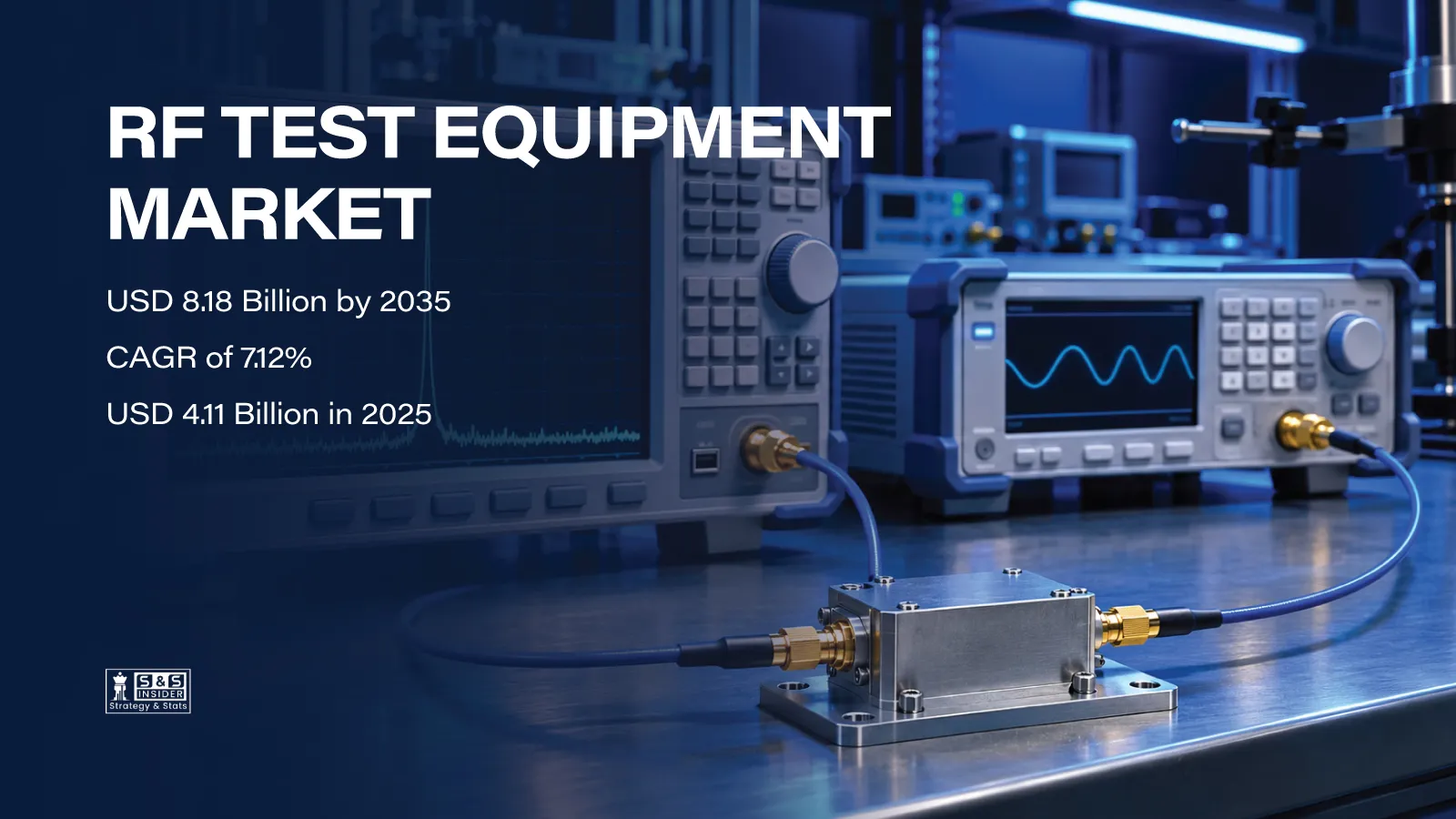
Equipment manufacturers are responding with modular testing architectures, software-defined measurement capabilities, automated testing systems, and high-frequency analyzers. These developments are improving laboratory productivity while enabling manufacturers to address increasingly demanding wireless performance requirements.
Asia-Pacific remains the largest regional market, benefiting from extensive electronics manufacturing, semiconductor production, and wireless network investment. The region is also expected to record the fastest growth through 2035.
Market Size and Forecast
|
Market Indicator |
Value |
|
Global Market Size, 2025 |
USD 4.11 Billion |
|
Global Market Size, 2026 |
USD 4.40 Billion |
|
Global Market Forecast, 2035 |
USD 8.18 Billion |
|
CAGR, 2026–2035 |
7.12% |
|
Leading Region, 2025 |
Asia-Pacific (36.84%) |
|
Fastest-Growing Region |
Asia-Pacific (8.03% CAGR) |
|
Leading Product Type |
Spectrum and Signal Analyzers |
|
Leading End User |
Telecommunications |
Demand Drivers and Market Constraints
Primary Demand Drivers
- 5G-Advanced network expansion: Increasing network density, advanced modulation technologies, and wider communication channels require precise RF testing throughout infrastructure development and device certification.
- Emerging 6G research: Research institutions and equipment developers are investing in higher-frequency measurement capabilities to evaluate prospective next-generation wireless technologies.
- Automotive radar integration: Advanced driver assistance systems, radar sensors, and connected vehicle technologies are expanding testing requirements across automotive development and manufacturing.
- Satellite communication development: Low Earth orbit satellite networks and advanced communication terminals create demand for high-frequency signal analyzers and network testing equipment.
- Semiconductor manufacturing growth: Increasing RF chip complexity encourages semiconductor producers to adopt efficient and automated testing systems.
- Test equipment modernization: Software-defined instruments and modular platforms offer manufacturers greater flexibility when testing multiple wireless standards.
Potential Growth Constraints
High acquisition costs remain a significant obstacle, particularly for smaller manufacturers and research laboratories. Advanced instruments require substantial investment in calibration, software, accessories, and maintenance. Rapidly changing wireless standards can also shorten equipment upgrade cycles. Additionally, shortages of experienced RF engineers, specialized component supply constraints, and international export restrictions may affect procurement decisions.
Demand Structure by Product Type
Spectrum and Signal Analyzers (2025 Market Share: 25.38%)
Spectrum and signal analyzers accounted for approximately 25.38% of the global market in 2025, representing the largest product category. These instruments enable engineers to measure signal strength, spectral characteristics, modulation performance, and unwanted interference. Their applications extend across wireless infrastructure, aerospace electronics, semiconductor development, and industrial communication systems. The increasing complexity of modern RF designs is encouraging laboratories to invest in instruments with greater measurement bandwidth, improved sensitivity, and advanced signal processing.
Current trend: Increasing demand for high-precision signal characterization across multiple wireless technologies.
Major trends: Real-time spectrum analysis, automated measurements, wider bandwidth coverage, and advanced interference detection.
Wireless Test Equipment (Forecast CAGR: 8.77%)
Wireless test equipment is projected to be the fastest-growing product category, expanding at approximately 8.77% CAGR through 2035. The proliferation of interconnected devices requires manufacturers to verify compatibility across cellular, Wi-Fi, and emerging communication standards. Wireless communication testers and channel emulators enable device manufacturers to evaluate network performance under controlled conditions before commercial deployment. Growing complexity in Wi-Fi 7, future Wi-Fi standards, 5G-Advanced, and satellite-enabled connectivity is expected to increase testing requirements.
Current trend: Rising investment in multi-standard wireless device validation.
Major trends: Network emulation, automated certification, interoperability testing, and advanced wireless performance assessment.
Demand Structure by Frequency Range
1 to 6 GHz (2025 Market Share: 56.38%)
The 1 to 6 GHz frequency category dominated the market with approximately 56.38% share in 2025. This range supports numerous established wireless applications, including cellular communications, Wi-Fi networks, and industrial connectivity solutions. Extensive deployment across commercial telecommunications and electronics manufacturing generates continuous demand for signal measurement and device verification. The availability of established testing infrastructure and relatively accessible equipment also supports adoption among manufacturers and research institutions.
Current trend: Consistent demand for established wireless frequency testing.
Above 6 GHz (Forecast CAGR: 9.42%)
Equipment operating above 6 GHz is projected to register the fastest frequency-range growth, with a CAGR of approximately 9.42% during 2026–2035. Growth is supported by millimeter-wave communications, automotive radar, advanced satellite systems, and emerging wireless research. Higher frequencies introduce additional measurement complexity, including signal attenuation, calibration sensitivity, and antenna performance challenges. These requirements are encouraging investment in specialized analyzers, frequency extension systems, and advanced measurement environments.
Current trend: Accelerating demand for high-frequency and millimeter-wave testing capabilities.
Demand Structure by Form Factor
Benchtop Equipment (2025 Market Share: 42.76%)
Benchtop instruments held approximately 42.76% of market revenue in 2025, maintaining leadership through their measurement accuracy, reliability, and broad application flexibility. Research laboratories, electronics manufacturers, and equipment developers use these systems for detailed signal evaluation, component characterization, and product validation. Their established functionality makes them valuable for engineering environments requiring comprehensive measurement capabilities.
Modular Equipment (Forecast CAGR: 8.83%)
Modular RF test equipment is expected to grow at approximately 8.83% CAGR through 2035. Manufacturers increasingly favor configurable systems that combine measurement modules within integrated testing platforms. These architectures support automated production testing, efficient laboratory space utilization, and upgrades without replacing complete systems.
Current trend: Growing adoption of scalable, software-controlled measurement platforms.
Demand Structure by End User
Telecommunications (2025 Market Share: 35.74%)
Telecommunications represented approximately 35.74% of global market demand in 2025. Wireless infrastructure manufacturers, network operators, and communication device developers rely on RF testing to verify network reliability, transmission quality, and equipment compliance. The deployment of 5G-Advanced technologies and the transition toward more sophisticated communication architectures continue to support equipment investment. Network maintenance, troubleshooting, and certification activities also generate recurring demand for portable and laboratory-based testing systems.
Automotive (Forecast CAGR: 8.68%)
Automotive is projected to be the fastest-growing end-use industry, expanding at approximately 8.68% CAGR during 2026–2035. Modern vehicles incorporate radar-based driver assistance, wireless connectivity, satellite navigation, and electronic communication modules. Automotive manufacturers and suppliers require specialized instruments to validate radar performance, assess electromagnetic compatibility, and verify communication reliability. The wider adoption of connected and automated vehicle technologies is expected to increase RF testing requirements across design centers and production facilities.
Current trend: Expanding automotive demand for radar validation and connected vehicle testing.
Regional Market Dynamics
Asia-Pacific (2025 Share: 36.84%; CAGR: 8.03%)
Asia-Pacific leads the global RF test equipment market, accounting for approximately 36.84% of revenue in 2025. The region is also forecast to grow fastest, at approximately 8.03% CAGR through 2035. China, Japan, South Korea, India, and Southeast Asian manufacturing economies contribute to demand through semiconductor production, electronics assembly, and wireless infrastructure development. China accounted for approximately 38.64% of Asia-Pacific market revenue in 2025. Continued investment in communications infrastructure, automotive electronics, and domestic technology manufacturing is expected to reinforce regional leadership.
North America (2025 Market Share: 33.27%)
North America represented approximately 33.27% of the global market in 2025. Demand is supported by defense electronics programs, aerospace research, semiconductor development, and advanced wireless infrastructure. The United States accounted for approximately 87.41% of regional market revenue in 2025. Investment in satellite communications, next-generation network research, and defense systems is expected to sustain demand for high-performance RF measurement instruments.
Europe (2025 Market Share: 23.19%)
Europe accounted for approximately 23.19% of the market in 2025. Automotive radar engineering, aerospace development, industrial wireless systems, and telecommunications research are important demand contributors. Germany represented approximately 25.73% of Europe's regional market revenue.Increasing vehicle connectivity, industrial automation, and regulatory testing requirements are expected to support continued equipment adoption.
Middle East & Africa
The Middle East & Africa market is developing through telecommunications infrastructure investment, defense modernization, and satellite communication initiatives. Saudi Arabia accounted for approximately 30.27% of regional demand in 2025. Growing wireless coverage and spectrum monitoring requirements are encouraging investment in portable analyzers, field testing systems, and network verification equipment.
Latin America
Latin American demand is supported by expanding wireless networks, electronics manufacturing, and automotive production. Brazil represented approximately 47.38% of regional market revenue in 2025. Operators and equipment manufacturers are expected to increase investment in field testing and network maintenance as connectivity infrastructure develops.
Competitive Landscape
The global RF test equipment market features established measurement instrument manufacturers and specialized wireless testing technology providers. Prominent participants include Keysight Technologies, Rohde & Schwarz, Anritsu, Tektronix, NI, VIAVI Solutions, Teradyne, Teledyne Technologies, Copper Mountain Technologies, Maury Microwave, SIGLENT, RIGOL, and Signal Hound. Competition centers on measurement accuracy, frequency coverage, software integration, automation capabilities, and customer support. Product innovation remains important as manufacturers introduce instruments designed for higher frequencies, complex wireless standards, and automated testing environments. During 2026, notable developments included Keysight's introduction of advanced signal analyzers, NI's expansion of modular RF testing solutions, and VIAVI's release of enhanced channel emulation technology.
Market Outlook (2026–2035)
The global RF test equipment market is forecast to reach USD 8.18 Billion by 2035, supported by sustained investment in wireless communication infrastructure, automotive electronics, semiconductor production, and aerospace technologies. Growth opportunities will increasingly favor instruments capable of supporting multiple communication standards, higher frequency ranges, and automated measurement workflows. Modular systems and software-defined platforms are expected to gain importance as manufacturers seek flexible testing solutions that reduce infrastructure complexity. Asia-Pacific is positioned to retain its leadership through extensive electronics manufacturing activity, while North America and Europe will continue contributing demand for advanced defense, aerospace, and automotive testing technologies. Although high equipment costs and evolving technical requirements may constrain purchasing decisions, the need for reliable RF performance verification remains fundamental to modern electronic systems. Overall, market growth through 2035 will be shaped by high-frequency testing innovation, wireless technology development, and increasing demand for accurate, efficient, and scalable RF measurement solutions.
About the Author

Get in touch




