
The world opto semiconductors market is entering a period of rapid technological development as car manufacturers, electronics companies and industrial equipment makers increase their reliance on light-based semiconductor technologies. The semiconductor industry is facing new opportunities because of increasing demand for advanced image sensors, energy-efficient lighting, optical communication components and intelligent sensing systems.
According to SNS Insider's Opto Semiconductors Market report, the global market was valued at USD 66.12 billion in 2025 and is estimated to reach USD 73.42 billion in 2026. Revenue is projected to increase to USD 188.42 billion by 2035, representing a CAGR of 11.04% during 2026–2035.
To Get Detailed Insights on the Opto Semiconductors Market – Request a Sample Report
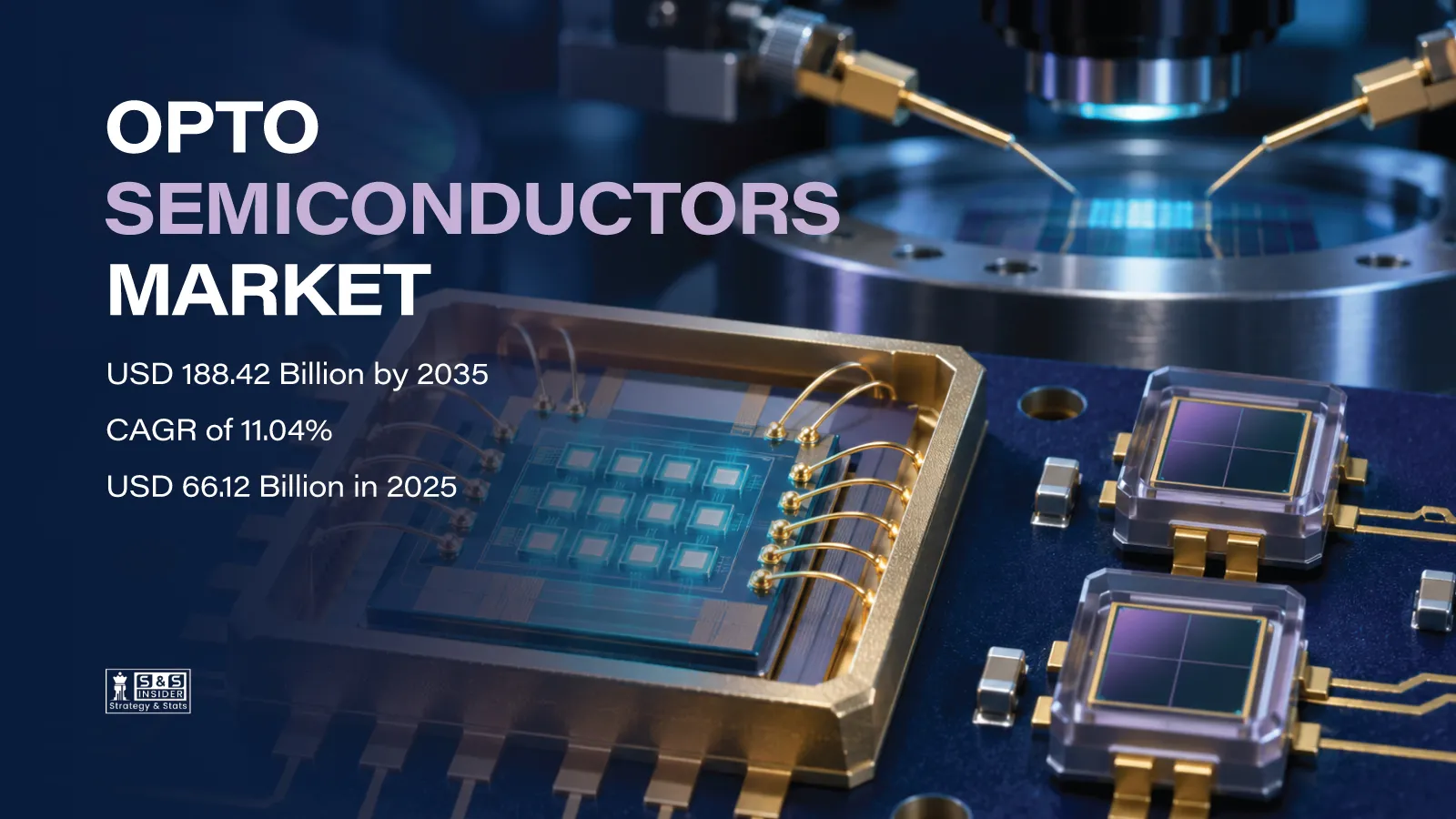
Opto semiconductors are made up of light emitting diodes, image sensors, photodiodes, infrared components, optocouplers and laser diodes. They are used for lighting, imaging, object detection, optical isolation and high-speed data transmission in a broad range of applications.
The industry’s growth reflects a shift toward more advanced optical functions in electronic systems. We need more cameras and optical sensors for cars, more advanced imaging capabilities in smartphones, and high-bandwidth optical connections for AI data centers.
Asia Pacific represents the largest regional market and is also projected to expand at the fastest pace, supported by its extensive electronics manufacturing infrastructure and increasing investment in compound semiconductor technologies.
Market Size and Forecast
|
Market Indicator |
Value |
|---|---|
|
Market Size, 2025 |
USD 66.12 Billion |
|
Market Size, 2026 |
USD 73.42 Billion |
|
Market Forecast, 2035 |
USD 188.42 Billion |
|
CAGR, 2026–2035 |
11.04% |
|
Largest Regional Market |
Asia Pacific, 43.58% |
|
Fastest-Growing Region |
Asia Pacific, 11.90% CAGR |
|
Leading Product Type |
LEDs, 30.74% |
|
Fastest-Growing Product Type |
Image Sensors, 12.67% CAGR |
Demand Drivers and Constraints
Primary Demand Drivers
Automotive Lighting and Advanced Driver Assistance Systems
Increasing integration of optical components in modern vehicles is becoming an important source of semiconductor demand. Adaptive headlights, surround-view cameras, driver monitoring systems and LiDAR technologies require specialized light emitters and detectors.
As automotive manufacturers expand advanced driver assistance capabilities across different vehicle categories, the number of optical components required per vehicle is increasing. This creates opportunities for suppliers offering reliable, automotive-qualified semiconductor solutions.
Smartphone Imaging and 3D Sensing Technologies
Smartphones remain important applications for advanced opto semiconductors. Manufacturers are adding higher-resolution cameras, sophisticated facial recognition, proximity detection and better low-light imaging capabilities.
The growing use of optical sensors in consumer devices drives the need for smaller components that can deliver better performance while consuming the least amount of power.
Energy-Efficient and Intelligent Lighting
The shift from conventional lighting technologies to LED-based solutions has driven the demand in the market.
Efficient lighting systems are being adopted for commercial buildings, residential properties, transportation infrastructure and industrial facilities to cut down on electricity consumption and operating expenses.
Higher-value applications are also being generated by smart lighting technologies that feature automated brightness adjustment, connectivity and programmable color controls.
Artificial Intelligence and Optical Communications
Rapid development of AI computing infrastructure is opening additional opportunities for optical semiconductor manufacturers.
Data centers increasingly require communication technologies capable of transferring large volumes of information with greater energy efficiency. Laser diodes, photodiodes and optical interconnect components are therefore gaining strategic importance in next-generation computing systems.
Potential Growth Constraints
Several challenges could affect market expansion:
- Critical material availability: Concentrated supplies and trade restrictions involving materials such as gallium and germanium can create procurement uncertainty.
- LED price competition: Standard lighting components face pricing pressure from established manufacturing capacity and intense supplier competition.
- Manufacturing investment: Advanced optical devices require specialized equipment, semiconductor fabrication processes and extensive testing.
- Thermal management: Higher-performance devices must control heat generation to maintain efficiency and operational reliability.
- Supply chain concentration: Geographic dependence on selected manufacturing regions can expose buyers to disruptions.
Demand Structure by Product Type
LEDs (2025 Market Share: 30.74%)
LEDs represent the largest product category, accounting for approximately 30.74% of global opto semiconductor market revenue in 2025.
Their broad adoption across lighting, electronic displays, automotive systems and industrial equipment supports substantial demand.
Automotive manufacturers increasingly require sophisticated LED solutions for adaptive headlights, interior illumination and vehicle signaling. Commercial customers are also investing in connected lighting systems that combine energy efficiency with intelligent control.
Emerging technologies such as micro-LEDs are creating additional possibilities in premium displays, augmented reality devices and high-resolution lighting applications.
Current trend: Growing demand for advanced LED architectures and specialized automotive lighting.
Major trends: Micro-LED development, intelligent illumination, adaptive headlights and high-efficiency semiconductor materials.
Image Sensors (Forecast CAGR: 12.67%)
Image sensors are projected to be the fastest-growing product category, expanding at a CAGR of approximately 12.67% during 2026–2035.
Demand is increasing across smartphones, automotive cameras, industrial robots, security equipment and medical imaging devices.
Manufacturers are prioritizing higher image quality, improved dynamic range, faster processing and advanced depth-sensing capabilities.
The expansion of machine vision and automated inspection is also supporting demand for specialized sensors capable of operating under demanding industrial conditions.
Current trend: Increasing adoption of high-performance imaging and depth-sensing semiconductor solutions.
Major trends: CMOS sensor innovation, automotive camera integration, three-dimensional sensing and machine vision.
Demand Structure by Semiconductor Material
Silicon (2025 Market Share: 41.26%)
Silicon remains the leading semiconductor material, capturing approximately 41.26% of market revenue in 2025.
Its established manufacturing infrastructure, cost advantages and compatibility with integrated circuits make it particularly important for image sensors, photodiodes and other optical detection components.
Semiconductor manufacturers benefit from mature fabrication processes that support consistent production quality and large-scale supply.
Increasing integration of sensing functions into consumer electronics and industrial equipment is expected to sustain silicon-based device demand.
Current trend: Continued reliance on established silicon manufacturing for high-volume optical sensing.
Gallium Nitride (Forecast CAGR: 13.38%)
Gallium nitride is projected to register the fastest material growth, with a CAGR of approximately 13.38% through 2035.
Its properties make it important for high-brightness LEDs, ultraviolet emitters and emerging micro-LED technologies.
Increasing investment in advanced semiconductor substrates and fabrication processes is supporting development of higher-performance gallium nitride devices.
Automotive lighting, specialized displays and industrial optical applications represent promising opportunities for manufacturers capable of improving production yields and reducing costs.
Current trend: Expanding commercialization of advanced gallium nitride-based optical devices.
Demand Structure by Application
Residential and Commercial (2025 Market Share: 54.36%)
Residential and commercial applications account for the largest market share, representing approximately 54.36% of revenue in 2025.
Demand is supported by widespread LED lighting adoption, consumer electronics production, building automation and optical sensing applications.
Commercial facilities increasingly employ connected lighting systems, while consumer devices require sophisticated imaging and proximity detection capabilities.
Regular replacement of electronic devices and continued lighting modernization provide an established demand base.
Industrial (Forecast CAGR: 12.95%)
Industrial applications are expected to expand at a CAGR of approximately 12.95% between 2026 and 2035.
Manufacturers are integrating optical sensors into robotics, automated production lines, quality inspection equipment and industrial monitoring systems.
Machine vision enables automated defect identification, accurate positioning and improved production consistency.
Increasing adoption of intelligent manufacturing technologies is expected to support demand for durable optical components capable of delivering reliable performance in industrial environments.
Regional Market Dynamics
Asia Pacific (2025 Share: 43.58%; CAGR: 11.90%)
Asia Pacific dominates the global market with a 43.58% revenue share in 2025 and is forecast to record the fastest regional CAGR of 11.90%.
The region benefits from extensive semiconductor manufacturing capacity, major consumer electronics production facilities and growing automotive technology investment.
China accounts for approximately 47.59% of the regional market, while Japan, South Korea, Taiwan and India contribute through semiconductor manufacturing, optical component development and electronics production.
Continued expansion of advanced packaging, compound semiconductor manufacturing and automated production infrastructure is expected to reinforce regional growth.
North America (2025 Share: 28.81%)
North America holds approximately 28.81% of the global market, supported by demand from automotive manufacturers, industrial technology companies, defense applications and data center operators.
The United States market was valued at USD 16.69 billion in 2025 and is projected to expand at a CAGR of 11.58% through 2035.
Investment in photonics research, high-performance computing and advanced sensing technologies is supporting opportunities for specialized component manufacturers.
Europe
Europe represents an important market for automotive lighting, industrial sensing and specialty photonics.
Germany accounts for approximately 26.82% of regional demand, supported by its automotive and industrial manufacturing industries.
Increasing adoption of factory automation, energy-efficient lighting and sophisticated vehicle electronics is expected to sustain regional growth.
Latin America and Middle East & Africa
Latin America is experiencing developing demand for optical components across automotive assembly, lighting infrastructure and industrial applications. Brazil represents approximately 49.76% of its regional market.
In the Middle East & Africa, Saudi Arabia accounts for approximately 33.45% of regional demand. Infrastructure development, smart city projects and energy-efficient lighting investments are supporting market opportunities.
Competitive Landscape and Industry Developments
The global opto semiconductor market includes established semiconductor manufacturers and specialized photonics technology providers.
Major companies identified in the SNS Insider report include ams OSRAM, Sony Semiconductor Solutions, onsemi, Vishay Intertechnology, Hamamatsu Photonics, Coherent and STMicroelectronics.
Competition increasingly focuses on imaging performance, optical efficiency, manufacturing reliability and integration with advanced electronic systems.
Recent developments highlighted by SNS Insider include:
- March 2025: onsemi introduced its Hyperlux ID family of indirect time-of-flight depth sensors.
- September 2025: Coherent introduced VCSEL and photodiode arrays designed for AI optical interconnect applications.
- March 2026: Sony Semiconductor Solutions announced its IMX908 image sensor.
- June 2026: STMicroelectronics introduced the VL53L9 direct time-of-flight sensing module.
These developments illustrate growing supplier investment in automotive sensing, advanced imaging and optical communication technologies.
Market Outlook (2026–2035)
The SNS Insider baseline forecast projects the opto semiconductors market will increase to USD 188.42 billion by 2035, driven by technological advancement and expanding applications.
Automotive electronics, intelligent sensing, efficient lighting and high-speed optical communications will remain central growth areas.
Increasing adoption of machine vision and advanced manufacturing systems is also expected to create opportunities for suppliers developing specialized industrial components.
Meanwhile, gallium nitride devices, micro-LED technologies and advanced image sensors offer opportunities for product differentiation and higher-value applications.
Despite challenges involving manufacturing costs, material availability and pricing competition, the market's diversified application base supports a favorable long-term outlook.
Overall, the opto semiconductors market is positioned for sustained expansion through 2035, with growth increasingly determined by optical performance, energy efficiency, manufacturing capabilities and integration into next-generation electronic systems.About the Author

Get in touch




