
The global optoelectronics industry is entering a new investment cycle as light-based components become essential to computing, mobility, manufacturing and connected devices. Rather than depending on a single product category, demand is spreading across technologies that generate, detect or transform light. LEDs remain important for everyday illumination, while image sensors, laser diodes and photodetectors are gaining strategic relevance in higher-value equipment.
According to the updated SNS Insider Optoelectronics Market report, the industry was worth USD 61.73 billion in 2025, is estimated at USD 67.46 billion in 2026 and is forecast to reach USD 149.94 billion by 2035, at a CAGR of 9.28% over 2026–2035. The revised report identifies Asia-Pacific as both the largest and fastest-growing regional market.
To Get Detailed Insights on the Optoelectronics Market – Request a Sample Report
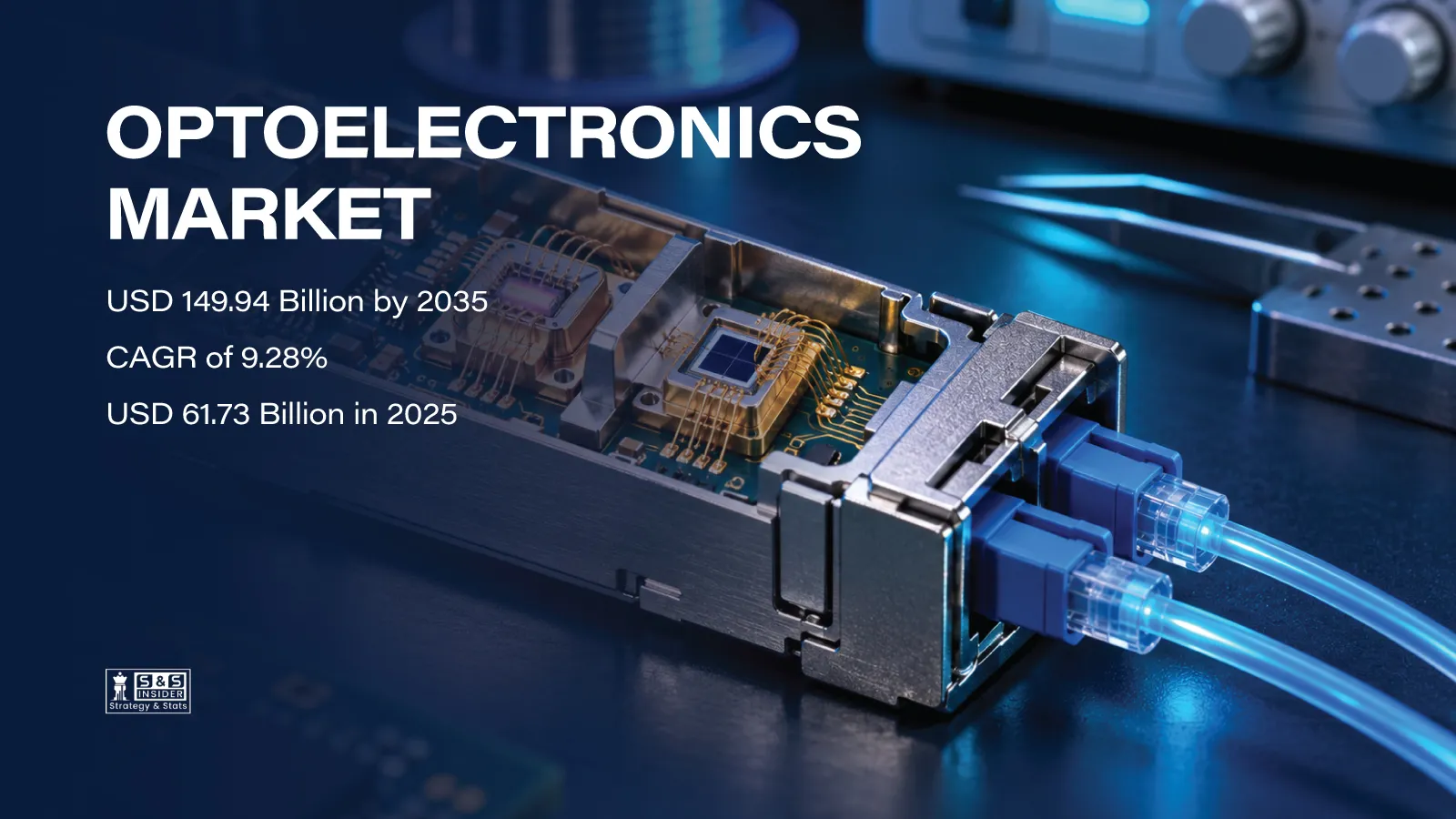
Beyond rising unit shipments, growth increasingly depends on how much optical functionality manufacturers integrate into each product. Faster data links require sophisticated light sources and receivers; vehicles need multiple sensing systems; and smaller consumer devices must deliver better visual performance without excessive power consumption. This combination is changing supplier priorities from component volume alone toward performance, reliability and production yield.
Market Size and Forecast
|
Indicator |
Updated Forecast |
|
Global market size, 2025 |
USD 61.73 Billion |
|
Global market size, 2026 |
USD 67.46 Billion |
|
Global market size, 2035 |
USD 149.94 Billion |
|
CAGR, 2026–2035 |
9.28% |
|
Leading region, 2025 |
Asia-Pacific: 43.64% share |
|
Fastest-growing region |
Asia-Pacific: 10.51% CAGR |
|
U.S. market size, 2025 |
USD 14.40 Billion |
Demand Drivers and Market Constraints
Primary Growth Drivers
AI infrastructure and optical connectivity. Large computing installations must move information rapidly between accelerators, switches and storage systems. As electrical connections encounter distance, heat and bandwidth limitations, optical transmitters, receivers and photonic components become increasingly valuable. Upgrades to faster networking equipment create opportunities beyond traditional telecom applications.
Modern automotive electronics. Adaptive headlamps, driver-facing cameras, LiDAR and infrared sensing place more optical devices inside each vehicle. Automotive customers also emphasize long product lifetimes and stringent qualification, giving established suppliers opportunities to develop durable commercial relationships.
Lighting replacement and intelligent controls. LED retrofits continue in buildings, roads, factories and specialist environments. Connected fixtures add sensing and control functions, raising the technological content of lighting installations even where basic LED products face pricing pressure.
Premium imaging and medical technology. Smartphones, security equipment, industrial inspection systems and diagnostic devices increasingly require compact sensors with improved sensitivity. New use cases reward component makers that can combine low power consumption with reliable image quality.
Principal Constraints
Growth faces obstacles in expensive semiconductor fabrication, limited supplies of certain compound materials and complex engineering integration. MicroLED manufacturing and advanced lasers can suffer from yield challenges before reaching economical production volumes. Buyers in price-sensitive markets may delay upgrades, while automotive and medical qualification schedules can postpone commercial launches. Geopolitical supply risks also encourage customers to diversify procurement and inventory strategies.
Demand Structure by Device Type
LEDs Lead; Image Sensors Gain Momentum
LEDs represented 32.86% of the market in 2025, making them the largest device category. Their broad use in illumination, indicators, electronics and vehicle lighting provides a substantial installed demand base. Opportunities increasingly lie in differentiated products, including highly controlled automotive beams, miniaturized emitters and application-specific lighting.
Image sensors are the fastest-growing device type, with an expected 11.83% CAGR during 2026–2035. Greater camera use in vehicles, robots, phones and security equipment is increasing the number of sensors per system. Suppliers that improve low-light capability, processing speed and compact packaging will be positioned to serve these emerging applications.
Demand Structure by Material
Silicon Retains Scale; Gallium Nitride Advances
Silicon held a 32.17% share in 2025, benefiting from manufacturing maturity, cost efficiency and compatibility with established electronics processes. It supports widely used photodiodes, image sensors and other light-responsive devices, while silicon photonics offers a path to more integrated communications hardware.
Gallium nitride is forecast to expand at an 11.46% CAGR through 2035. Its properties enable efficient light emission and support applications such as blue LEDs, microLED arrays and selected laser devices. Commercial adoption will depend partly on epitaxial wafer quality, processing economics and consistent yields as manufacturers scale production.
Demand Structure by Application
Lighting Leads; Communication Expands Faster
Lighting accounted for 29.41% of market revenue in 2025. Replacement of conventional lamps remains a fundamental source of demand, while industrial facilities, infrastructure operators and commercial property owners are increasingly evaluating lighting together with controls, maintenance and electricity consumption.
Communication is the fastest-growing application, projected at an 11.37% CAGR over 2026–2035. Data center and fiber-network investments are stimulating purchases of lasers, photodetectors and integrated optical devices. For suppliers, the commercial opportunity lies not simply in selling more components but in meeting tougher requirements for transmission speed, energy efficiency and thermal performance.
Demand Structure by End Use
Consumer Electronics Dominates; Automotive Accelerates
Consumer electronics contributed 31.58% of revenue in 2025. Cameras, wearables, televisions and smart devices collectively sustain large orders for emitters and sensors. Product differentiation increasingly depends on improved image capture, brighter displays and smaller optical assemblies.
Automotive is projected to record the fastest end-use growth at 10.63% CAGR through 2035. As safety and automation features reach broader vehicle categories, manufacturers require higher-performance lighting, sensing and isolation devices. Strict reliability standards could favor suppliers capable of maintaining consistent quality at industrial scale.
Regional Market Dynamics
Asia-Pacific: Largest and Fastest-Growing Region
Asia-Pacific held 43.64% of global revenue in 2025 and is forecast to grow at 10.51% CAGR through 2035. The region combines semiconductor fabrication, electronics assembly and substantial domestic device demand. China accounted for 41.37% of the Asia-Pacific market in 2025, while Japan, South Korea and Taiwan contribute specialized expertise across imaging, displays and optical devices. Expanding manufacturing ecosystems in India and Southeast Asia provide additional capacity and sourcing options.
North America: Strong Demand from Data Centers and Specialized Systems
The U.S. market was valued at USD 14.40 billion in 2025 and is expected to grow at 8.84% CAGR from 2026–2035. The country represented 88.46% of North American demand in 2025. AI computing infrastructure, aerospace applications, defense equipment and medical imaging support higher-specification optoelectronic components, alongside ongoing investment in domestic semiconductor capabilities.
Europe: Automotive and Industrial Applications Anchor Demand
Europe's market draws on automotive engineering, industrial automation and specialist photonics. Germany accounted for 26.41% of regional demand in 2025. Manufacturers across the region continue to prioritize dependable sensors, efficient lighting, precision lasers and components capable of meeting rigorous operating requirements.
Latin America and Middle East & Africa: Infrastructure-Led Opportunities
Brazil represented 38.22% of Latin American demand in 2025, where lighting modernization, electronics assembly and surveillance installations support purchases. In the Middle East & Africa, Saudi Arabia accounted for 27.18% of regional revenue. Smart infrastructure, solar energy equipment and telecom projects create opportunities, although import dependence, purchasing costs and uneven industrial capacity remain challenges.
Competitive Landscape and 2026 Developments
Competition spans diversified electronics companies and specialized makers of emitters, sensors and optical communications hardware. The SNS Insider report identifies ams OSRAM, Nichia, Lumileds, Seoul Semiconductor, Samsung Electronics, LG Innotek, Broadcom, Vishay Intertechnology, Sony Semiconductor Solutions, Hamamatsu Photonics, Lumentum, Coherent Corp. and other participants.
Recent activity illustrates how strategies are shifting. In January 2026, LG Innotek showcased a compact LiDAR solution developed with Aeva. In March 2026, Broadcom presented 400G-per-lane optical technology, while Lumentum moved to repurpose a Greensboro facility for indium phosphide manufacturing. These initiatives illustrate investment in advanced sensing, higher-bandwidth links and specialized production capacity.
Market Outlook: 2026–2035
The move toward USD 149.94 billion by 2035 is likely to be shaped by two different demand patterns. High-volume LED and consumer products will reward manufacturing efficiency and cost control, while optical networking, advanced sensing and specialty lasers will reward performance improvements and application-specific expertise.
Supply-chain resilience is becoming a commercial consideration alongside device specifications. Customers may increasingly compare suppliers on capacity commitments, manufacturing geography and the ability to qualify components across several product generations. Firms that balance innovation with dependable output stand to benefit as optical technology becomes more deeply embedded in digital infrastructure, mobility and industrial equipment.
About the Author

Get in touch




