
The global hepatitis testing market is entering a period of sustained expansion as healthcare systems strengthen viral hepatitis detection, increase screening coverage, and adopt advanced molecular diagnostic technologies. Growing awareness of hepatitis B and C infections, government-backed elimination initiatives, and improvements in laboratory infrastructure are supporting demand for reliable diagnostic solutions across developed and emerging healthcare markets.
According to SNS Insider, the global hepatitis testing market was valued at USD 4.42 billion in 2025 and is estimated at USD 4.67 billion in 2026. The market is projected to reach USD 7.65 billion by 2035, registering a CAGR of 5.64% during 2026–2035.
The industry is evolving from conventional antibody-based screening toward integrated diagnostic pathways combining immunoassays, nucleic acid testing, rapid diagnostics, and automated laboratory platforms. This transition is creating opportunities for diagnostic manufacturers, clinical laboratories, molecular testing specialists, and healthcare technology providers.
North America remains the largest regional market, while Asia-Pacific is expected to experience the fastest growth as governments expand hepatitis screening and improve access to confirmatory testing.
To Get Detailed Insights on the Hepatitis Testing Market – Request a Sample Report
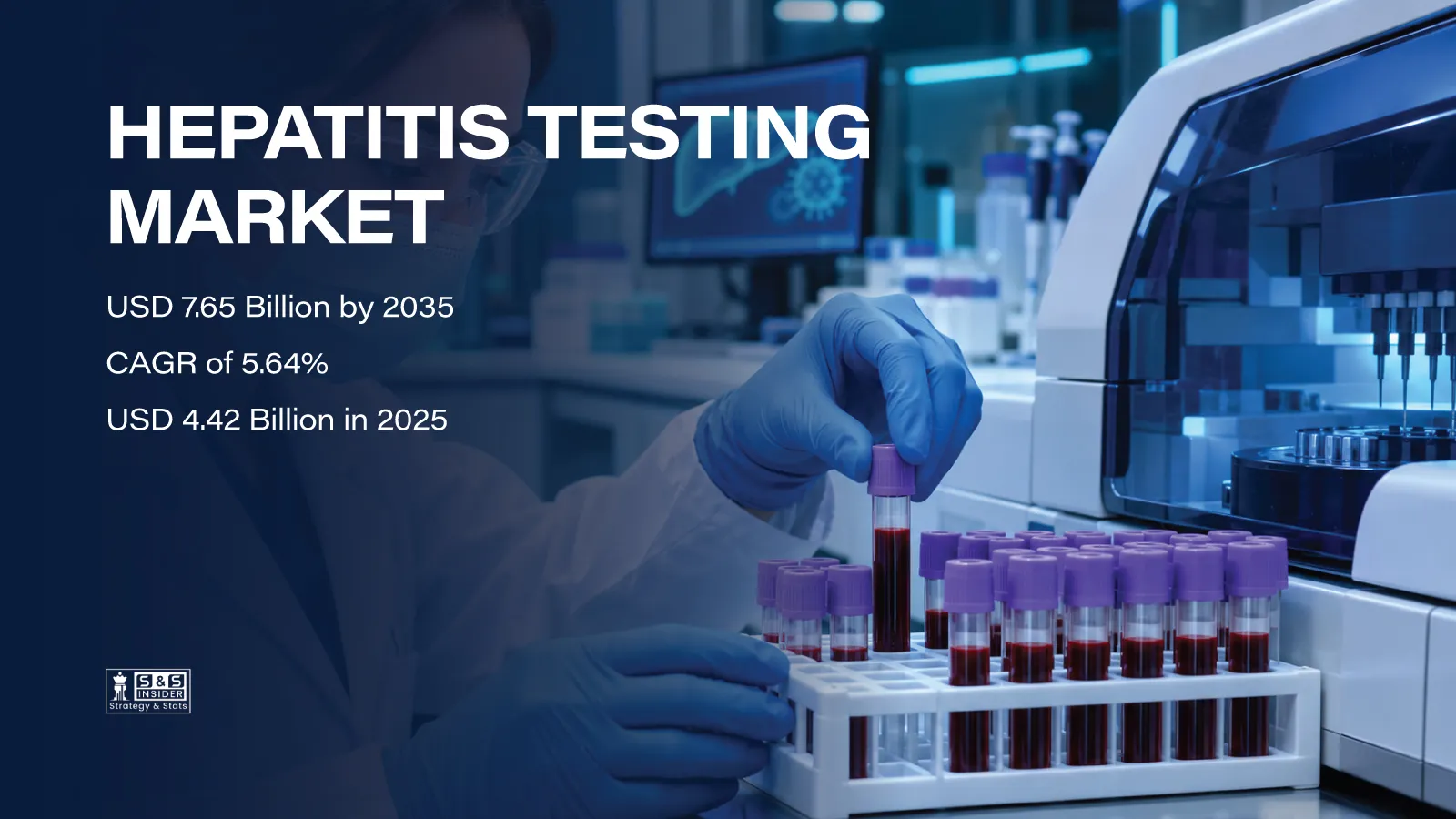
Market Size and Forecast
| Market Indicator | Value |
|---|---|
| Global Market Size, 2025 | USD 4.42 Billion |
| Global Market Size, 2026 | USD 4.67 Billion |
| Global Market Forecast, 2035 | USD 7.65 Billion |
| CAGR, 2026–2035 | 5.64% |
| North America Share, 2025 | 41.46% |
| Asia-Pacific Forecast CAGR | 6.54% |
| Leading Disease Segment | Hepatitis B (46.72%) |
| Leading Technology Segment | Immunoassays (46.58%) |
Demand Drivers and Constraints
Primary Demand Drivers
-
Increasing hepatitis disease burden: Undiagnosed hepatitis B and C infections continue to create demand for early detection, viral load assessment, and treatment monitoring.
-
Government screening initiatives: Public health programs targeting hepatitis elimination are encouraging routine testing among adults, pregnant women, blood donors, and higher-risk populations.
-
Molecular diagnostics adoption: PCR-based and other nucleic acid technologies are gaining importance for confirming active infection and measuring viral load.
-
Point-of-care testing expansion: Portable and rapid diagnostic technologies are improving access in community clinics, rural healthcare facilities, and outreach programs.
-
Growing laboratory automation: High-throughput analyzers are helping hospitals and diagnostic laboratories improve testing capacity and turnaround times.
-
Increasing blood safety requirements: Blood banks continue investing in infectious disease screening technologies to reduce transfusion-related risks.
Potential Growth Constraints
-
High acquisition and operating costs associated with molecular testing platforms.
-
Inadequate diagnostic infrastructure in underserved regions.
-
Shortages of trained laboratory professionals.
-
Regulatory complexity surrounding self-testing technologies.
-
Limited healthcare budgets and reimbursement coverage in developing economies.
Demand Structure by Disease
Hepatitis B (2025 Market Share: 46.72%)
Hepatitis B represents the largest disease segment, accounting for approximately 46.72% of global hepatitis testing revenue in 2025. Its established position reflects widespread screening requirements across prenatal healthcare, blood donation centers, hospitals, and routine diagnostic services. Healthcare providers use hepatitis B surface antigen and antibody assays to identify infections, evaluate immunity, and guide clinical decisions. The need for viral load monitoring among patients with chronic infection generates additional demand for molecular testing. Government vaccination programs also support testing for immune status in selected populations.
Current trend: Sustained demand for hepatitis B screening and long-term infection monitoring.
Major trends: Automated immunoassays, prenatal screening, molecular viral load testing, and integrated laboratory workflows.
Hepatitis C (Forecast CAGR: 6.41%)
Hepatitis C is expected to register the fastest growth among disease segments, with a projected CAGR of 6.41% from 2026 to 2035. Increasing availability of effective antiviral treatments is encouraging governments to identify undiagnosed individuals and connect them with appropriate care. Hepatitis C testing commonly begins with antibody screening, followed by molecular confirmation of active infection. Wider implementation of reflex testing can reduce delays between these diagnostic stages. Rapid molecular platforms and self-testing technologies are also expanding opportunities for screening populations that experience difficulty accessing conventional laboratory services.
Current trend: Accelerating adoption of hepatitis C elimination-oriented diagnostic programs.
Major trends: Reflex RNA testing, decentralized diagnosis, self-testing, and treatment-linked screening.
Demand Structure by Technology
Immunoassays (2025 Market Share: 46.58%)
Immunoassays dominate the technology segment, representing approximately 46.58% of total market revenue in 2025. These technologies remain central to hepatitis diagnostics because they provide efficient detection of viral antigens and antibodies across high-volume screening environments. Hospitals, reference laboratories, and blood banks routinely use automated immunoassay platforms to process large sample volumes with standardized workflows. Established laboratory infrastructure, relatively economical testing costs, and recurring demand for screening reagents support this segment's market position.
Current trend: Continued utilization of automated immunoassays for routine hepatitis screening.
Major trends: High-throughput analyzers, improved assay sensitivity, laboratory workflow integration, and cost-efficient population screening.
Molecular Tests (Forecast CAGR: 6.97%)
Molecular testing is projected to be the fastest-growing technology segment, registering a CAGR of approximately 6.97% during 2026–2035. Nucleic acid testing technologies help clinicians confirm active viral infection, quantify viral load, and monitor treatment response. Increasing deployment of automated molecular platforms is improving laboratory efficiency and supporting broader adoption beyond specialized reference laboratories. Compact molecular systems are also making advanced testing more accessible in decentralized healthcare settings.
Current trend: Growing preference for molecular confirmation and viral load monitoring.
Major trends: PCR automation, point-of-care RNA testing, integrated molecular platforms, and faster diagnostic turnaround.
Demand Structure by Product and End User
Reagents and Kits (2025 Market Share: 60.38%)
Reagents and kits account for approximately 60.38% of the hepatitis testing market in 2025. Repeated screening, confirmatory diagnosis, and treatment monitoring generate recurring consumption of diagnostic reagents, cartridges, and testing kits. Long-term reagent supply arrangements also support consistent demand from hospital laboratories and centralized diagnostic networks. Meanwhile, software and services are expected to register the fastest product growth, at a CAGR of 6.58%, as laboratories adopt connected reporting, quality management, and information integration solutions.
Current trend: Strong recurring demand for diagnostic consumables alongside increasing digital laboratory integration.
Hospitals and Diagnostic Laboratories (2025 Market Share: 56.73%)
Hospitals and diagnostic laboratories represent the largest end-user category, accounting for 56.73% of revenue in 2025. These facilities conduct routine screening, confirmatory testing, and viral load monitoring while supporting physician-directed diagnosis and treatment planning. Reference laboratories benefit from centralized sample processing and automated diagnostic systems. Blood banks are expected to be the fastest-growing end-user segment, recording a CAGR of 6.73% through 2035 as transfusion safety requirements increase demand for sensitive infectious disease screening.
Current trend: Expansion of automated laboratory testing and enhanced blood donor screening.
Regional Market Dynamics
North America (2025 Market Share: 41.46%)
- North America accounted for approximately 41.46% of global hepatitis testing revenue in 2025, establishing its position as the leading regional market.
- The region benefits from established laboratory networks, routine screening recommendations, advanced molecular diagnostic infrastructure, and public health programs targeting viral hepatitis.
- The United States represented USD 1.61 billion in market revenue in 2025 and is expected to grow at a CAGR of 5.21% through 2035.
- Increasing adoption of automated assays and community-based testing solutions supports regional demand.
Direction: Established market leadership supported by screening policies and diagnostic technology modernization.
Europe — Established Diagnostic Infrastructure
- Europe remains a major hepatitis testing market, supported by national screening initiatives, established healthcare systems, and extensive laboratory capabilities.
- Germany, the United Kingdom, France, Italy, and Spain contribute significantly to regional diagnostic demand.
- Expansion of hepatitis elimination programs and improved testing accessibility in community healthcare settings are encouraging greater adoption of immunoassays and molecular diagnostics.
Direction: Steady expansion supported by public health screening and laboratory modernization.
Asia-Pacific (Forecast CAGR: 6.54%)
- Asia-Pacific is projected to be the fastest-growing regional hepatitis testing market, registering a CAGR of 6.54% from 2026 to 2035.
- China, India, Japan, South Korea, and Southeast Asian countries are expanding hepatitis detection programs and strengthening healthcare infrastructure.
- Government initiatives, rising diagnostic awareness, and broader availability of affordable testing kits are supporting market development.
- Investment in private laboratories and automated molecular systems is also expanding access to advanced testing services.
Direction: Fastest regional growth driven by improved screening coverage and diagnostic accessibility.
Latin America and Middle East & Africa
- Latin America and the Middle East & Africa offer emerging opportunities for hepatitis diagnostic manufacturers.
- Brazil, Mexico, Saudi Arabia, Egypt, and South Africa are important markets where public health programs and laboratory investments support testing demand.
- However, unequal healthcare access, infrastructure limitations, and diagnostic affordability remain significant challenges.
Direction: Gradual expansion through public screening initiatives and accessible diagnostic technologies.
Competitive Landscape
The hepatitis testing industry includes established diagnostics manufacturers and specialized molecular testing companies. Leading participants include Abbott, Roche Diagnostics, Siemens Healthineers, Danaher, Cepheid, Beckman Coulter, Bio-Rad Laboratories, DiaSorin, Grifols, Hologic, and OraSure Technologies. Competition is increasingly focused on assay sensitivity, automation, affordability, platform versatility, and faster diagnostic results. Recent industry developments include Abbott's September 2025 FDA clearance for its Alinity m HCV quantitative assay, DiaSorin's June 2026 clearance for its LIAISON Murex hepatitis B surface antigen assay, and Roche Diagnostics' July 2026 introduction of its cobas hepatitis D RNA test, as reported by SNS Insider. These developments illustrate increasing investment in molecular testing capabilities and broader hepatitis diagnostic menus.
Market Outlook (2026–2035)
The global hepatitis testing market is projected to reach USD 7.65 billion by 2035, supported by expanding screening initiatives, increasing molecular testing adoption, and continued investment in laboratory infrastructure. A major structural shift will involve connecting initial screening with confirmatory diagnosis and clinical follow-up, reducing the number of patients lost between testing stages. Molecular diagnostics are expected to gain importance as healthcare systems prioritize accurate viral detection and treatment monitoring. Meanwhile, rapid testing and decentralized solutions will help improve accessibility in underserved populations. North America is expected to maintain its leading market position, while Asia-Pacific offers the strongest regional growth prospects.
Overall, the hepatitis testing market is positioned for steady expansion through 2035, with opportunities increasingly concentrated in molecular diagnostics, automated laboratory systems, affordable testing technologies, and government-supported hepatitis elimination programs.
About the Author

Get in touch




