
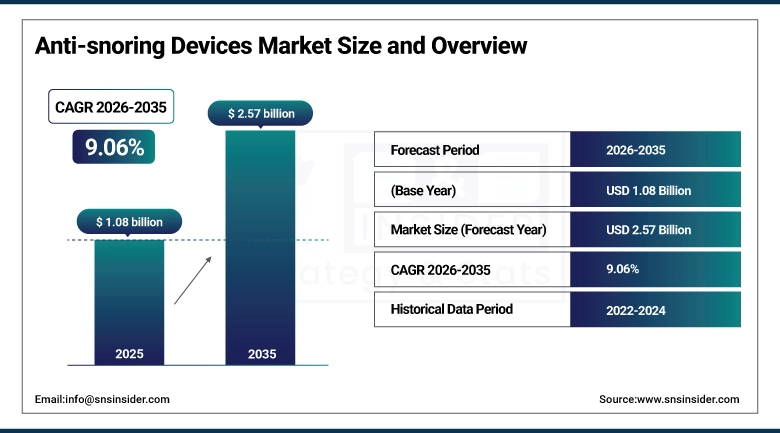
As per the SNS Insider Report titled, Anti-snoring Devices Market by Product Type, by Material, by Distribution Channel, by End User, and Region, Global Forecast 2026–2035, “The global Anti-snoring Devices Market size was estimated at USD 1.08 billion in 2025, is anticipated to grow to USD 2.57 billion by 2035, registering a CAGR of 9.06% over the forecast period 2026–2035.”
Key Takeaways
-
Mandibular Advancement Devices (MADs) accounted for approximately 42.5% of the market share in 2025, driven by their proven effectiveness in reducing snoring and improving airway patency during sleep.
-
Tongue Stabilizing Devices (TSDs) are projected to witness the fastest growth during 2026–2035, registering a CAGR of 12.8% due to increasing adoption among patients seeking non-invasive and easy-to-use treatment options.
-
Thermoplastic materials dominated the market with a 38.9% revenue share in 2025 owing to their affordability, customization capabilities, and widespread use in oral anti-snoring devices.
-
Silicone is expected to register the fastest CAGR of 12.1% through 2035 as manufacturers increasingly focus on comfort, flexibility, and long-term wearability.
-
Specialty Sleep Clinics held approximately 36.7% of the market share in 2025, supported by growing diagnosis rates of sleep-disordered breathing and increasing patient referrals.
-
Online Stores are anticipated to emerge as the fastest-growing distribution channel with a CAGR of 13.5% during the forecast period due to convenience, wider product availability, and growing e-commerce penetration.
-
Homecare Settings represented nearly 41.3% of total market revenue in 2025 as consumers increasingly prefer self-managed treatment solutions that can be used in the comfort of their homes.
-
Sleep Laboratories are expected to witness the fastest growth through 2035, expanding at a CAGR of 12.2% due to rising demand for sleep diagnostics and specialized treatment services.
-
North America captured around 38.00% of total market revenue in 2025, while Asia Pacific is projected to record the fastest CAGR of 11.02% from 2026 to 2035.
Why Anti-snoring Devices Market is Growing?
There are numerous factors boosting the global market of anti-snoring devices. The increase in the number of snoring cases and sleep breathing disorders around the world can be considered one of them. The increased awareness concerning the adverse consequences of snoring on people's health is pushing patients towards choosing appropriate treatments.
Moreover, higher healthcare expenditure and greater availability of sleep diagnosis equipment, together with the development of sleep health campaigns aimed at raising public awareness, are facilitating the development of the market under analysis. Today, patients prefer using simple and affordable solutions instead of invasive techniques. Therefore, there is a steady rise in demand for different oral, nasal, and positional aids.
Due to the technological innovations in device manufacturing, improvements in comfort level and customization options are observed among anti-snoring products. Moreover, the increasing availability of such devices online stimulates their purchase rate.
Additionally, an increase in the share of older people, obesity, and sedentary lifestyles contribute to the growth of the global market of anti-snoring devices.
Anti-snoring Devices Market Statistics
-
Sleep-disordered breathing conditions continue to affect millions of individuals globally, creating substantial demand for anti-snoring and sleep management solutions.
-
Rising obesity prevalence is increasing the risk of snoring and obstructive sleep apnea, supporting long-term market growth.
-
Growing awareness of sleep quality and its impact on overall health is encouraging consumers to seek preventive and therapeutic interventions.
-
Healthcare providers are increasingly recommending non-invasive oral appliances as first-line treatment options for mild to moderate snoring conditions.
-
E-commerce platforms are becoming an important sales channel for sleep-related healthcare products due to improved accessibility and consumer convenience.
-
Advances in material science are enabling the development of more comfortable, lightweight, and customizable anti-snoring devices.
-
Increasing investments in sleep health research and diagnostics are expanding treatment opportunities across both developed and emerging economies.
Emerging Trends
There are several key developments in the Anti-snoring Devices Market which include technological advances, connectivity, and monitoring. More and more manufacturers are creating devices capable of sleep tracking and monitoring and offering real-time feedback.
Personalization is currently a popular trend in this industry as many customers look for custom devices according to their body shape and comfort needs. Advanced materials including medical-grade silicone are now being used to enhance product efficiency and compliance among users.
Direct-to-consumer sales have become an important channel in the industry allowing for the growth of customized solutions. Subscription services for sleep health management are being introduced by various manufacturers as well.
Preventive healthcare, sleep tracking wearables, and at-home sleep management are currently gaining popularity as drivers of development within the industry.
Top 10 Companies
-
ResMed Inc.
-
SomnoMed Limited
-
Koninklijke Philips N.V.
-
Apnea Sciences Corporation
-
Airway Management Inc.
-
ZQuiet
-
Glidewell Laboratories
-
Theravent Inc.
-
MPowrx Health and Wellness Products
-
Fisher & Paykel Healthcare Corporation Limited
About the Author

Get in touch




