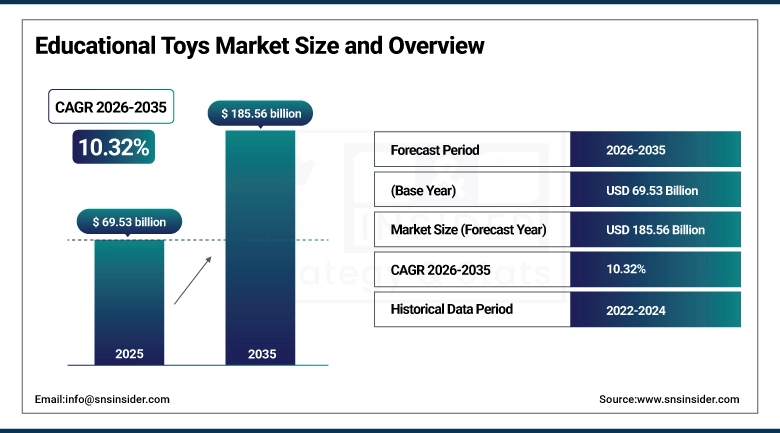
As per the SNS Insider Report titled, Educational Toys Market by Type, by Age Group, by Distribution Channel, by Application, and Region | Global Forecast 2026-2035, “The global Educational Toys Market size valued at USD 69.53 billion in 2025, is anticipated to grow to USD 185.56 billion by 2035, registering a CAGR of 10.32% over the 2026–2035 forecast period.”
Key Takeaways
-
STEM Toys accounted for nearly 28.40% of the market share in 2025, driven by increasing emphasis on science, technology, engineering, and mathematics education among children.
-
STEM Toys are also projected to witness the fastest growth during 2026–2035 with a CAGR of 11.50% due to rising demand for interactive and skill-based learning solutions.
-
Children between 4 and 8 Years dominated the age group segment with a 42.30% revenue share in 2025 owing to growing parental focus on early childhood cognitive and educational development.
-
The 4 to 8 Years age group is expected to register the fastest CAGR of 10.93% through 2035 supported by increasing enrollment in preschool and elementary education programs globally.
-
E-commerce held approximately 38.50% share in 2025, supported by rising online toy purchases, wider product availability, and growing digital retail penetration.
-
Other distribution channels are anticipated to emerge as the fastest-growing segment during the forecast period with a CAGR of 12.85% driven by increasing adoption of specialty educational toy stores and experiential retail formats.
-
Educational Learning & Skill Development represented nearly 26.20% of the market revenue in 2025 owing to growing demand for toys that enhance problem-solving, communication, and analytical skills.
-
Creative Development is projected to record the fastest CAGR of 11.92% from 2026 to 2035 due to increasing consumer preference for toys that encourage imagination, innovation, and artistic learning.
-
Asia-Pacific captured around 36.60% of total market revenue in 2025 and is expected to strengthen its market position further through 2035 supported by rising disposable incomes, expanding middle-class population, and growing educational awareness.
-
North America accounted for approximately 27.60% of the global market share in 2025 driven by strong consumer spending on premium educational and developmental toys.
Why Educational Toys Market is Growing?
The market of Educational Toys is witnessing rapid growth due to the rising awareness among parents and teachers about the significance of interactive learning and cognitive development during the early stages of a child's life. Toys designed for educational purposes are increasingly gaining popularity as effective means to improve creativity, communication, physical ability, and analytical capabilities in children.
An increased focus on STEM education and digital learning is rapidly boosting the demand for educational toys. There is an ever-growing trend among parents to buy toys that would help their children learn basic concepts related to science, mathematics, coding, engineering, and technology.
The rapid growth of the e-commerce industry is also playing its part in contributing to the rapid expansion of the market, while manufacturers are now embedding smart technologies and artificial intelligence along with augmented reality features in toys. Growing demand for educational toys that offer screen-free learning, creative development, and collaboration games is another reason behind rapid market expansion.
Educational Toys Market Statistics
-
The demand for educational toys based on science and technology education continues to grow due to an increased focus on STEM education among children.
-
Online shopping websites are playing a major role in increasing the availability of educational toys and creating new trends within e-commerce.
-
The trend in selecting toys that foster cognitive development, creativity, and communications is rising among parents.
-
Smart educational toys utilizing Artificial Intelligence (AI), voice recognition systems, and augmented reality are becoming popular all across the globe.
-
Classrooms and educational institutes are turning towards interactive learning toys to improve classroom interactions and learning.
-
Imaginative and creative toys are experiencing rising demands due to the increasing emphasis on creativity and emotional development.
-
The Asia-Pacific region is expected to dominate the educational toy market owing to robust demographics and educational expenditure.
Emerging Trends
There are various innovative changes taking place in the market for Educational Toys, such as the use of intelligent toys powered by artificial intelligence as well as gamification-based learning solutions. One trend that companies are following is that of creating custom educational experiences for each child based on their learning speed and cognitive capabilities.
One of the factors that is driving growth in the market for educational toys is STEM and coding toys owing to the increased focus on technical literacy among children across the world. AR and VR technology are two examples of other innovative developments within educational toys.
In addition to this, there is growing interest in using sustainable and environmentally friendly educational toys that are created using recyclable materials as well as non-toxic components.
Top 10 Companies
-
LEGO Group
-
Mattel Inc.
-
Hasbro Inc.
-
Melissa & Doug
-
VTech Holdings Ltd.
-
Fisher-Price
-
Ravensburger AG
-
Learning Resources Inc.
-
Spin Master Corp.
-
LeapFrog Enterprises Inc.
About the Author

Get in touch