
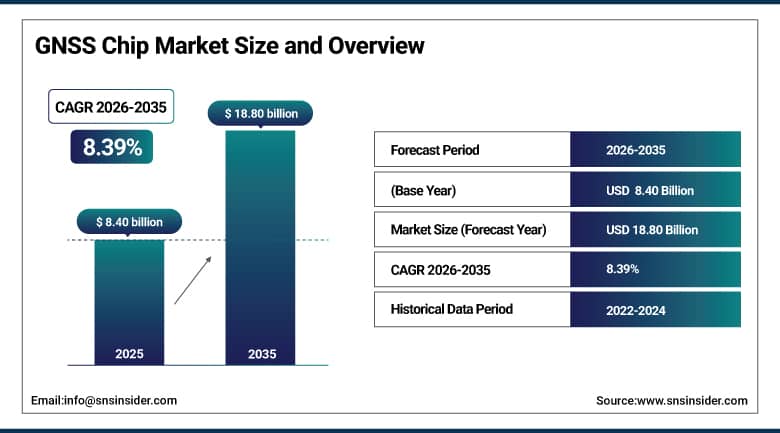
As per the SNS Insider Report titled, GNSS Chip Market by Type, by End Use, by Technology, by Application, and Region | Global Forecast 2026-2035, “The global GNSS Chip Market size valued at USD 8.40 billion in 2025, is anticipated to grow to USD 18.80 billion by 2035, registering a CAGR of 8.39% over the 2026–2035 forecast period.”
Key Takeaways
-
Dual-band GNSS chips accounted for nearly 33.70% of the market share in 2025 and are projected to remain the fastest-growing segment through 2035 due to their superior positioning accuracy, enhanced signal reliability, and growing adoption across automotive and industrial applications.
-
Personal Navigation dominated the end-user segment with a 31.60% revenue share in 2025 owing to widespread use of GNSS-enabled smartphones, wearable devices, and consumer navigation systems.
-
Fleet Management is expected to register the fastest growth during 2026–2035 as organizations increasingly deploy location intelligence, vehicle tracking, and logistics optimization solutions.
-
Global Navigation Satellite System (GNSS) technology held approximately 42.80% share in 2025, supported by growing demand for multi-constellation positioning capabilities and enhanced navigation performance.
-
Global Positioning System (GPS) technology is anticipated to emerge as the fastest-growing technology segment during the forecast period due to continued advancements in satellite infrastructure and location-based service applications.
-
Automotive applications represented nearly 29.40% of the market revenue in 2025 and are projected to witness the fastest growth through 2035 driven by rising adoption of connected vehicles, autonomous driving technologies, and advanced navigation systems.
-
North America maintained a significant position in the global GNSS chip market, supported by strong technological innovation, widespread deployment of navigation technologies, and growing investments in intelligent transportation systems.
-
The United States accounted for the largest share within North America, representing approximately 27.00% of the global market in 2025 with a market value of USD 2.27 billion.
Why GNSS Chip Market is Growing?
The GNSS Chip Market is projected to grow at a considerable CAGR owing to the rising demand for accurate positioning, navigation and timing solutions in automotive, consumer electronics, transportation, agriculture and industrial applications. GNSS chips have emerged as a key component in connected devices and intelligent systems that require accurate location tracking and navigation capabilities.
Advancement in connected vehicles, autonomous driving and advanced driver assistance systems (ADAS) are majorly driving the market demand. High-precision GNSS solutions are increasingly being adopted by automotive OEMs to improve navigation accuracy, vehicle safety and autonomous driving capabilities.
The increasing penetration of smartphones, wearables, drones and IoT-enabled devices is also propelling the market growth. GNSS chips are the foundation for location-based services, asset tracking, route optimization and geospatial intelligence applications that are increasingly critical in consumer and enterprise environments.
Technological advances such as multi-frequency positioning, integration of satellite constellations and real-time correction services are improving the accuracy and reliability of location. These innovations are driving GNSS applications for precision agriculture, smart cities, industrial automation and next-gen mobility solutions.
GNSS Chip Market Statistics
-
Dual-band and multi-frequency GNSS chips are gaining popularity due to improved positioning accuracy and signal resilience.
-
Automotive applications continue to represent one of the largest opportunities for GNSS chip manufacturers globally.
-
Fleet management solutions are witnessing increasing adoption as businesses seek greater operational efficiency and real-time asset visibility.
-
Smartphones remain a major application area for GNSS chips, supporting navigation, location services, and emergency response functions.
-
Smart city initiatives are creating new opportunities for location-based infrastructure management and transportation optimization.
-
Precision agriculture technologies are increasingly utilizing GNSS-enabled equipment for field mapping, guidance systems, and resource optimization.
-
North America continues to be a key market due to strong technological innovation and widespread deployment of navigation solutions.
Emerging Trends
The GNSS Chip Market is witnessing several transformative trends including the growing adoption of dual-band and multi-frequency positioning technologies that offer higher accuracy and enhanced signal integrity. The manufacturer is working on combining multiple satellite constellations, to improve navigation performance in challenging urban and remote environments.
Automotive applications are also emerging as a major growth driver, with automobile manufacturers investing heavily in autonomous driving systems, intelligent transportation platforms and connected mobility solutions. GNSS chips are becoming more and more important for lane level positioning, route optimization and real time navigation capability.
The market is also witnessing growing demand for GNSS enabled IoT devices, drones, robotics and industrial automation systems. Furthermore, the advancements in satellite modernization programs, AI-based positioning algorithms, and precise point positioning technologies are likely to further propel the market innovation and long-term growth.
Top 10 Companies
-
Qualcomm Technologies, Inc.
-
Broadcom Inc.
-
MediaTek Inc.
-
STMicroelectronics N.V.
-
u-blox Holding AG
-
Sony Semiconductor Solutions Corporation
-
Intel Corporation
-
Septentrio NV
-
Furuno Electric Co., Ltd.
-
Quectel Wireless Solutions Co., Ltd.
About the Author

Get in touch




