
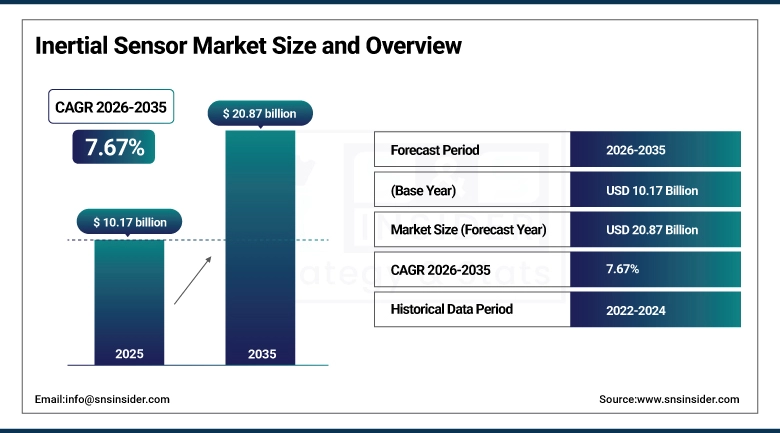
As per the SNS Insider Report titled, Inertial Sensor Market by Sensor Type, by Technology, by Application, by End-Use Industry, and by Region | Global Forecast 2025-2035, “The global Inertial Sensor Market size valued at USD 10.17 billion in 2025, is anticipated to grow to USD 20.87 billion by 2035, registering a CAGR of 7.67% over the 2026–2035 forecast period.”
Key Takeaways
-
Inertial Measurement Units (IMUs) accounted for nearly 40.25% of the market share in 2025, driven by increasing adoption across aerospace, defense, automotive, and consumer electronics applications.
-
Gyroscopes are projected to witness the fastest growth during 2025–2035 with a CAGR of 7.84% due to rising demand for precise motion sensing and stabilization technologies.
-
MEMS technology dominated the market with a 69.43% revenue share in 2025 owing to its compact size, low power consumption, and cost-effective integration into smart devices.
-
Fiber Optic Gyroscopes (FOG) are expected to register the fastest CAGR of 8.24% through 2035 as industries increasingly demand high-precision navigation and positioning systems.
-
Navigation & Positioning held approximately 35.41% share in 2025, supported by growing deployment across autonomous vehicles, aircraft systems, drones, and industrial automation applications.
-
Motion Tracking is anticipated to emerge as the fastest-growing application segment during the forecast period due to increasing use in wearable devices, gaming systems, robotics, and augmented reality technologies.
-
Consumer Electronics represented nearly 33.14% of the market revenue in 2025 owing to rising integration of inertial sensors into smartphones, tablets, wearables, and smart consumer devices.
-
Automotive is projected to record the fastest CAGR of 8.04% from 2025 to 2035 driven by increasing adoption of advanced driver assistance systems (ADAS), autonomous driving technologies, and vehicle stability systems.
-
North America captured around 35.45% of total market revenue in 2025, while Asia-Pacific is projected to record the fastest CAGR of 9.32% during the forecast period.
Why Inertial Sensor Market is Growing?
The Inertial Sensor Market is experiencing consistent growth owing to the rising demand for motion sensing, navigation, and positioning technology in the automotive, aerospace, defense, healthcare, and consumer electronics segments among other applications. The quick adoption of autonomous technologies, connectivity, and smart technology has been playing an instrumental role in driving the growth of the global market.
The increasing use of MEMS based inertial sensors in smartphone devices, wearable gadgets, gaming devices, and industrial automation solutions is fueling the need for small-sized, power-efficient, and highly capable sensors. Besides, the increased use of inertial sensors in autonomous vehicles and ADAS systems is helping boost the growth of the market.
In the aerospace and defense industry, there has been a significant trend of utilizing advanced inertial measurement systems for navigation in aircraft, missile guidance, drones, and even space exploration. Moreover, increased spending on smart mobility, robotics, and IoT infrastructure is supporting the growth of the market.
Advancements in sensor miniaturization, increased accuracy, and motion analytics are enhancing the operational efficiency and capability to be deployed for advanced applications.
Inertial Sensor Market Statistics
-
The MEMS technology still rules the market with its affordability, small size, and ability to be integrated into mass-produced consumer electronics devices.
-
Vehicle manufacturers are using more inertial sensors in their advanced driver assistance systems, electronic stability controls, and self-driving car navigation systems.
-
The aerospace industry is actively investing in the development of highly accurate inertial navigation systems for planes, guided missiles, satellites, and unmanned aerial vehicles.
-
With wearable devices experiencing growing popularity, there is a rising demand for the motion tracking and activity sensing sensors.
-
Inertia-based measurement systems are seeing accelerated use in the sphere of industrial automation and robotics because of precision and accurate position control requirements.
-
The fiber-optic gyroscope technology is becoming more widespread as part of highly accurate navigation systems.
-
In smart manufacturing and IoT, inertial sensors also have plenty of applications.
Emerging Trends
Some of the transformative trends within the Inertial Sensor Market include the incorporation of artificial intelligence and sensor fusion in motion sensing systems. Artificial intelligence will improve navigation and predictive maintenance, among other aspects.
Trends such as the miniaturization of MEMS sensors can be considered among the latest developments in this market because many companies are looking for ways to develop lightweight, energy-efficient, and small-size sensor systems. Autonomous robots, drones, and intelligent mobility are some of the key factors influencing innovation in this industry.
Furthermore, there is a notable increase in demand for multi-axis IMUs and gyroscopes that offer navigation and tracking functions. Some of the key areas attracting significant investments at the moment include autonomous vehicles, AR technologies, and defense innovations.
Top 10 Companies
-
Honeywell International Inc.
-
Bosch Sensortec
-
STMicroelectronics
-
Analog Devices Inc.
-
TDK Corporation
-
Northrop Grumman Corporation
-
Safran Electronics & Defense
-
Murata Manufacturing Co., Ltd.
-
Epson Corporation
-
InvenSense Inc.
About the Author

Get in touch




