
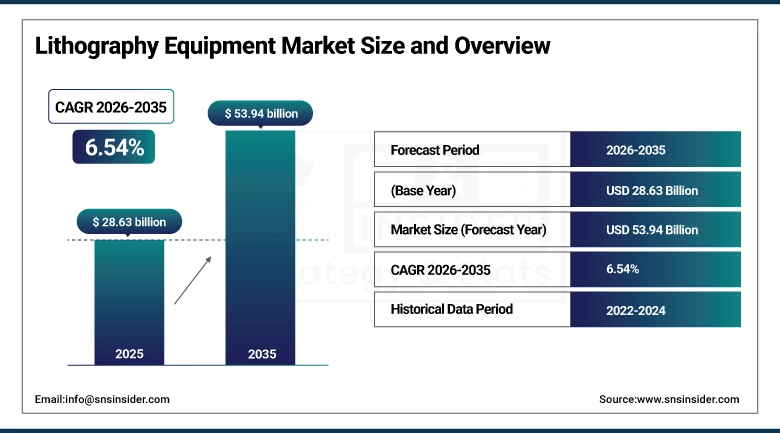
As per the SNS Insider Report titled, Lithography Equipment Market by Technology, by Equipment, by Application, by End Use, and Region | Global Forecast 2026-2035, “The global Lithography Equipment Market size valued at USD 28.63 billion in 2025, is anticipated to grow to USD 53.94 billion by 2035, registering a CAGR of 6.54% over the 2026–2035 forecast period.”
Key Takeaways
-
ArF Immersion technology accounted for nearly 49.20% of the market share in 2025, driven by its widespread deployment in mature high-volume semiconductor manufacturing processes.
-
Extreme Ultraviolet (EUV) Lithography is projected to witness the fastest growth during 2026–2035 with a CAGR of 8.99% due to increasing adoption for advanced node scaling below 7nm and rising AI/HPC chip demand.
-
Optical Lithography/Photolithography dominated the equipment segment with a 66.40% revenue share in 2025 owing to its extensive use in mainstream semiconductor fabrication operations.
-
Electron Beam Lithography is expected to register the fastest CAGR of 11.87% through 2035 as demand increases for advanced patterning, semiconductor R&D, and mask manufacturing applications.
-
Advanced Packaging held approximately 35.70% share in 2025, supported by growing adoption of heterogeneous integration and chiplet-based semiconductor architectures.
-
Advanced Packaging is also anticipated to emerge as the fastest-growing application segment during the forecast period driven by rising AI, 5G, and high-performance computing semiconductor demand.
-
Electronics Manufacturing represented nearly 44.50% of the market revenue in 2025 owing to large-scale production of consumer electronics, smartphones, and computing devices.
-
Automotive Industry is projected to record the fastest CAGR of 8.44% from 2026 to 2035 driven by increasing electric vehicle adoption, ADAS deployment, and higher semiconductor content per vehicle.
-
Asia-Pacific captured around 45.50% of total market revenue in 2025 supported by strong semiconductor fabrication capacity and large-scale electronics manufacturing activities.
-
North America accounted for approximately 23.90% of the global market share in 2025 driven by advanced semiconductor R&D investments and growing domestic chip manufacturing initiatives.
Why Lithography Equipment Market is Growing?
The Lithography Equipment Market is growing at a steady rate owing to the rising global demand for semiconductor devices in the artificial intelligence, high-performance computing, automotive electronics, and consumer electronics end-use industries. The semiconductor industry is witnessing heavy investments in advanced lithography technology for the fabrication and manufacture of smaller chips.
With the fast-paced innovations happening in the realm of AI processors, 5G network systems, cloud computing technology, and data centers, there is an escalating demand for advanced semiconductor fabrication and manufacturing equipment. The demand for EUV lithography systems will be driven by their adoption by semiconductor players with a view to manufacturing chips using 5nm, 3nm, and below 3nm process technologies.
The rising demand for advanced packaging and heterogeneous integration technologies will boost the growth of the market during the forecast period. Advanced packaging is being used by semiconductor players for improving processing performance.
Investments in semiconductor manufacturing technology and manufacturing capabilities for domestic chip manufacturing are boosting the demand for advanced lithography equipment.
Lithography Equipment Market Statistics
-
Semiconductor companies globally are making more investments in lithography solutions to enhance the capabilities of chip manufacturing processes.
-
The usage of EUV lithography is seeing substantial growth for manufacturing advanced nodes under 7nm technology.
-
Demand for semiconductor manufacturing equipment is witnessing a significant uptick due to AI, HPC, and 5G applications.
-
Lithography applications are seeing strong growth due to advanced packaging and chiplet integration technologies in semiconductor manufacturing.
-
Motivated by the growing demand for automotive semiconductors, investments in lithography solutions for EVs and ADAS are growing.
-
The Asia-Pacific region continues to lead the way in semiconductor manufacturing capacity due to robust activities from its foundries.
-
Semiconductor companies are investing more in R&D, resulting in greater utilization of EB lithography applications.
Emerging Trends
Key trends in the Lithography Equipment Market include an increased use of extreme ultraviolet lithography machines in advanced semiconductor processing. There is a growing focus among semiconductor manufacturers on patterning accuracy, increased transistor density, and greater manufacturing efficiency to cater to needs in areas such as artificial intelligence and high-performance computing.
One important trend shaping this market is advanced packaging, which is driven by growing interest in heterogeneous integration, stacked chips, and chiplets. Another key trend includes electron beam lithography machines that are increasingly being used for advanced semiconductor processing, mask creation, and fabrication processes.
Another trend driving innovation in the Lithography Equipment Market is the growing adoption of artificial intelligence, automation, and predictive analytics solutions in semiconductor manufacturing. Moreover, increasing investment in local semiconductor manufacturing capabilities, sustainable manufacturing technologies, and advanced process development is expected to drive market innovation.
Top 10 Companies
-
ASML Holding NV
-
Nikon Corporation
-
Canon Inc.
-
Applied Materials Inc.
-
Lam Research Corporation
-
Tokyo Electron Limited
-
KLA Corporation
-
SCREEN Holdings Co., Ltd.
-
Veeco Instruments Inc.
-
Ultratech Inc.
About the Author

Get in touch




