
Mobile Biometrics Market Report Scope & Overview:
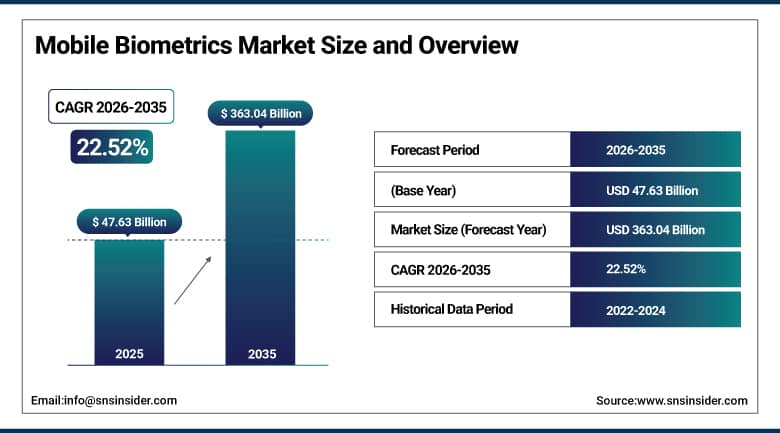
The Mobile Biometrics Market size is valued at USD 47.63 billion in 2025 and is expected to reach USD 363.04 billion by 2035, growing at a CAGR of 22.52% from 2026 to 2035.
The mobile biometrics industry is growing rapidly due to increasing demand for secure authentication and identity verification across smartphones, tablets, and wearable devices. Rising concerns over data breaches, the need for contactless solutions, growing adoption of mobile banking, e-commerce, and government initiatives for digital identity programs are driving market expansion. Additionally, advancements in AI and machine learning are enhancing biometric accuracy, further boosting the adoption of mobile biometric solutions across various industries.
In 2025, the mobile biometrics market surged by 48% fueled by 85% global smartphone biometric penetration, AI-enhanced accuracy, and widespread use in mobile banking, e-commerce, and national digital ID programs, with over 160 billion secure transactions annually.
Market Size and Forecast
-
Market Size in 2025: USD 47.63 Billion
-
Market Size by 2035: USD 363.04 Billion
-
CAGR: 22.52% from 2026 to 2035
-
Base Year: 2025
-
Forecast Period: 2026–2035
-
Historical Data: 2022–2024
To Get more information on Mobile Biometrics Market - Request Free Sample Report
Mobile Biometrics Market Trends
-
Rising adoption of fingerprint facial and iris recognition in smartphones for secure authentication and user convenience
-
Growing integration of mobile biometrics with digital payments banking and mobile wallets to prevent fraud
-
Increasing demand for contactless biometric authentication driven by hygiene concerns and post pandemic digital behavior
-
Advancements in AI and machine learning improving biometric accuracy speed and spoof detection capabilities
-
Expanding use of mobile biometrics in government ID programs eKYC and border control applications
U.S. Mobile Biometrics Market Size Outlook:
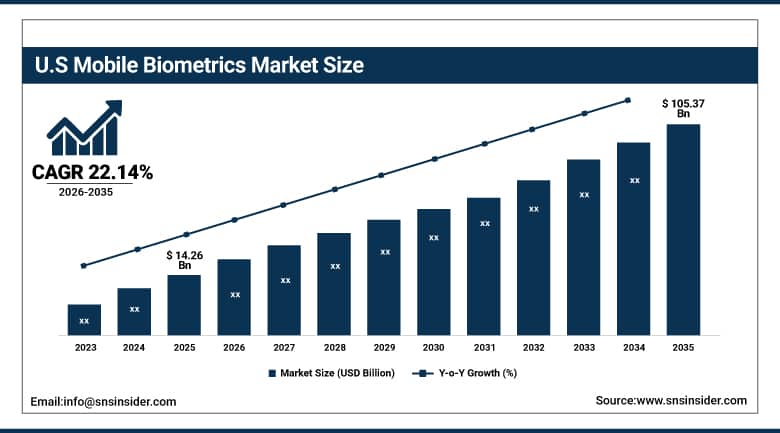
The U.S. Mobile Biometrics Market is valued at USD 14.26 billion in 2025 and is expected to reach USD 105.37 billion by 2035, growing at a CAGR of 22.14% during the forecast period. The U.S. mobile biometrics industry is expanding due to increasing demand for secure, contactless authentication in smartphones, banking, and e-commerce. Rising concerns over data breaches, government digital ID initiatives, and advancements in AI-driven biometric technologies are driving adoption across various industries, fueling rapid market growth.
Mobile Biometrics Market Growth Drivers:
-
Rising smartphone penetration and growing demand for secure authentication in banking, payments, and digital identity applications are accelerating adoption of mobile biometric technologies globally
The rapid increase in smartphone usage worldwide has created a strong foundation for mobile biometric adoption. Consumers increasingly rely on mobile devices for banking, payments, and digital services, driving demand for secure and convenient authentication methods. Mobile biometrics such as fingerprint, facial recognition, and iris scanning provide enhanced security while improving user experience. Financial institutions and digital service providers are adopting biometric authentication to reduce fraud, strengthen cybersecurity, and comply with regulatory requirements. This widespread integration across consumer applications is a major driver supporting sustained growth of the mobile biometrics market globally.
82% of smartphones featured built-in biometrics driving a 50% surge in global adoption for secure banking, payments, and digital ID, with mobile biometric transactions exceeding 150 billion annually.
-
Increasing government initiatives for digital identity programs and e-governance are driving large-scale deployment of mobile biometrics for citizen authentication and service access
Governments worldwide are implementing digital identity and e-governance initiatives to improve service delivery, reduce fraud, and enhance national security. Mobile biometric solutions enable secure and scalable citizen authentication for accessing public services, welfare programs, and financial inclusion initiatives. Countries adopting digital ID platforms increasingly rely on biometrics for accurate identity verification. Mobile-based biometric authentication reduces administrative costs, improves transparency, and enhances accessibility, especially in remote regions. Strong government backing and public-sector investments are significantly driving large-scale adoption of mobile biometrics across national identity and governance ecosystems.
60% of governments globally deployed mobile biometrics for digital ID and e-governance enrolling over 2.5 billion citizens and boosting secure access to public services by 50%.
Mobile Biometrics Market Restraints:
-
High implementation costs, data privacy concerns, and risks of biometric data breaches limit adoption, particularly among cost-sensitive users and organizations
Deploying mobile biometric systems requires investment in advanced hardware, software integration, and cybersecurity infrastructure, increasing implementation costs. Small organizations and cost-sensitive users may find these solutions financially challenging. Additionally, concerns regarding biometric data privacy, misuse, and unauthorized access raise regulatory and ethical issues. High-profile data breaches have heightened public apprehension about storing sensitive biometric information on mobile devices. These concerns create resistance among users and enterprises, slowing adoption rates and limiting market expansion, particularly in regions with strict data protection regulations.
68% of cost-sensitive organizations delayed biometric adoption due to high implementation costs (averaging USD100K+), stringent data privacy regulations, and growing fears of irreversible biometric data breaches.
-
Performance limitations of biometric systems due to environmental factors, device quality variations, and spoofing threats hinder reliability and user trust
Mobile biometric performance can be affected by external factors such as poor lighting, dirty sensors, device quality inconsistencies, and physical changes in users. These limitations can result in authentication errors, reducing reliability and user confidence. Additionally, spoofing techniques, including fake fingerprints or facial replicas, pose security risks. Although technology is improving, concerns over accuracy and vulnerability persist. These challenges hinder widespread adoption, particularly in high-security applications, as users and organizations demand highly reliable, fraud-resistant authentication solutions.
65% of users reported reduced trust in mobile biometrics citing 25% higher error rates in poor lighting, low-quality sensors, and rising spoofing attacks like deepfake and fingerprint replication.
Mobile Biometrics Market Opportunities:
-
Integration of AI, machine learning, and multimodal biometrics offers opportunities to improve accuracy, fraud prevention, and user experience across mobile authentication platforms
The integration of artificial intelligence and machine learning is transforming mobile biometric systems by improving accuracy, speed, and adaptability. AI-powered algorithms enhance pattern recognition, reduce false acceptance rates, and strengthen anti-spoofing capabilities. Multimodal biometrics, combining fingerprint, facial, voice, or iris recognition, provide layered security and improved authentication reliability. These advancements enhance user experience while addressing security concerns. As mobile devices become more powerful, the adoption of intelligent, AI-driven biometric solutions presents significant growth opportunities for technology providers and application developers.
In 2025, 72% of mobile authentication platforms adopted AI-driven multimodal biometrics boosting fraud detection accuracy by 40% and reducing false rejections by 30% to enhance security and user experience.
-
Rapid growth of mobile payments, fintech services, and digital healthcare creates new application areas, expanding demand for secure mobile biometric solutions worldwide
The expansion of mobile payments, digital wallets, fintech platforms, and telehealth services is creating strong demand for secure authentication methods. Mobile biometrics enable seamless and secure access to financial transactions, medical records, and remote healthcare services. As consumers increasingly adopt cashless payments and digital health platforms, service providers prioritize biometric security to prevent fraud and unauthorized access. Emerging markets, in particular, present high growth potential as mobile-first financial and healthcare ecosystems expand, creating new opportunities for mobile biometric solution providers globally.
In 2025, 78% of mobile payment and digital health providers integrated secure biometric authentication spurring a 45% global increase in demand for fingerprint, facial, and behavioral biometrics amid rising fraud concerns.
Mobile Biometrics Market Segment Analysis
-
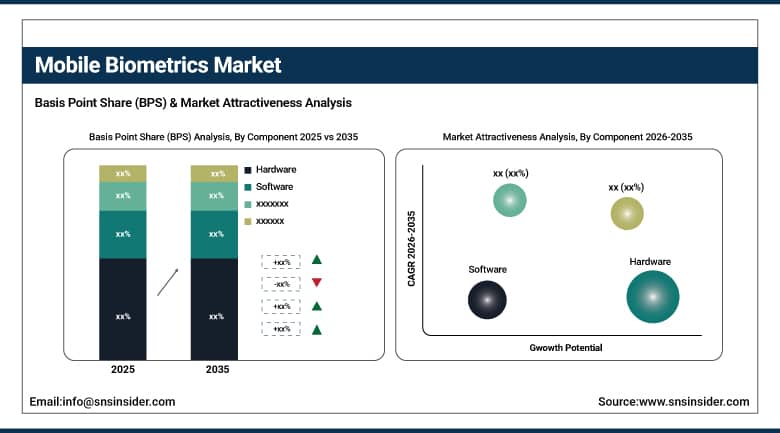
By Component: Hardware led with 42.8% share, while Software is the fastest-growing segment with CAGR of 26.5%.
-
By Technology: Fingerprint Recognition led with 45.3% share, while Facial Recognition is the fastest-growing segment with CAGR of 27.1%.
-
By Application: Mobile Banking & Payments led with 40.6% share, while Identity Verification is the fastest-growing segment with CAGR of 25.9%.
-
By End User: BFSI led with 44.2% share, while Government is the fastest-growing segment with CAGR of 26.8%.
By Component: Hardware led, while Software is the fastest-growing segment.
Hardware dominates the mobile biometrics market as it forms the core infrastructure for biometric systems, including sensors, scanners, and embedded modules in mobile devices. Its widespread adoption across smartphones, tablets, and wearable devices ensures reliable performance, accuracy, and security. The consistent demand from enterprises, BFSI, government, and healthcare sectors, coupled with advancements in miniaturization and integration, reinforces its market leadership. Hardware remains critical for capturing and processing biometric data, making it indispensable in both personal and enterprise mobile authentication systems.
Software is the fastest-growing component segment due to increasing reliance on AI-powered biometric algorithms, mobile authentication platforms, and cloud-based identity management solutions. It enables real-time data analysis, fraud detection, and multi-modal integration for facial, fingerprint, iris, and voice recognition. Growing adoption by BFSI, government, and large enterprises, combined with the need for scalable and customizable biometric solutions, drives rapid growth. The segment benefits from advances in machine learning, software updates, and integration with mobile applications, expanding its relevance across multiple industries.
By Technology: Fingerprint Recognition led, while Facial Recognition is the fastest-growing segment.
Fingerprint Recognition remains the dominant technology due to its accuracy, speed, cost-effectiveness, and integration in smartphones and mobile devices worldwide. It provides reliable authentication for mobile banking, payments, device access, and enterprise security. High user familiarity, ease of deployment, and low error rates make fingerprint scanning the preferred choice for both consumers and organizations. Its robust performance in diverse environments and compatibility with multiple mobile platforms ensures continued adoption and revenue contribution, solidifying its leadership in the mobile biometrics’ technology landscape.
Facial Recognition is the fastest-growing technology, driven by increasing adoption in mobile banking, government ID verification, secure enterprise access, and contactless authentication. Advanced AI algorithms, 3D mapping, and infrared sensors enhance accuracy, even under varying lighting or environmental conditions. Growing privacy-compliant adoption in Asia and expanding use in identity verification, fraud prevention, and surveillance systems contribute to rapid CAGR. Integration with mobile applications, IoT devices, and public services further accelerates adoption, making it a critical growth area in mobile biometrics technology.
By Application: Mobile Banking & Payments led, while Identity Verification is the fastest-growing segment.
Mobile Banking & Payments dominate as mobile biometrics ensures secure, quick, and convenient transaction authentication. High adoption in the BFSI sector is fueled by digital transformation, smartphone penetration, and increasing online financial transactions. Biometric solutions reduce fraud, enhance user trust, and comply with regulatory security standards. Banks and payment providers prefer fingerprint and facial authentication to protect sensitive financial data. Widespread consumer awareness and preference for fast, contactless authentication support the continued leadership of mobile banking and payment applications in biometrics.
Identity Verification is the fastest-growing application segment due to heightened demand for secure authentication in government services, financial institutions, healthcare, and e-commerce. Biometric solutions, including facial and fingerprint recognition, enable quick, reliable, and fraud-resistant verification of users. Regulatory compliance, digital onboarding, and cross-border identity validation are driving adoption in Asia and other emerging markets. Growing focus on digital ID programs, KYC, and AML initiatives accelerates growth. The increasing need for secure, scalable, and multi-modal authentication solutions contributes to strong CAGR in this application segment.
By End User: BFSI led, while Government is the fastest-growing segment.
The BFSI sector dominates the mobile biometrics market because banks and financial institutions require secure, fast, and reliable authentication for mobile banking, payments, and online transactions. High adoption of fingerprint and facial recognition technologies ensures reduced fraud, regulatory compliance, and enhanced customer trust. Widespread smartphone penetration and digital banking growth contribute to consistent demand. BFSI organizations also integrate biometric solutions with digital wallets, payment platforms, and mobile apps, reinforcing their position as the largest end-user segment for mobile biometrics globally.
Government entities represent the fastest-growing end-user segment due to increasing deployment of mobile biometrics in national ID programs, border control, law enforcement, and secure citizen services. Rapid digitalization initiatives and identity verification requirements in Asia accelerate adoption. Multi-modal biometric systems, including facial, fingerprint, and iris recognition, ensure secure, contactless authentication for public services. Government investment in large-scale biometric projects, coupled with increasing regulatory support and awareness, drives rapid CAGR, making this segment a key driver in the mobile biometrics market growth.
Mobile Biometrics Market Regional Analysis
North America Mobile Biometrics Market Insights:
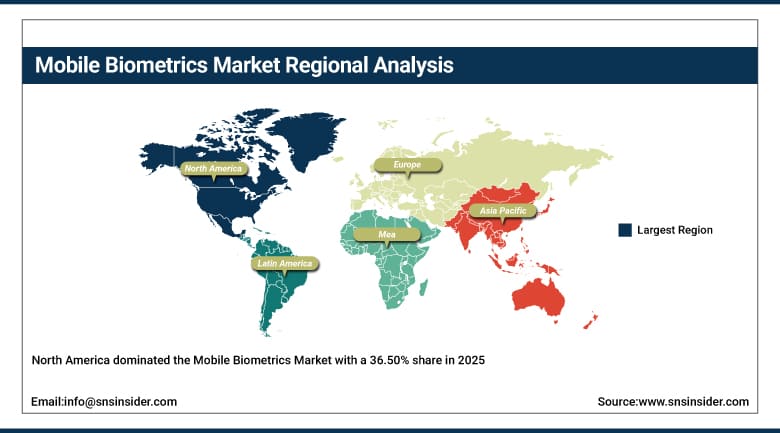
North America dominated the Mobile Biometrics Market with a 36.50% share in 2025 due to advanced technological infrastructure, high adoption of mobile authentication solutions, and strong presence of leading biometric solution providers. Increasing smartphone penetration, stringent security regulations, and widespread enterprise and government implementation further strengthened the region’s leadership in the market.
Get Customized Report as per Your Business Requirement - Enquiry Now
Asia Pacific Mobile Biometrics Market Insights
Asia Pacific is expected to grow at the fastest CAGR of about 24.37% from 2026–2035, driven by rapid smartphone adoption, expanding digital banking, and growing e-commerce penetration. Rising demand for secure mobile transactions, government initiatives promoting digital identity solutions, and increasing awareness of biometric authentication across enterprises and consumers accelerate market growth across the region.
Europe Mobile Biometrics Market Insights
Europe held a significant share in the Mobile Biometrics Market in 2025, supported by robust technological infrastructure, increasing adoption of biometric authentication in banking and government services, and strong regulatory frameworks for data security. Rising enterprise adoption, digital transformation initiatives, and growing demand for secure mobile solutions strengthened Europe’s market presence.
Middle East & Africa and Latin America Mobile Biometrics Market Insights
The Middle East & Africa and Latin America together showed steady growth in the Mobile Biometrics Industry in 2025, driven by expanding smartphone usage, increasing demand for secure mobile transactions, and rising digital banking adoption. Government initiatives promoting digital identity systems, improving technological infrastructure, and growing awareness of biometric security solutions further contributed to the regions’ market development.
Mobile Biometrics Market Competitive Landscape:
Apple Inc.
Apple Inc., headquartered in Cupertino, USA, is a global leader in consumer electronics, software, and digital services. The company is widely recognized for its innovation in mobile biometrics, particularly through its Face ID and Touch ID technologies integrated into iPhones and iPads. Apple focuses on security, privacy, and seamless user experience, making its biometric solutions highly reliable. The company continuously invests in research and development to enhance mobile authentication, fraud prevention, and secure access across its devices and services.
-
June 2024, with the launch of iOS 18 and visionOS 2, Apple enhanced Face ID with advanced attention awareness and expanded accessibility support without collecting or storing facial emotion data.
Samsung Electronics Co., Ltd.
Samsung Electronics Co., Ltd., based in South Korea, is a global technology giant known for smartphones, tablets, and semiconductor products. In mobile biometrics, Samsung offers advanced fingerprint scanning, facial recognition, and iris scanning technologies integrated into its Galaxy devices. The company emphasizes security, user convenience, and performance in its solutions. Samsung actively collaborates with software and security partners to innovate authentication methods, supporting secure mobile payments, device access, and enterprise-level data protection for both consumer and corporate markets.
-
January 2025, Samsung introduced Knox Matrix, a cross-device identity framework that uses fused biometrics (fingerprint + face + behavioral) for secure, seamless authentication across Galaxy phones, tablets, watches, and PCs.
Qualcomm Incorporated
Qualcomm Incorporated, headquartered in San Diego, USA, is a leading semiconductor and telecommunications company providing chipsets, processors, and connectivity solutions. In the mobile biometrics sector, Qualcomm enables advanced fingerprint sensors, face recognition, and secure on-device authentication through its Snapdragon processors. The company focuses on speed, accuracy, and energy efficiency in biometric solutions, supporting smartphones, IoT devices, and wearables. Qualcomm also invests heavily in R&D to enhance security, anti-spoofing technologies, and integration of AI-powered biometric authentication for global device manufacturers.
-
October 2023, Qualcomm announced the Secure Processing Unit (SPU) integrated into its Snapdragon 8 Gen 3 and Gen 4 Mobile Platforms, enabling ultra-secure, low-power biometric authentication for OEMs.
Mobile Biometrics Companies are:
-
Apple Inc.
-
Samsung Electronics Co., Ltd.
-
Qualcomm Incorporated
-
Thales Group
-
IDEMIA
-
Synaptics Incorporated
-
Fingerprint Cards AB
-
Precise Biometrics AB
-
Gemalto NV
-
HID Global Corporation
-
Aware Inc.
-
M2SYS Technology
-
Fujitsu Limited
-
Nuance Communications Inc.
-
BioEnable Technologies Pvt. Ltd.
-
Suprema Inc.
-
Cognitec Systems GmbH
-
OneSpan Inc.
| Report Attributes | Details |
|---|---|
| Market Size in 2025 | USD 47.63 Billion |
| Market Size by 2035 | USD 363.04 Billion |
| CAGR | CAGR of 22.52% From 2026 to 2035 |
| Base Year | 2025 |
| Forecast Period | 2026-2035 |
| Historical Data | 2022-2024 |
| Report Scope & Coverage | Market Size, Segments Analysis, Competitive Landscape, Regional Analysis, DROC & SWOT Analysis, Forecast Outlook |
| Key Segments | • By Component (Hardware, Software, Services) • By Technology (Fingerprint Recognition, Facial Recognition, Iris Recognition, Voice Recognition, Palm / Hand Geometry) • By Application (Mobile Banking & Payments, Device Access Control, Identity Verification, Mobile Commerce, Government & Public Services) • By End User (BFSI, Government, Healthcare, Retail & E-commerce, IT & Telecom) |
| Regional Analysis/Coverage | North America (US, Canada), Europe (Germany, UK, France, Italy, Spain, Russia, Poland, Rest of Europe), Asia Pacific (China, India, Japan, South Korea, Australia, ASEAN Countries, Rest of Asia Pacific), Middle East & Africa (UAE, Saudi Arabia, Qatar, South Africa, Rest of Middle East & Africa), Latin America (Brazil, Argentina, Mexico, Colombia, Rest of Latin America). |
| Company Profiles | Apple Inc., Samsung Electronics Co., Ltd., Qualcomm Incorporated, Thales Group, IDEMIA, NEC Corporation, Synaptics Incorporated, Fingerprint Cards AB, Precise Biometrics AB, Gemalto NV, HID Global Corporation, Aware Inc., M2SYS Technology, Fujitsu Limited, Nuance Communications Inc., FacePhi Biometria SA, BioEnable Technologies Pvt. Ltd., Suprema Inc., Cognitec Systems GmbH, OneSpan Inc. |
Frequently Asked Questions
The Mobile Biometrics Market is projected to grow at a CAGR of 22.52% from 2026 to 2035, driven by secure mobile authentication and digital identity adoption.
In 2025, the Mobile Biometrics Market is valued at USD 47.63 billion, fueled by smartphone biometric penetration, mobile banking, and government digital ID initiatives.
Rising smartphone adoption, growing demand for secure authentication in banking, payments, and digital identity programs, coupled with AI-enhanced biometric accuracy, is the key growth driver.
Hardware component, Fingerprint Recognition technology, Mobile Banking & Payments application, and BFSI end-user segment dominated the Mobile Biometrics Market during the forecast period.
North America dominated the Mobile Biometrics Market in 2025 with a 36.50% share, driven by advanced mobile infrastructure, strong enterprise adoption, and leading biometric solution providers.
