
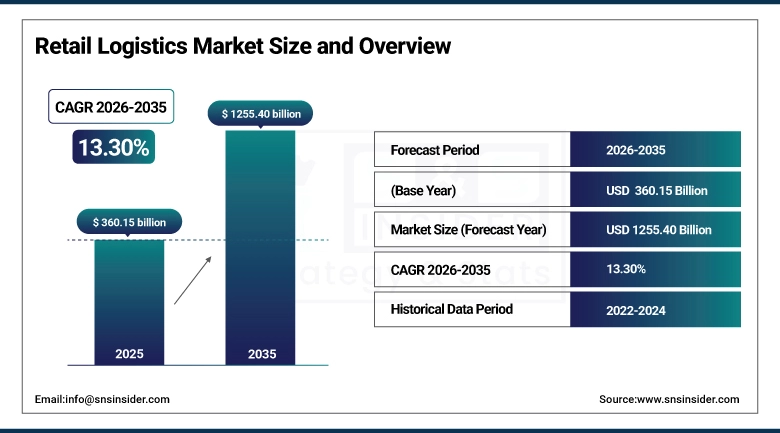
As per the SNS Insider Report titled, Retail Logistics Market by Service Type, by Mode of Transportation, by Retail Type, by End-User, Region, and Global Forecast 2026-2035, “The global Retail Logistics Market size valued at USD 360.15 billion in 2025, is anticipated to grow to USD 1255.40 billion by 2035, registering a CAGR of 13.30% over the 2026–2035 forecast period.”
Key Takeaways
-
Transportation accounted for nearly 38.6% of the market share in 2025, driven by increasing demand for efficient product movement across global retail supply chains.
-
Reverse Logistics is projected to witness the fastest growth during 2026–2035 due to rising product return volumes associated with expanding e-commerce activities.
-
Roadways dominated the mode of transportation segment with a 57.2% revenue share in 2025 owing to extensive last-mile delivery operations and flexible freight movement capabilities.
-
Airways is expected to register the fastest CAGR of 19.1% through 2035 as retailers increasingly prioritize rapid delivery and cross-border e-commerce fulfillment.
-
Online / E-commerce Retail held approximately 49.8% share in 2025, supported by growing consumer preference for digital shopping platforms and home delivery services.
-
Omnichannel Retail is anticipated to emerge as the fastest-growing retail segment during the forecast period due to increasing integration of online and offline retail operations.
-
Grocery & Food Retail represented nearly 34.5% of the market revenue in 2025 owing to rising demand for fast-moving consumer goods and temperature-controlled logistics services.
-
Pharmaceuticals & Healthcare is projected to record the fastest CAGR of 18.9% from 2026 to 2035 driven by increasing demand for secure and time-sensitive healthcare product distribution.
-
North America captured around 35.00% of total market revenue in 2025, while Asia Pacific is projected to record the fastest CAGR of 15.02% from 2026 to 2035.
Why Retail Logistics Market is Growing?
The Retail Logistics market is growing at a tremendous rate because of the rise of e-commerce, consumer demand for fast deliveries, and increasing globalization of the supply chain of retailers. Retailers are making substantial investments in state-of-the-art logistics infrastructure and logistics capability improvements.
Rapid acceptance and usage of online stores and payments have led to an increased demand for logistics facilities and processes such as warehousing, inventory management, transportation, and delivery. Rising trends towards same-day and next-day delivery have resulted in increased investment in logistics automation.
The rise in returns of goods due to growing e-commerce has been another contributing factor to growing reverse logistics demand. Retailers are focusing on improving their return processing systems and supply chain visibility.
Advanced technologies in artificial intelligence, warehouse robots, IoT, and logistics tracking are making the logistics process more efficient and helping in effective inventory management. Omnichannel retailing also opens up many opportunities in the global retail logistics industry.
Retail Logistics Market Statistics
-
Growth of e-commerce around the world leads to the rising need for warehouses, transportations, and deliveries.
-
The trend of automation in warehousing and operations via robots and technological solutions is gaining popularity among retailers.
-
Same-day and next-day deliveries are becoming critical competitive advantages among retailers on the global market.
-
Volumes of reverse logistics are rising because of the growing number of products returned and exchanges.
-
Analytics based on artificial intelligence technology makes supply chain performance management more effective.
-
The rise in cold chain logistics is evident in grocery, food delivery, and pharmaceutical retail businesses.
-
Omnichannel fulfillment logistics strategies have become an essential focus for many retail organizations.
Emerging Trends
Some of the notable trends currently affecting the Retail Logistics Market include the growing utilization of automated warehouses, autonomous deliveries, and AI-based supply chain optimization solutions. Retailers and logistics players are concentrating on improving their agility and delivery speed to cope with rising customer demands.
Rapidly growing omnichannel retailing is fueling the need for a seamless logistics infrastructure that enables retailers to efficiently manage their inventory as well as facilitate order deliveries across different channels. Micro-fulfillment centers as well as urban distribution centers have become popular recently in order to enable efficient last-mile delivery services.
Sustainability programs are becoming a significant trend in the retail logistics market amid investments by logistics providers into electric vehicles, green packaging solutions, and carbon-efficient transport networks. Moreover, improvements in drones, shipment tracking systems, and smart logistics solutions are anticipated to revolutionize the global retail logistics industry in the years to come.
Top 10 Companies
-
DHL Supply Chain
-
FedEx Corporation
-
United Parcel Service (UPS)
-
XPO Logistics
-
Kuehne + Nagel
-
DB Schenker
-
Nippon Express
-
C.H. Robinson
-
Ryder System Inc.
-
CEVA Logistics
About the Author

Get in touch




