
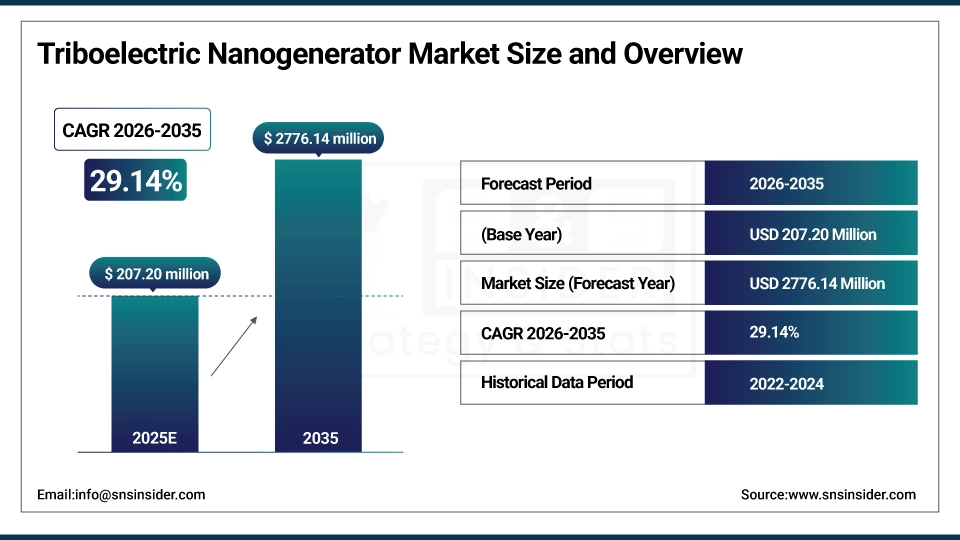
As per the SNS Insider Report titled, Triboelectric Nanogenerator Market by Device, by Material Type, by Application, by End-user Industry, by Region, And Global Forecast 2026–2035, "The global Triboelectric Nanogenerator Market size valued at USD 207.20 million in 2025, is anticipated to grow to USD 2,776.14 million by 2035, registering a CAGR of 29.14% over the 2026–2035 forecast period."
Key Takeaways
-
The vertical contact-separation TENGs occupied the leading share of 45% in 2025, backed by their efficiency in the energy conversion applications.
-
The single-electrode TENGs are anticipated to record highest growth rate as compared to other segments between 2026 and 2035 due to their simple structure.
-
The polymer based TENGs occupied the majority share of about 50% in 2025, attributed to their flexibility, low cost, and easy fabrication.
-
The nanostructured material based TENGs are anticipated to witness fastest growth among all other segments during the forecast period of 2026–2035 due to high output energy.
-
The consumer electronics occupied a 42% share in 2025, and hence, it was the largest application segment because of increasing usage of self-powered devices.
-
The medical devices are expected to occupy the fastest growth rate in the coming years because of increasing use of wearable health monitoring devices.
-
The energy harvesting systems occupied a 40% share in 2025, while the smart textiles & wearables are anticipated to grow at fastest pace until 2035.
-
Asia Pacific region recorded a share of ~40.12% in 2025 and will record a faster growth rate of ~31.65% between 2026 and 2035, thanks to its electronics industry and research facilities.
Why Triboelectric Nanogenerator Market is Growing?
Market Expansion in the Triboelectric Nanogenerator Market can be attributed to growing demand for self-powered systems and energy harvesting applications. Moreover, increasing use of Internet of Things-enabled devices has also been a contributing factor to this trend.
Technology improvements in the development of flexible electronics, sensors, and nano-materials have led to improved efficiency and performance of devices. Growing interest in smart technology integration and wearable systems can also accelerate the growth of this market.
Growing interest in renewable energy generation and increasing research and development spending on clean energy systems is also expected to contribute to market expansion.
Triboelectric Nanogenerator Market Statistics
-
The global electronics manufacturing industry is growing, creating a greater need for small-sized power sources for mobile gadgets.
-
The trend towards wearable gadgets has been on the rise, particularly in health care and smart clothing sectors.
-
Digital healthcare is fostering the use of sensors that will enable the continuous monitoring of patients.
-
Increasing automation in industries creates a demand for wireless sensors that can operate independently and save on maintenance costs.
-
Self-charging gadgets are becoming more efficient due to developments in nanostructure technology.
-
The increasing use of smart clothing fosters its application in sports and military sectors.
Emerging Trends:
There have been innovations in developing flexible and stretchable TENG devices that can be used for wearable and implantable purposes. The integration of triboelectric-based technology within IoT devices allows for efficient energy generation and wireless data transmission.
Triboelectric-based energy harvesting technologies used in conjunction with other renewable energy sources are proving to be promising for increased energy production. Moreover, the application of nanomaterials and 3D microstructuring of materials is contributing toward greater efficiency and use in extreme conditions.
The growing demand for smart textiles, self-sufficient medical implants, and autonomous sensors will drive changes in the competitive environment.
Top 10 Companies:
-
TSINGHUA University Research Groups
-
Georgia Institute of Technology
-
Wuhan University
-
Northwestern University
-
Hitachi Ltd.
-
Samsung Electronics
-
LG Electronics
-
Panasonic Corporation
-
STMicroelectronics
-
Texas Instruments Incorporated
About the Author

Get in touch




