
3D Motion Capture System Market Report Scope & Overview:
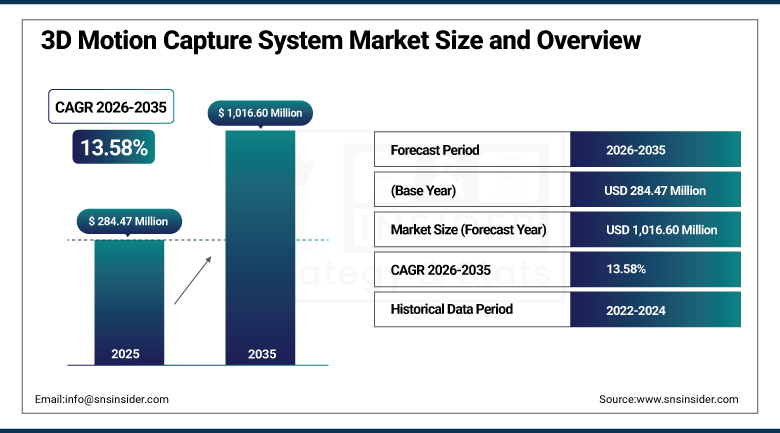
The 3D Motion Capture System Market size was valued at USD 284.47 Million in 2025 and is expected to reach USD 1,016.60 Million by 2035, growing at a CAGR of 13.58% from 2026 to 2035.
The 3D Motion Capture System Market continues to expand as demand shifts well beyond its traditional film and game production base into tele-rehabilitation, autonomous robot training, and industrial ergonomics assessment. Markerless capture systems, once experimental, now benefit from edge artificial intelligence chips capable of compressing processing latency below the twenty-millisecond threshold that immersive virtual reality applications require, opening genuinely new commercial use cases beyond traditional studio environments. Rising workflow complexity is pushing buyers toward service-based offerings that bundle installation, cloud processing, and real-time support rather than relying purely on capital equipment purchases, and combined motion capture, virtual reality, and augmented reality platforms continue creating engaging training environments that let athletes and clinicians visualize and adjust movement patterns instantly.
Vicon launched its Markerless Motion Capture solution at the Game Developers Conference in San Francisco in March 2025, following an immersive exhibition of the Vicon Markerless prototype at SIGGRAPH in 2023, while Movella released Xsens Animate 2025 the same year, an updated inertial motion capture software engine featuring male and female native anatomy models and a redesigned, more efficient user interface.
Market Size and Forecast
-
Market Size in 2026E: USD 323.11 Million
-
Market Size by 2035: USD 1,016.60 Million
-
CAGR: 13.58% from 2026 to 2035
-
Fastest Growing Region: Asia Pacific
-
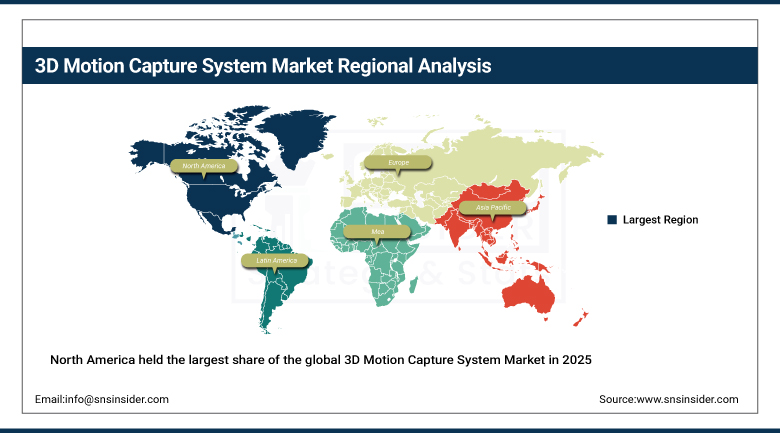
Largest Region: North America
To Get more information On 3D Motion Capture System Market - Request Free Sample Report
3D Motion Capture System Market Trends
-
Markerless capture systems are gaining commercial viability as edge AI chips compress processing latency below immersive application thresholds.
-
Rising workflow complexity is pushing buyers toward service-based offerings bundling installation, cloud processing, and real-time support.
-
Cross-industry adoption is expanding demand from film studios into tele-rehabilitation and industrial ergonomics assessment.
-
Multi-camera vision AI systems are closing the accuracy gap with traditional marker-based optical rigs at meaningfully lower cost.
-
Emerging interoperability standards are pushing vendors to differentiate through premium service tiers rather than raw software capability.
U.S. 3D Motion Capture System Market Size Outlook
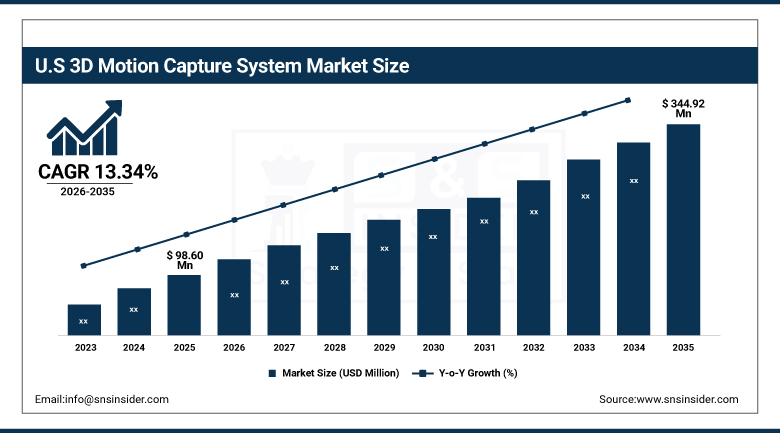
The U.S. 3D Motion Capture System Market was valued at USD 98.60 Million in 2025 and is expected to reach USD 344.92 Million by 2035, growing at a CAGR of 13.34% from 2026 to 2035.
The United States remained one of the key players on the North American market of 3D motion capture systems thanks to its well-established presence in the production of entertainment and games, its involvement in healthcare rehabilitation practices and increasing use of 3D motion capture technologies in research institutions. The increasing number of AAA game development studios and film production companies, together with growing defense and robotics training simulation practices, ensured the commercial importance of the country as one of the leaders of the market of 3D motion capture systems.
OptiTrack launched its PrimeX 41W camera in 2025, providing a wide angle of view to perform wall-to-wall and floor-to-ceiling tracking along with its new Duplex Mode function which enables cameras to capture both marker data and video data at once.
3D Motion Capture System Market Segment Analysis
-
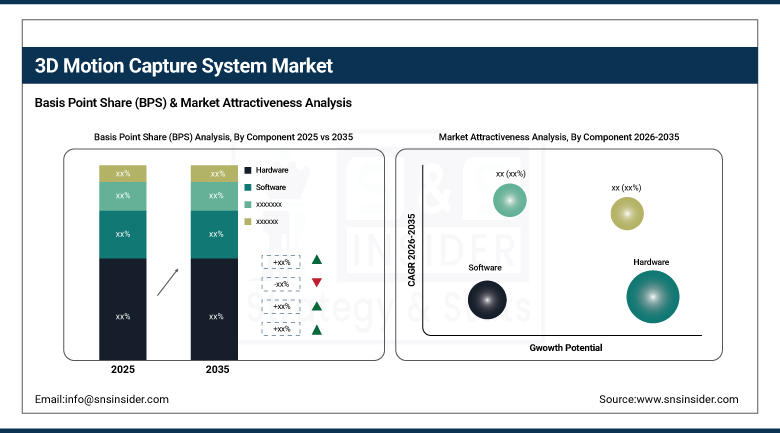
By Component, the Hardware segment held the largest share in 2025, while the Services segment is the fastest growing.
-
By Technology, the Optical segment held the largest share in 2025, while the Inertial segment is the fastest growing.
-
By Application, the Entertainment segment held approximately 40% share in 2025, while the Healthcare segment is the fastest growing.
-
By End-User, the Film Studios segment held the largest share in 2025, while the Research Institutions segment is the fastest growing.
By Component, Hardware led the market, Services grew fastest
The Hardware segment dominated the component category in 2025, remaining the principal revenue engine for the broader market. Cameras, sensors, and capture rigs represent the foundational capital investment for any motion capture deployment, and that necessary physical infrastructure layer continues keeping hardware firmly at the top of the component segmentation across film studios, sports science laboratories, and healthcare rehabilitation facilities worldwide.
The Services segment is projected to grow at the fastest CAGR during the forecast period, as rising workflow complexity pushes buyers toward offerings that bundle installation, cloud processing, and real-time support rather than relying purely on capital equipment purchases. Buyers increasingly value predictable operating budgets over capital depreciation, and emerging interoperability standards threaten to commoditize raw software, pushing vendors to differentiate through premium service tiers including AI-assisted retargeting and clinical trial consulting that continue driving this segment's above-average growth.
By Technology, Optical led the market, Inertial grew fastest
The Optical segment held the largest technology share in 2025, remaining the preferred choice in accuracy-sensitive workflows including visual effects production and biomechanical research. Marker-based optical systems have ruled premium, high-accuracy applications for decades, and that established reliability continues keeping optical technology the dominant category across the highest-value segments of the broader technology segmentation.
The Inertial segment is projected to grow at the fastest CAGR during the forecast period, advancing quickly as a portable, lower-cost option for sports science and field research applications that do not require a fixed camera rig. Inertial systems offer meaningful advantages in portability, working indoors or outdoors without a dedicated capture space, and that flexibility continues pushing inertial technology adoption ahead of the broader technology segmentation, particularly for field-based and remote research applications.
By Application, Entertainment led the market, Healthcare grew fastest
The Entertainment segment held the largest application share in 2025, at approximately 40%, anchored by sustained demand from film studios and AAA game development studios producing increasingly realistic character animation. Hundreds of animation studios and game development firms continue adopting motion capture to reduce production timelines and increase frame reusability, and that entrenched production workflow role keeps entertainment firmly at the center of overall motion capture demand.
The Healthcare segment is projected to grow at the fastest CAGR during the forecast period, driven by expanding tele-rehabilitation applications, biomechanical gait analysis, and clinical movement disorder assessment that increasingly rely on precise 3D motion tracking. Growing clinical adoption of motion capture for objective rehabilitation progress measurement continues pushing this application segment's growth rate well ahead of the broader application segmentation.
By End-User, Film Studios led the market, Research Institutions grew fastest
Film Studios had the highest market share in terms of end-users in 2025 due to the long-standing use of motion capture technology in character animation and visual effects in the entertainment industry. Motion capture technology in film studios continues to experience growth through both marker-based and markerless motion capture technology in order to meet customer demands for realistic virtual character performances, thereby maintaining the lead position among end-users.
Research Institutions are expected to have the highest growth rate during the forecast period as a result of increased research and development activities in the areas of biomechanics, robot training, and rehabilitation science. Increased financial investments by governments and universities in motion analysis research has increased demand for high precision motion capture devices within laboratories, thus making Research Institutions the leader in terms of growth rates among end-users.
Regional Analysis
|
Region |
Major Country |
Share within Region, 2025 (%) |
|---|---|---|
|
North America |
United States |
88.0% |
|
Europe |
United Kingdom |
27.0% |
|
Asia Pacific |
China |
36.0% |
|
Middle East & Africa |
UAE |
26.0% |
|
Latin America |
Brazil |
37.0% |
North America 3D Motion Capture System Market Insights
North America held the largest share of the global 3D Motion Capture System Market in 2025, at approximately 49.8%, propelled by a robust presence in the entertainment and gaming sectors, advanced healthcare rehabilitation applications, and rising investment in motion capture technology across research and defense institutions. Hollywood film production and AAA game development studios continue anchoring sustained regional demand for both hardware and software motion capture solutions.
The United States accounted for roughly 88% of regional revenue, reflecting its dense concentration of entertainment production studios, healthcare rehabilitation centers, and research institutions investing in motion capture technology. Canada contributed a smaller but steadily growing share of regional revenue, supported by its own expanding animation and visual effects production industry, keeping North America firmly ahead of every other region in this market.
Get Customized Report as per Your Business Requirement - Enquiry Now
Europe 3D Motion Capture System Market Insights
Europe held the second-largest share of the global 3D Motion Capture System Market in 2025, supported by an established games and animation production base alongside growing sports science and healthcare rehabilitation applications across the continent. The United Kingdom accounted for roughly 27% of regional revenue, supported by its concentration of visual effects studios and game development companies.
Germany, France, and the Nordic countries followed a broadly similar trajectory, as continued investment in sports biomechanics research and healthcare rehabilitation technology extended motion capture adoption across the continent's largest research and production markets. Continued growth in European game development and animation production is expected to keep supporting steady regional demand through the remainder of the forecast period.
Asia Pacific 3D Motion Capture System Market Insights
Asia Pacific was the fastest-growing region in the global 3D Motion Capture System Market, as studios across China, Japan, South Korea, and Southeast Asia continued scaling their use of motion capture technology for both entertainment and industrial applications. Rapid growth in domestic game development and animation production continued driving regional demand at a pace considerably faster than more mature Western markets.
China accounted for roughly 36% of regional revenue, supported by its rapidly expanding domestic game development and animation industry. Japan and South Korea contributed significant additional regional demand through their own advanced entertainment production and robotics research sectors, reinforcing Asia Pacific's position as the clear growth leader in motion capture technology adoption through the forecast period.
MEA & Latin America 3D Motion Capture System Market Insights
In the Middle East and Africa region, there was a constant trend in 3D motion capture market penetration in 2025 as more investment was being made towards media production and healthcare rehabilitation equipment in the Gulf countries. The United Arab Emirates contributed almost 26% to the total revenue generated in the region due to increasing enterprise demand for media production technology and sports science.
Similarly, the Latin American market also grew steadily with Brazil leading at almost 37% of the total revenue of the region owing to increased investments in media production and sports science. Mexico and Argentina also showed the same trends for the remaining period of the forecast period.
Growth Drivers: Cross-industry expansion beyond traditional entertainment applications
Strong cross-industry uptake continues shifting motion capture demand well beyond film studios into tele-rehabilitation, autonomous robot training, and industrial ergonomics assessment. Rising demand for realistic animations and accurate movement analysis across entertainment, sports, healthcare, and industrial applications continues expanding the addressable market for motion capture systems considerably beyond their traditional studio-centric origins.
Combined motion capture, virtual reality, and augmented reality platforms continue creating engaging training environments that let athletes and clinicians visualize and adjust movements instantly, reinforcing demand growth across sports performance and rehabilitation applications. Technological advancements in sensor and real-time rendering technology continue propelling market dynamics forward, as edge AI processing capability increasingly enables markerless systems to match the precision that only marker-based optical rigs could previously deliver.
Restraints: High equipment costs and space requirements limiting adoption
High-cost optical systems, frequently ranging between forty-five thousand and two hundred fifty thousand dollars with substantial additional annual maintenance costs, continue limiting adoption in emerging regions and among smaller studios and research institutions operating with constrained budgets. That cost barrier keeps premium marker-based systems concentrated among the largest, best-capitalized studios and research institutions capable of absorbing both the upfront investment and ongoing maintenance expense.
The substantial physical space requirements that traditional optical capture systems demand continue posing a genuine barrier for smaller production studios and research facilities lacking dedicated capture volume space. These combined cost and space constraints continue to concentrate high-end motion capture deployment among well-resourced entertainment studios and research institutions, even as more portable inertial and markerless alternatives continue expanding access to smaller organizations.
Opportunities: Expanding healthcare and robotics training applications
Growing adoption of motion capture technology in tele-rehabilitation and clinical movement disorder assessment presents substantial opportunity for vendors positioned to serve the expanding healthcare application category. As telehealth adoption continues accelerating, demand for objective, remotely monitorable movement analysis tools capable of tracking patient rehabilitation progress continues widening the addressable market for motion capture vendors well beyond entertainment applications.
Rising demand for autonomous robot training data represents a further significant growth avenue, as robotics developers increasingly rely on precise human motion capture data to train robots for complex physical tasks. Vendors capable of delivering motion capture systems optimized for robotics training data collection stand to capture meaningful new revenue streams as industrial and service robotics adoption continues expanding through 2035.
Recent Developments:
-
2024: Vicon debuted its machine learning-powered markerless technology at SIGGRAPH in Los Angeles in collaboration with Artanim, the Swiss research institute, and Dreamscape Immersive, following nearly three years of dedicated research and development at Vicon's facility in Oxford, United Kingdom.
-
2025: OptiTrack expanded its hardware and software portfolio with the PrimeX 41W camera and new Duplex Mode capability, enabling simultaneous marker and video data streaming from a single camera setup.
-
2025: Movella released Xsens Animate 2025, introducing male and female native anatomy models, enhanced data accuracy, and a refined user interface designed to improve animation workflows for film, television, and video game production.
3D Motion Capture System Companies are:
-
OptiTrack
-
Motion Analysis Corporation
-
Qualisys AB
-
PhaseSpace, Inc.
-
Noitom Ltd.
-
Move AI Ltd.
-
Noraxon USA
-
Codamotion
-
AR Tracking
-
AiQ Synertial
-
Rokoko
-
NANSENSE Inc.
-
Vicon Motion Systems Ltd.
-
STT Systems
-
Northern Digital Inc.
-
Ascension Technology Corporation
-
Polhemus
-
IKinema Ltd.
3D Motion Capture System Market Report Scope:
| Report Attributes | Details |
|---|---|
| Market Size in 2025 | USD 284.47 Million |
| Market Size by 2035 | USD 1,016.60 Million |
| CAGR | CAGR of 13.58% From 2026 to 2035 |
| Base Year | 2025 |
| Forecast Period | 2026-2035 |
| Historical Data | 2022-2024 |
| Report Scope & Coverage | Market Size, Segments Analysis, Competitive Landscape, Regional Analysis, DROC & SWOT Analysis, Forecast Outlook |
| Key Segments | • by Component (Hardware, Software, and Services) • by Technology (Optical, Inertial, and Markerless) • by Application (Media Entertainment, Sports Science, Healthcare, and Industrial) • by End-User (Film Studios, Game Developers, Research Institutions, and Enterprises) |
| Regional Analysis/Coverage | North America (US, Canada, Mexico), Europe (Eastern Europe [Poland, Romania, Hungary, Turkey, Rest of Eastern Europe] Western Europe] Germany, France, UK, Italy, Spain, Netherlands, Switzerland, Austria, Rest of Western Europe]), Asia Pacific (China, India, Japan, South Korea, Vietnam, Singapore, Australia, Rest of Asia Pacific), Middle East & Africa (Middle East [UAE, Egypt, Saudi Arabia, Qatar, Rest of Middle East], Africa [Nigeria, South Africa, Rest of Africa], Latin America (Brazil, Argentina, Colombia, Rest of Latin America) |
| Company Profiles | OptiTrack, Movella Inc., Motion Analysis Corporation, Qualisys AB, PhaseSpace, Inc., Motus Digital, Noitom Ltd., Move AI Ltd., Noraxon USA, Codamotion, AR Tracking, AiQ Synertial, Rokoko, NANSENSE Inc., Vicon Motion Systems Ltd., STT Systems, Northern, Digital Inc., Ascension Technology Corporation, Polhemus, IKinema Ltd. |
Frequently Asked Questions
The 3D Motion Capture System Market is expected to grow at a CAGR of 13.58% from 2026 to 2035.
The 3D Motion Capture System Market was valued at USD 284.47 Million in 2025.
Cross-industry expansion beyond entertainment into healthcare, robotics training, and industrial ergonomics is the major growth factor.
The Entertainment segment held approximately 40% share in 2025.
North America held the largest share of the 3D Motion Capture System Market in 2025, at approximately 49.8%, while Asia Pacific was the fastest-growing region.
