
Acrylic Emulsions Market Report Scope & Overview:
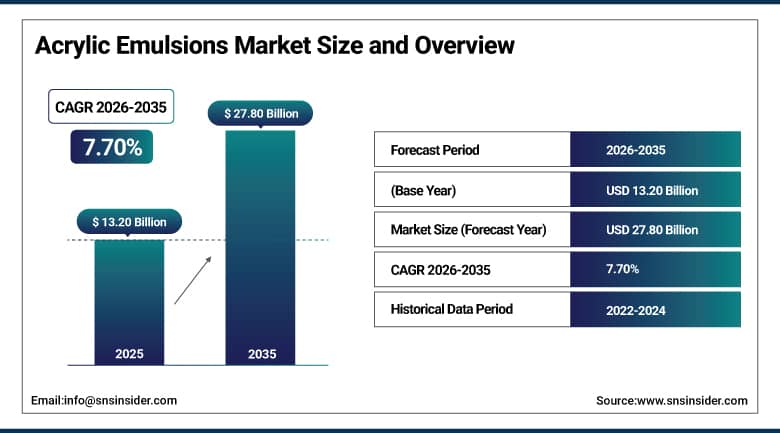
The Acrylic Emulsions Market was valued at USD 13.20 Billion in 2025 and is expected to reach USD 27.80 Billion by 2035, growing at a CAGR of 7.70% from 2026 to 2035.
The Acrylic Emulsions Market is experiencing significant growth because of growing demand for environment-friendly, low-VOC, and water-based coatings. Strict environmental laws are fueling the adoption of acrylic emulsions as substitutes for solvent-based products. Increasing infrastructure developments and urbanization, along with rising investment in residential and commercial constructions, are contributing to high demands for paints, coatings, and construction chemicals. Moreover, technological advancements in polymer technology have improved durability, weatherability, flexibility, and adhesion properties. The growing use of acrylic emulsions in adhesives, sealants, paper coatings, and speciality applications is also boosting the market growth.
According to the United Nations Environment Programme (UNEP), the buildings and construction sector accounts for approximately 37% of global energy-related CO₂ emissions, driving the adoption of sustainable building materials, including low-VOC water-based acrylic emulsion coatings. According to the World Bank, 56% of the world's population lives in urban areas, and this figure is projected to increase to nearly 70% by 2050, significantly boosting residential and commercial construction and increasing demand for paints, coatings, adhesives, and sealants.
To Get More Information On Acrylic Emulsions Market - Request Free Sample Report
Acrylic Emulsions Market Trends
-
Rising demand for low-VOC and water-based coatings driving adoption of acrylic emulsions in paints, coatings, and construction applications
-
Growing use of acrylic emulsions in adhesives, sealants, and textiles due to their excellent bonding strength, flexibility, and durability
-
Increasing focus on sustainable and environmentally friendly formulations encouraging the development of bio-based and high-performance acrylic emulsions
-
Expanding construction and infrastructure activities boosting demand for acrylic emulsion-based architectural coatings with enhanced weather resistance
-
Continuous advancements in polymerization technologies improving the performance, chemical resistance, and application versatility of acrylic emulsion products
The U.S. Acrylic Emulsions Market Outlook
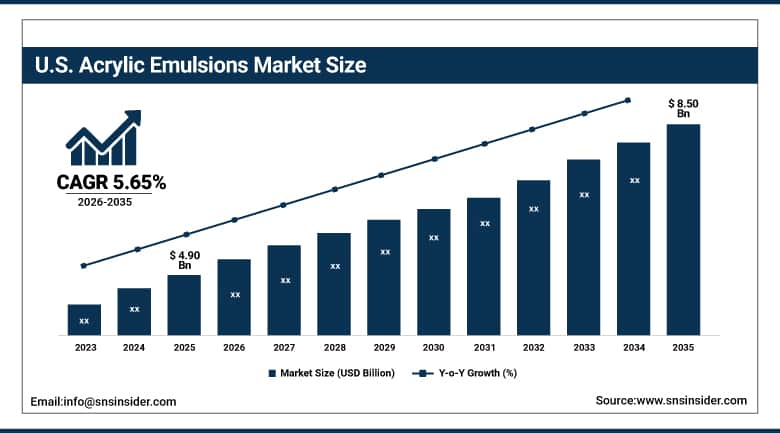
The U.S. Acrylic Emulsions Market was valued at approximately USD 4.90 Billion in 2025 and is expected to reach approximately USD 8.50 Billion by 2035, growing at a CAGR of approximately 5.65%.
The United States is the world's largest single national acrylic emulsions market within the North American region, anchored by the domestic presence of Dow Inc., Celanese, and Arkema's North American operations whose combined production capacity serves the U.S. architectural coatings, adhesives, and construction materials industries whose combined acrylic emulsion consumption creates the world's most concentrated national demand base. The U.S. architectural coatings market, led by Sherwin-Williams, PPG Industries, and Benjamin Moore, represents the largest single application of acrylic emulsions nationally, with exterior acrylic latex paint for residential and commercial building applications consuming millions of tonnes of acrylic emulsion binder annually.
According to the U.S. Census Bureau, the value of U.S. construction put in place exceeded USD 2.1 trillion in 2024, reflecting robust investment in residential, commercial, and infrastructure projects. This sustained construction activity is driving strong demand for architectural paints, protective coatings, adhesives, sealants, and other construction chemicals, thereby supporting the growth of the market.
Acrylic Emulsions Market Segment Analysis
-
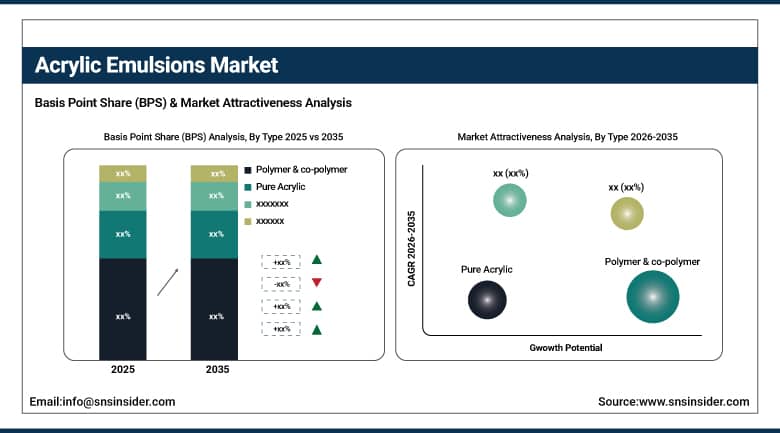
By Type, Polymer & Co-polymer segment dominated the Acrylic Emulsions Market in 2025 with 64% share; Pure Acrylic segment is the fastest growing segment.
-
By Application, Paints & Coatings segment dominated the market in 2025 with 57% share; Construction Additives segment is the fastest growing segment.
By Type, Polymer & Co-polymer segment dominates the Acrylic Emulsions Market, Pure Acrylic segment expected to grow fastest
The Polymer & Co-polymer segment dominated the Acrylic Emulsions Market in 2025 owing to its versatility, low cost, and well-balanced properties. The acrylate emulsions have high adhesion, good flexibility, moisture resistance, and durability and are hence used in paints, coatings, adhesives, textiles, paper, and construction products. The wide formulation capabilities and processability of these emulsions have driven their industrial usage. Stable demand from industries such as manufacturing, packaging, and construction has helped maintain the dominance of this segment in the market.
The Pure Acrylic segment is the fastest-growing in the Acrylic Emulsions Market because of the growing need for high-quality coating products that can withstand extreme weather conditions and possess high durability and UV resistance. Pure acrylic emulsions are being increasingly preferred in various applications requiring long service life such as exterior architectural coatings and waterproofing products. Investment in sustainable construction projects, infrastructure development, and green water-based coating products has helped drive the growth of this segment.
By Application, Paints & Coatings segment dominates the Acrylic Emulsions Market, Construction Additives segment expected to grow fastest
The Paints & Coatings segment dominated the Acrylic Emulsions Market in 2025 due to the widespread usage of acrylic emulsions as decorative, industrial, and protective coatings. Their good film formation capability, superior adhesion strength, weather-resistance properties, low VOC emissions, and durability have made them a popular choice for residential, commercial, and industrial uses. The rising activities of renovation, infrastructure development, and preference for environment-friendly water-based coatings are constantly contributing to the dominance of this segment in the market.
The Construction Additives segment is the fastest growing in the Acrylic Emulsions Market owing to increased infrastructure development and the rising demand for high-performing building products. Acrylic emulsion enhances the properties of various construction additives such as waterproofing compounds, sealants, tile adhesives, cement modifiers, and repair mortars by providing them with improved flexibility, better adhesion, and improved resistance to cracking and wear. The increasing investment in residential and commercial constructions and urban developments are driving the growth of acrylic-based construction additives.
Regional Analysis
|
Region |
Major Country |
Share within Region, 2025 (%) |
|---|---|---|
|
North America |
United States |
84.73% |
|
Europe |
Germany |
27.84% |
|
Asia Pacific |
China |
42.84% |
|
Middle East & Africa |
UAE |
22.84% |
|
Latin America |
Brazil |
43.84% |
North America Acrylic Emulsions Market Insights
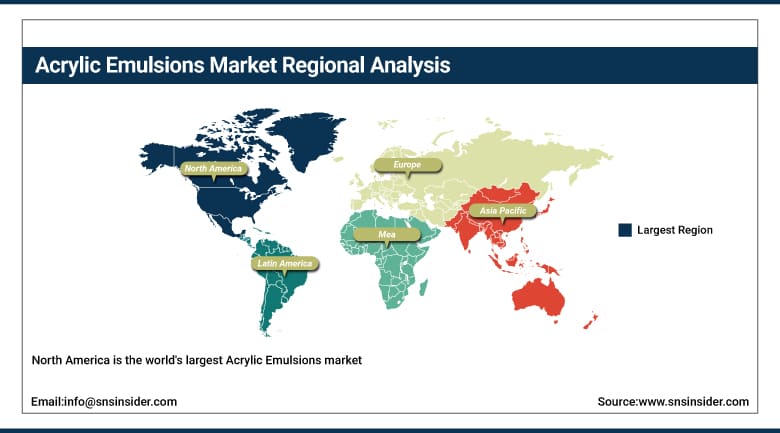
North America is the world's largest Acrylic Emulsions market, anchored by the U.S. architectural coatings industry's large-volume pure and styrene acrylic emulsion consumption, the domestic manufacturing operations of Dow, Celanese, and Arkema, and the progressive tightening of EPA VOC regulations that are structurally redirecting formulation investment toward water-based acrylic alternatives.
The United States accounts for approximately 84.73% of regional revenue through its combination of the world's most mature architectural coatings market, the domestic adhesives and sealants industry whose construction sector growth creates sustained acrylic emulsion demand, and the paper and packaging industry whose coating and barrier applications create additional acrylic polymer consumption.
Get Customized Report as Per Your Business Requirement - Enquiry Now
Europe Acrylic Emulsions Market Insights
Europe held approximately 24.84% of global Acrylic Emulsions revenues in 2025. Germany accounts for approximately 27.84% of European revenues through its large construction industry, the domestic presence of BASF SE's Joncryl and Acronal acrylic emulsion brands, and the established architectural coatings and industrial adhesives markets whose acrylic emulsion demand is sustained by stringent EU VOC regulations that favour water-based formulations.
The EU Ecodesign and Green Deal regulatory agenda is progressively extending low-emission product requirements to construction materials and adhesives categories that create growing acrylic emulsion adoption mandates. The UK, France, Italy, and the Netherlands each contribute meaningful European acrylic emulsion demand through their construction, automotive, and packaging industries.
According to the European Commission, the European Green Deal aims to achieve climate neutrality by 2050, accelerating the adoption of sustainable construction materials, low-emission coatings, and environmentally friendly building solutions. This policy framework is encouraging greater use of water-based acrylic emulsions in paints, coatings, adhesives, and other construction applications to support decarbonization and sustainable development.
Asia Pacific Acrylic Emulsions Market Insights
Asia Pacific is the fastest-growing regional Acrylic Emulsions market, projected to expand at a CAGR of approximately 9.50% through 2035. China accounts for approximately 42.84% of Asia Pacific revenues through its world-leading construction sector whose annual floor area under construction creates the largest single national acrylic emulsion consumption market, its massive architectural coating production volume, and its growing automotive sector creating increasing demand for acrylic-based automotive refinish and OEM coating systems.
According to the World Bank, Asia is expected to account for the largest share of future urban population growth, driving substantial demand for residential and commercial construction materials, including paints, coatings, adhesives, and sealants used in expanding urban infrastructure.
India is growing at approximately 9.60% CAGR through expanding residential and commercial construction investment, government infrastructure programme implementation, and rising middle-class renovation activity that collectively sustain above-average architectural coating demand growth.
MEA & Latin America Acrylic Emulsions Market Insights
Middle East and Latin America are growing Acrylic Emulsions markets where construction investment and industrial development are creating expanding binder demand. The UAE leads MEA revenues at approximately 22.84% of the regional total through its major real estate and infrastructure development programme creating large architectural coating consumption, and its position as a distribution hub for acrylic emulsion products serving the broader Gulf region.
Saudi Arabia's Vision 2030 construction programme contributes significant MEA acrylic emulsion demand through NEOM and large-scale residential and commercial building investment. Brazil leads Latin American revenues at approximately 43.84% of the regional total through its large construction sector, domestic architectural coating production, and growing infrastructure investment.
Market Dynamics
Growth Drivers: Global VOC emission regulations and expanding construction activities are accelerating demand for sustainable water-based acrylic emulsions
Environmental regulations governing VOC emissions from paints, coatings, and adhesives represent the most commercially significant structural demand driver for acrylic emulsions as the technically and commercially superior water-based alternative to solvent-borne coating systems. The EU's Directive 2004/42/CE VOC content limits, California's CARB Architectural Coating Regulation, and equivalent national standards across China, India, Japan, and South Korea each specify declining VOC content limits across architectural coating categories that progressively eliminate the market space for solvent-borne acrylic coatings while creating mandatory demand for water-based acrylic emulsion alternatives.
Construction sector expansion in Asia Pacific and emerging markets sustains the volume demand growth that mature North American and European markets whose construction activity is constrained by land availability and population growth rates cannot deliver independently.
Restraints: Volatile acrylic monomer prices and performance limitations in extreme environments challenge acrylic emulsion market growth
Acrylic emulsion production costs are directly linked to acrylic acid and acrylic ester monomer prices whose feedstock dependency on propylene creates exposure to petroleum price cycles and the supply-demand dynamics of the global acrylic acid market. The 2021 and 2022 propylene price escalations driven by post-COVID energy market disruptions and logistics constraints caused acrylic monomer price spikes whose magnitude exceeded 50 percent in some markets, compressing emulsion manufacturer margins and creating downstream formulator cost management challenges that delayed end-user product reformulation and procurement decisions.
Water-based acrylic emulsion coatings are technically constrained relative to solvent-borne alternatives in specific applications requiring chemical solvent resistance, high-temperature cure performance, or extreme film build, limiting acrylic emulsion substitution in industrial and protective coating applications with the most demanding performance specifications.
Opportunities: Bio-based acrylic emulsions and sustainable packaging adhesive applications are creating lucrative growth opportunities for manufacturers.
The green building materials market's growing requirement for environmental product declarations, lifecycle assessment data, and renewable carbon content certification is creating commercial differentiation opportunity for bio-attributed acrylic emulsion grades whose ISCC PLUS or REDcert chain of custody certification provides the documentation that LEED, BREEAM, and national green building programme submittal requirements demand.
As major architectural coating brands including Sherwin-Williams, AkzoNobel, and Asian Paints progressively expand their sustainable product lines with verified renewable content claims, their upstream binder procurement specifications increasingly favour bio-attributed acrylic emulsion grades that enable downstream product sustainability claims. Pressure sensitive adhesive acrylic emulsions for sustainable e-commerce packaging, which require water-washable adhesive residue to enable paper and cardboard recycling under EN 13-432 and equivalent recyclability standards, are creating new technology development investment that expands the addressable acrylic PSA market.
Recent Developments:
-
2025: BASF SE launched the Joncryl ECO series of bio-based acrylic emulsion binders using bio-attributed monomers certified to ISCC PLUS mass balance standards, targeting architectural coating formulators seeking renewable content credentials for green building certification submissions and EPD documentation.
-
2025: Dow Inc. launched Primal EC-3620 pure acrylic emulsion for exterior masonry coating applications, incorporating hydrophobic groups reducing substrate moisture absorption and enabling VOC-exempt solvent-free formulations satisfying California CARB Architectural Coating Regulation Phase II limits.
-
2024: Arkema Group announced expansion of its Encor acrylic emulsion production capacity at its Stallingborough, UK facility to serve growing demand for waterborne exterior coatings binders in European architectural and industrial maintenance coating markets, aligning capacity investment with regulatory demand for low-VOC formulations.
Acrylic Emulsions Market Key Players are:
-
BASF SE
-
Dow Inc.
-
Arkema S.A.
-
Celanese Corporation
-
Synthomer plc
-
The Lubrizol Corporation
-
DIC Corporation
-
Covestro AG
-
H.B. Fuller Company
-
Allnex GmbH
-
Ashland Inc.
-
Akzo Nobel N.V.
-
Wacker Chemie AG
-
Mitsubishi Chemical Corporation
-
PPG Industries, Inc.
-
Mallard Creek Polymers
-
Avery Dennison Corporation
-
Nippon Paint Holdings Co., Ltd.
-
Evonik Industries AG
-
Sumitomo Chemical Co., Ltd.
Acrylic Emulsions Market Report Scope:
| Report Attributes | Details |
|---|---|
| Market Size in 2025 | USD 13.20 Billion |
| Market Size by 2035 | USD 27.80 Billion |
| CAGR | CAGR of 7.70% From 2026 to 2035 |
| Base Year | 2025 |
| Forecast Period | 2026-2035 |
| Historical Data | 2022-2024 |
| Report Scope & Coverage | Market Size, Segments Analysis, Competitive Landscape, Regional Analysis, DROC & SWOT Analysis, Forecast Outlook |
| Key Segments | • By Type (Polymer & co-polymer, Pure Acrylic) • By Application (Paints & coatings, Adhesives & sealants, Construction additives, Paper coating, Others) |
| Regional Analysis/Coverage | North America (US, Canada), Europe (Germany, UK, France, Italy, Spain, Russia, Poland, Rest of Europe), Asia Pacific (China, India, Japan, South Korea, Australia, ASEAN Countries, Rest of Asia Pacific), Middle East & Africa (UAE, Saudi Arabia, Qatar, South Africa, Rest of Middle East & Africa), Latin America (Brazil, Argentina, Mexico, Colombia, Rest of Latin America). |
| Company Profiles | BASF SE, Dow Inc., Arkema S.A., Celanese Corporation, Synthomer plc, The Lubrizol Corporation, DIC Corporation, Covestro AG, H.B. Fuller Company, Allnex GmbH, Ashland Inc., Akzo Nobel N.V., Wacker Chemie AG, Mitsubishi Chemical Corporation, PPG Industries, Inc., Mallard Creek Polymers, Avery Dennison Corporation, Nippon Paint Holdings Co., Ltd., Evonik Industries AG, Sumitomo Chemical Co., Ltd. |
Frequently Asked Questions
The Polymer & Co-polymer segment dominated the Acrylic Emulsions Market.
North America dominated the Acrylic Emulsions Market in 2025.
The Acrylic Emulsions Market is expected to grow at a CAGR of 7.70% from 2026 to 2035.
The Acrylic Emulsions Market was valued at USD 13.20 Billion in 2025.
Global VOC regulations, construction growth, bio-based innovations, expanding sustainable packaging demand, and polymer technology advancements are driving acrylic emulsions market growth.
