
Acrylic Resins Market Insights & Overview:
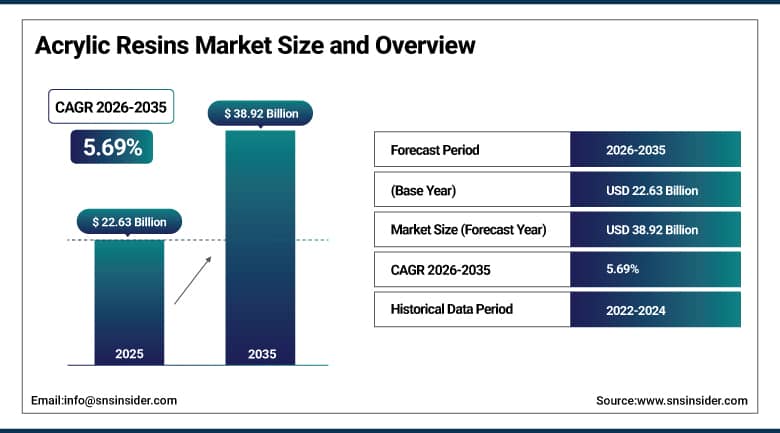
The Acrylic Resins Market was valued at USD 22.63 Billion in 2025 and is expected to reach USD 38.92 Billion by 2035, growing at a CAGR of 5.69% from 2026 to 2035.
Acrylic resins Market have proven to be one of the most commercially essential polymer chemistries in the world of specialty chemicals and industrial materials manufacturing. They offer a unique blend of transparency, weatherability, chemical resistance, adhesive characteristics, and formula versatility, which allows them to serve as an ideal binding agent for applications as diverse as paints and coatings, adhesives and sealants, printing inks, plastic materials, and textile finishes. Acrylic resin chemistries owe their commercial success to the fact that they can be customized by choice of monomers and polymerization process to develop desired characteristics.
In 2025, acrylic resin manufacturers across North America expanded production and sustainability initiatives to meet rising demand from construction, automotive coatings, and industrial applications. Meanwhile, the U.S. Environmental Protection Agency strengthened low-VOC coating regulations, accelerating adoption of water-based acrylic resins in paints and protective coatings used in infrastructure modernization projects throughout the region.
Market Size and Forecast
-
Market Size in 2026E: USD 23.65 Billion
-
Market Size by 2035: USD 38.92 Billion
-
CAGR: 5.69% from 2026 to 2035
-
Fastest Growing Region: Asia Pacific
-
Largest Region: Asia Pacific
To Get More Information On Acrylic Resins Market - Request Free Sample Report
Key Market Trends
-
Growing regulatory pressure to reduce VOC emissions is accelerating the global transition toward water-based acrylic resin formulations across applications.
-
Rising demand for UV-curable acrylic resin systems in printing inks, optical coatings, and electronics applications.
-
Expanding adoption of acrylic-based pressure-sensitive adhesives in e-commerce packaging, medical device assembly, and automotive interior trim bonding is creating high-growth application.
-
Increasing deployment of bio-based acrylic monomers derived from fermentation of renewable feedstocks is supporting sustainability positioning.
-
Growing construction activity sustaining structural demand for architectural and protective coating resins with acrylic binder platforms.
U.S. Acrylic Resins Market Size Outlook
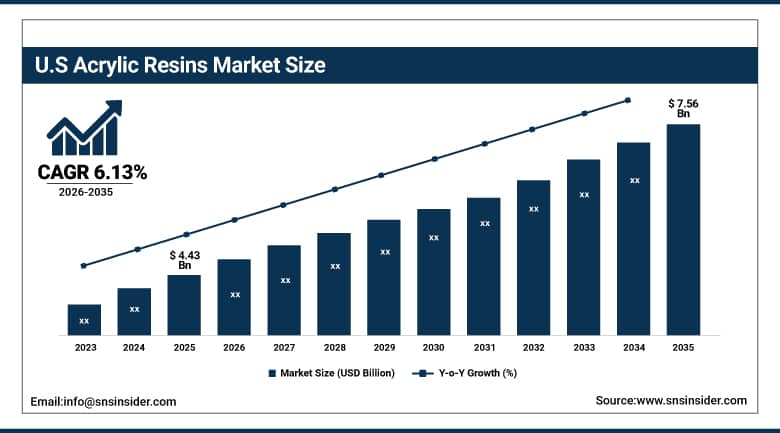
The U.S. Acrylic Resins Market was valued at USD 4.43 billion in 2025 and is expected to reach around USD 7.56 billion by 2035, growing at a CAGR of 6.13% from 2026–2035.
The United States is one of the largest and most advanced national markets for acrylic resins, being driven by the developed coating manufacturers in the country, the developed adhesives and sealants market and also its strong automobile and aerospace original equipment manufacturer base where premium quality acrylic resins are specified in coating formulations. The United States' architectural coatings end-use market accounts for the single biggest end-use market for acrylic emulsion resins in the United States, which receives consistent demand, fuelled by residential construction activity, commercial building renovation projects, as well as investments made by the US Department of Housing and Urban Development to rehabilitate public housing stock using water-borne acrylic latex coatings.
Dow, Michigan, launched new RHOPLEX ultra-low VOC acrylic emulsion resin grades in 2025 for premium exterior architectural coatings. The newly introduced binder technologies were developed for flat and satin coating formulations compatible with LEED-certified building projects while delivering enhanced dirt-pickup resistance and efflorescence blocking performance for commercial and institutional building facades.
Acrylic Resins Market Segment Analysis
-
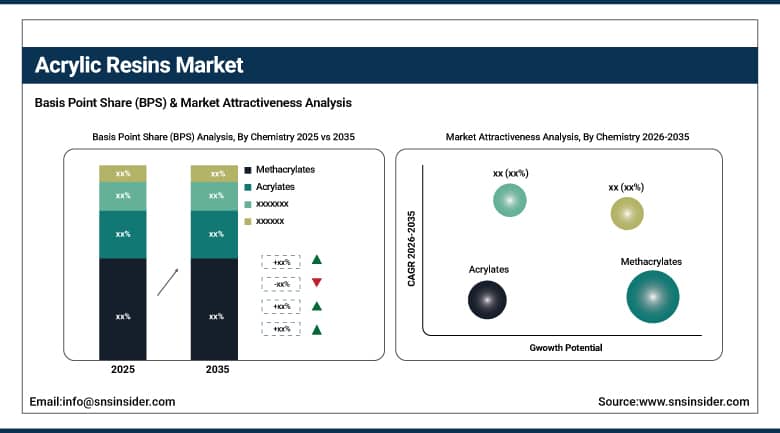
By Chemistry, the methacrylates segment dominated the acrylic resins market with 47.21% share in 2025, while the acrylates segment is the fastest growing chemistry type with CAGR of 6.39% during 2026 to 2035.
-
By Solvency, the water-based segment dominated the acrylic resins market with 65.43% share in 2025, while the solvent-based segment is the fastest growing solvency type with CAGR of 6.82% during 2026 to 2035.
-
By Property, the thermoplastics segment dominated the acrylic resins market with 58.13% share in 2025, while the thermosetting segment is the fastest growing property type with CAGR of 6.12% during 2026 to 2035.
-
By Application, the paints & coatings segment dominated the acrylic resins market with 45.67% share in 2025, while the adhesives & sealants segment is the fastest growing application with CAGR of 6.59% during 2026 to 2035.
-
By End-Use Industry, building & construction segment dominated the acrylic resins market with 32.51% share in 2025, while automotive segment is the fastest growing application with CAGR of 6.89% during 2026 to 2035.
By Chemistry, methacrylates segment dominates, acrylates segment grows fastest
Methacrylates segment retained the dominant chemistry position with 47.21% of acrylic resins market revenue in 2025. Methacrylic acid esters and their polymer derivatives deliver the optical clarity, hardness, weatherability, and thermal stability that make them the preferred monomer platform for premium architectural coating binders, automotive refinish resins, optical lens materials, and specialty adhesives whose performance requirements demand the highest levels of UV resistance and color retention achievable within acrylic polymer chemistry.
Acrylates segment represent the fastest-growing chemistry segment, driven by the accelerating adoption of acrylate-based pressure-sensitive adhesives in flexible electronics, medical wearable device bonding, and automotive structural adhesive applications where the lower glass transition temperatures and higher chain flexibility of acrylate polymers deliver superior adhesion performance on low-surface-energy substrates and under dynamic stress conditions compared with methacrylate-dominated copolymer alternatives.
By Solvency, water-based segment dominates, solvent-based segment grows fastest
Water-based acrylic resins segment accounted for 65.43% of market revenue in 2025, reflecting the decades-long regulatory and commercial transition of the global coatings, adhesives, and textile finishing industries from solvent-borne to water-borne formulation platforms under VOC emission regulation frameworks that now encompass the majority of global industrial coatings consumption in North America, Europe, and the increasingly regulated markets of East and Southeast Asia.
Solvent-based acrylic resins segment are the fastest-growing solvency segment, driven by continued demand in high-performance industrial coating applications including heavy-duty corrosion protection, automotive OEM clearcoat systems, and aerospace coating specifications where solvent-borne delivery platforms sustain performance advantages in cure efficiency, inter-coat adhesion, and film build that water-borne systems have not yet fully replicated in regulated industrial facility environments that can accommodate solvent emission compliance infrastructure.
By Property, thermoplastics segment dominates, thermosetting segment grows fastest
Thermoplastics segment dominated the Acrylic Resins Market with 58.13% share in 2025. Thermoplastic acrylic resins maintain strong market leadership due to their excellent transparency, weather resistance, impact durability, and ease of processing, making them widely preferred for architectural coatings, automotive finishes, signage materials, and consumer goods applications where recyclability and re-formability provide significant manufacturing and performance advantages.
Therosetting segment represents the fastest-growing property type, projected to expand at a CAGR of 6.12% during 2026 to 2035. Growth is primarily driven by rising demand for high-performance industrial coatings, automotive components, electrical insulation systems, and advanced composite materials where thermosetting acrylic resins deliver superior chemical resistance, heat stability, cross-linking strength, and long-term durability under extreme operational and environmental conditions.
By Application, paints & coatings segment dominate, adhesives & sealants segment grow fastest
Paints and coatings segment accounted for 45.67% of acrylic resins application revenue in 2025. The paints and coatings industry is the foundational end-use market for acrylic resin technology, having integrated acrylic binder chemistry as the dominant film-forming platform across architectural, automotive OEM and refinish, industrial maintenance, marine, and protective coating product categories whose combined global market volume consumes the majority of the world's commercially produced acrylic resin output annually.
Adhesives and sealants segment represent the fastest-growing application segment as the expansion of acrylic-based pressure-sensitive adhesive consumption in e-commerce packaging tape, medical device assembly, automotive interior panel bonding, and consumer electronics display lamination accelerates under the combined influence of global parcel delivery volume growth, lightweighting-driven fastener elimination in automotive design, and miniaturization trends in consumer electronics whose manufacturing assembly requirements increasingly favor precision-applied acrylic adhesive systems over mechanical fastening alternatives.
By End-Use Industry, building & construction segment dominate, automotive segment grows fastest
The building & construction segment held the largest revenue share of 32.51% in 2025 due to the extensive use of acrylic resins in architectural coatings, waterproofing systems, sealants, adhesives, and protective surface coatings. The segment benefits from rapid urbanization, infrastructure expansion, and renovation activities across residential, commercial, and industrial construction projects. Acrylic resins are widely preferred in this sector owing to their excellent weather resistance, UV stability, durability, and strong adhesion properties, making them ideal for long-lasting building protection and aesthetic finishes.
Automotive segment is expected to register the fastest growth from 2026 to 2035, driven by increasing demand for lightweight, durable, and high-performance coating materials used in vehicle manufacturing and refinishing applications. Acrylic resins are increasingly used in automotive coatings due to their superior gloss retention, chemical resistance, fast drying properties, and compatibility with waterborne formulations that meet stringent environmental regulations. Growth in electric vehicles (EVs), rising automotive production, and advancements in high-performance coating technologies are further accelerating demand in this segment.
Regional Analysis
|
Region |
Major Country |
Share within Region, 2025(%) |
|---|---|---|
|
North America |
United States |
79.69% |
|
Europe |
Germany |
24.80% |
|
Asia Pacific |
China |
43.60% |
|
Middle East & Africa |
UAE |
18.35% |
|
Latin America |
Brazil |
36.20% |
Asia Pacific Acrylic Resins Market Insights
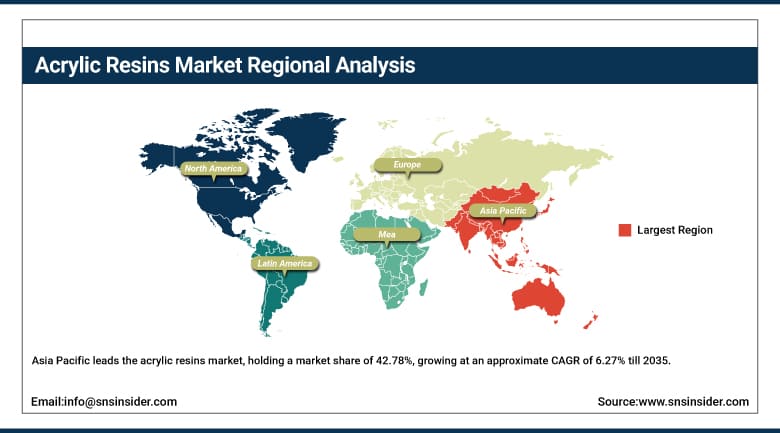
Asia Pacific leads the acrylic resins market, holding a market share of 42.78%, growing at an approximate CAGR of 6.27% till 2035. China represents a market share of 43.60% in Asia Pacific, being the largest manufacturer of acrylic resins and the largest user of architectural, automotive, and industrial coatings systems that together require more coating resins than any other market in any country in the world. The production of acrylic resins in China has grown considerably over the last decade due to the government initiatives for self-sufficiency in specialty chemicals, and the quality of acrylic resins manufactured in China has grown so much that Chinese manufacturers can now compete internationally in mid-tier export markets.
BASF achieved mechanical completion of its acrylics complex at the Zhanjiang Verbund site in China, including facilities with around 400,000 metric tons annual butyl acrylate capacity, strengthening Asia-Pacific supply chains.
Get Customized Report as Per Your Business Requirement - Enquiry Now
North America Acrylic Resins Market Insights
The North American region played a key role in contributing to global acrylic resins revenues growth on a constant basis during the forecast period. The United States is an example of a country where the growth witnessed in the revenues was prominent. This was due to the significant presence of a highly technical coatings industry within the region as well as its significant automotive OEM and refinish coating supply chain. Moreover, structural demands for coatings created due to commercial and residential construction activities with the demand for architectural coating resulted in a continuous demand for acrylic emulsion resins.
Strong ecosystem expansion in North America’s Acrylic Resins Market is visible through large-scale infrastructure modernization and sustainable coatings adoption across industrial sectors. More than 65% of newly developed commercial construction projects in the U.S. are incorporating low-VOC acrylic-based paints and coatings to comply with stricter environmental standards and green building initiatives. Additionally, leading resin manufacturers expanded regional production and supply networks across over 100 industrial sites, improving raw material availability and reducing delivery timelines for automotive, construction, and protective coating applications by nearly 30%.
Europe Acrylic Resins Market Insights
The European regional market shares some features of the European market include the existence of a well-developed legislation in terms of regulating VOC emissions from the coating system, a big number of complex OEM coating supply chains in the automobile sector, and the advanced architectural coating market, where there is a need to invest continuously in acrylic resins due to high demands for premium decorative and protective coatings. With regard to the EU’s Chemical Strategy for Sustainability and the current revision of the Industrial Emissions Directive, more regulation pressure is placed on acrylic resins, especially concerning VOC and hazardous substances.
In Europe, the Acrylic Resins Market is accelerating through large-scale sustainable manufacturing and green construction initiatives, with Germany leading regional demand for advanced coating technologies. More than 60% of newly established automotive coating lines in Germany are utilizing water-based acrylic resin systems to comply with stringent EU VOC emission standards and carbon-reduction targets.
Middle East & Africa and Latin America Acrylic Resins Market Insights
Middle East and Africa and Latin America are growth-stage acrylic resins markets where infrastructure investment, automotive industry expansion, and the development of domestic coatings and adhesives manufacturing capacity are progressively expanding acrylic resin consumption from a comparatively modest 2025 base. The UAE leads MEA revenues at approximately 30% of the regional total through its large construction sector, its advanced industrial manufacturing diversification programmes under UAE Vision 2031, and its growing domestic specialty chemicals distribution infrastructure that serves regional coating and adhesive formulators across the Gulf Cooperation Council.
In Latin America, acrylic resin manufacturers expanded regional production by 30% and sustainability initiatives to strengthen supply chains and support rising construction and packaging demand in 2025. Brazil-based Braskem increased investments around 10.11% in bio-based and specialty chemical production facilities to support sustainable coatings and industrial materials applications across the region.
Market Dynamics
Growth Drivers: Global VOC regulation transition and construction sector expansion
Increasingly stringent regulations for volatile organic compound emissions in major economies are the most critical driver of structure-led growth for water-based acrylic resin technology, with the required formulation transitions in architectural, automotive, industrial maintenance, and wood coatings providing an inevitable opportunity over many years for water-dispersed acrylic resins and acrylic emulsions to capture growth in terms of market share. Construction activity in developing economies, such as those in Asia, the Middle East, Africa, and Latin America, is growing due to urbanization, rising populations, and investment programs by governments. This trend is leading to structural growth in the market for acrylic-based binders in architectural and protective coatings applications.
The European Union expanded enforcement of low-emission coating standards under the Green Deal, increasing adoption of water-based acrylic resin systems across construction and automotive applications.
Restraints: Raw material price volatility and bio-based feedstock supply constraints create cost uncertainty.
The economics of producing acrylic resins is largely vulnerable to the price fluctuations in propylene and ethylene derivatives like acrylic acid, methacrylic acid, methyl methacrylate, and butyl acrylate, where the prices of the commodities involved tend to fluctuate based on the petrochemical market prices which can be highly volatile due to changes in crude oil prices, plant shutdowns, and regional shortages/surpluses, making them hard to foresee and protect against through contracts.
Opportunities: UV-curable and bio-based acrylic resin platforms represent high-growth technology frontiers.
The UV-curable oligomers and monomers based on acrylic resins are some of the fastest-growing segments of the overall acrylic resin market due to their usage in digital inkjet printing, optical fiber coatings, electronic display panel bonding, and 3D resin systems for their benefits including energy savings, instant curing, and solvent-free composition that are opening up new possibilities for their application in industries facing challenges such as processing time, energy usage, or other issues with conventional curing or solvent evaporation techniques.
Polycure introduced new bio-based acrylic resin solutions with reduced carbon footprint for industrial coatings and packaging applications, reflecting increasing commercialization of sustainable acrylic technologies worldwide.
Recent Developments:
-
2025: Arkema Group announced the commercial scale-up of its bio-based methyl methacrylate production technology at its Carling, France facility, utilizing renewable raw material pathways to produce MMA with a substantially reduced carbon footprint compared with conventional acetone cyanohydrin process routes, targeting premium coating resin customers with documented Scope 3 emission reduction commitments.
-
2025: Allnex Belgium SA/NV launched a new range of waterborne UV-curable acrylic oligomers designed for industrial wood coating applications, delivering the cure speed and chemical resistance advantages of UV-curable technology in a water-borne formulation platform that meets European VOC regulation compliance requirements without the organic co-solvent content that limits the regulatory acceptability of conventional UV-curable solvent-borne wood coating systems.
-
2025: Evonik Industries AG expanded its VISIOMER specialty methacrylate monomer portfolio with new functional monomer grades engineered for use in acrylic adhesive formulations targeting structural bonding in battery cell assembly for electric vehicle applications, addressing the growing demand for specialized acrylic adhesive chemistries in EV manufacturing supply chains where battery pack structural integrity and thermal management requirements are driving adhesive performance specifications beyond the capability of standard acrylic pressure-sensitive adhesive systems.
Key Market Players:
-
BASF SE
-
Dow Chemical Company
-
Arkema Group
-
Mitsubishi Chemical Group Corporation
-
Sumitomo Chemical Co. Ltd.
-
Evonik Industries AG
-
Allnex Belgium SA/NV
-
Covestro AG
-
DIC Corporation
-
Nippon Shokubai Co. Ltd.
-
Resonac Holdings Corporation
-
Röhm GmbH
-
DSM Coating Resins
-
Henkel AG & Co. KGaA
-
Reichhold LLC
-
Polycure
-
JSR Corporation
-
Celanese Corporation
-
SABIC
-
LG Chem
Acrylic Resins Market Report Scope:
| Report Attributes | Details |
|---|---|
| Market Size in 2025 | USD 22.63 Billion |
| Market Size by 2035 | USD 38.92 Billion |
| CAGR | CAGR of 5.69% From 2026 to 2035 |
| Base Year | 2025 |
| Forecast Period | 2026-2035 |
| Historical Data | 2022-2024 |
| Report Scope & Coverage | Market Size, Segments Analysis, Competitive Landscape, Regional Analysis, DROC & SWOT Analysis, Forecast Outlook |
| Key Segments | • By Chemistry (Methacrylates, Acrylates, Hybrids), • By Solvency (Water-based, Solvent-based, Others), • By Property (Thermoplastics, Thermosetting), • By Application (Paints & Coatings, Adhesives & Sealants, Printing Inks, Plastics & Composites, Textile Finishing, Others), • By End-Use Industry (Building & Construction, Automotive, Packaging, Industrial Manufacturing, Electronics, Marine, Others) |
| Regional Analysis/Coverage | North America (US, Canada), Europe (Germany, UK, France, Italy, Spain, Russia, Poland, Rest of Europe), Asia Pacific (China, India, Japan, South Korea, Australia, ASEAN Countries, Rest of Asia Pacific), Middle East & Africa (UAE, Saudi Arabia, Qatar, South Africa, Rest of Middle East & Africa), Latin America (Brazil, Argentina, Mexico, Colombia, Rest of Latin America). |
| Company Profiles | BASF SE, Dow Chemical Company, Arkema Group, Mitsubishi Chemical Group Corporation, Sumitomo Chemical Co. Ltd., Evonik Industries AG, Allnex Belgium SA/NV, Covestro AG, DIC Corporation, Nippon Shokubai Co. Ltd., Resonac Holdings Corporation, Röhm GmbH, DSM Coating Resins, Henkel AG & Co. KGaA, Reichhold LLC, Polycure, JSR Corporation, Celanese Corporation, SABIC, LG Chem. |
Frequently Asked Questions
The acrylic resins market is expected to grow at a CAGR of 5.69% from 2026 to 2035.
The acrylic resins market was valued at USD 22.63 Billion in 2025.
The primary growth factors include the global regulatory transition from solvent-borne to water-borne coating formulations driven by VOC emission regulations, expanding construction activity.
The paints & coatings segment dominated the acrylic resins market with 45.67% share in 2025.
Asia Pacific dominated the acrylic resins market in 2025, holding approximately 42.78% of global revenues.
Get in Touch
