
Active Protection Systems Market Report Scope & Overview:
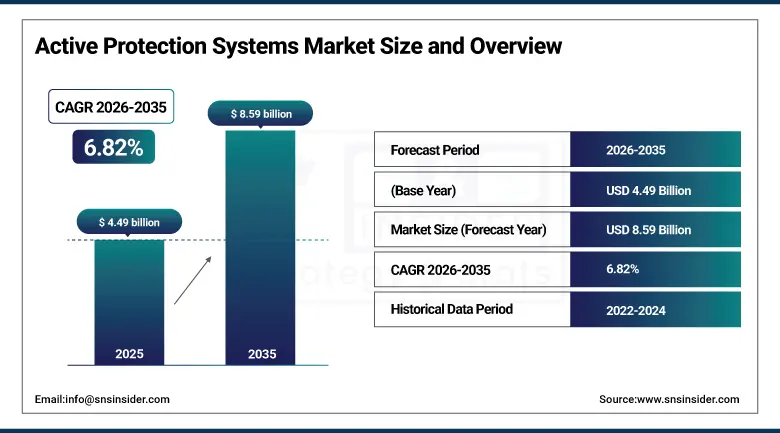
The Active Protection Systems Market was valued at USD 4.49 billion in 2025 and is projected to reach around USD 8.59 billion by 2035, growing at a CAGR of 6.82% from 2026–2035.
The Active Protection Systems Market is showing considerable growth, attributed to rising geopolitical tensions, increasing modernization efforts within the armed forces, and the growing requirement to improve survivability of armored vehicles against sophisticated threats. The rising usage of anti-tank guided missile systems (ATGMs), rocket propelled grenade launchers (RPGs), loitering munitions, and next generation battlefield threats is driving the need for active protection systems in the current scenario. Furthermore, the rising investment in networking-centric warfare and digitizing the defense force capabilities is also supporting the market growth.
Recent developments indicate growing momentum in strategic defense collaborations, armored platform upgrades, and advanced survivability technology integration. Defense manufacturers are increasingly expanding hard-kill and hybrid protection capabilities through partnerships and military procurement programs. Several nations have accelerated APS integration into main battle tanks and infantry fighting vehicles following heightened battlefield lessons and increased focus on vehicle survivability in modern combat environments.
To Get more information on Active Protection Systems Market - Request Free Sample Report
Active Protection Systems Market Trends
-
Rising deployment of hard-kill active protection systems is enhancing armored vehicle survivability against modern battlefield threats.
-
Increasing military modernization programs are accelerating procurement of next-generation vehicle protection technologies globally.
-
Rapid integration of AI-enabled threat detection systems is improving real-time battlefield awareness and interception accuracy.
-
Growing adoption of modular and retrofit APS solutions is strengthening upgrade programs for legacy armored vehicle fleets.
-
Increasing investments in multi-layer defense architectures are driving demand for integrated survivability ecosystems.
-
Rising deployment of advanced radar, sensor fusion, and electronic warfare technologies is expanding active threat engagement capabilities.
-
Expanding focus on countering loitering munitions, anti-tank guided missiles, and asymmetric threats is accelerating innovation in next-generation APS platforms.
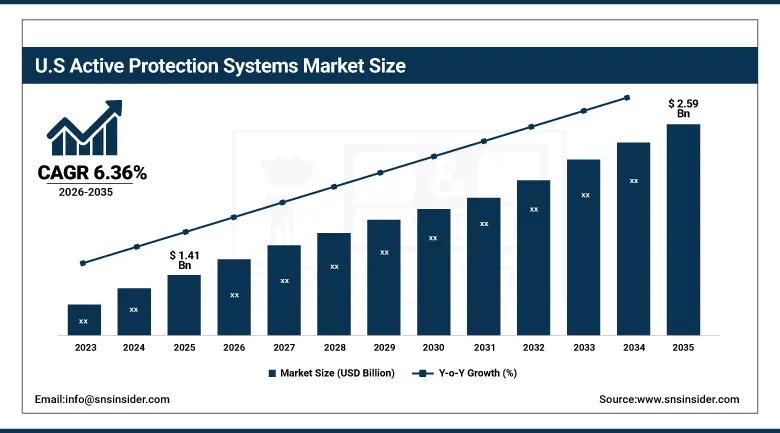
The U.S. Active Protection Systems Market was valued at USD 1.41 billion in 2025 and is expected to reach around USD 2.59 billion by 2035, growing at a CAGR of 6.36% from 2026–2035.
The US market stands out as the prominent market for active protection systems considering the various military upgrading initiatives as well as substantial defense budgets allocated to upgrading the survivability of armored vehicles. This is boosted by the increasing procurement of new generation combat vehicles, upgrading of Abrams and Stryker series vehicles, and increasing concerns over protection against ATGMs and loitering munitions.
Supporting this growth, defense contractors are increasingly investing in advanced survivability technologies and next-generation integrated protection architectures for future combat systems. Additionally, recent developments such as the U.S. Army continuing deployment and expansion of Rafael’s Trophy APS integration on Abrams platforms and Rheinmetall advancing next-generation StrikeShield/ADS survivability technologies for modern armored combat systems are reinforcing long-term market growth and strengthening competitive positioning across defense modernization programs.
Active Protection Systems Market Segmentation Analysis
-
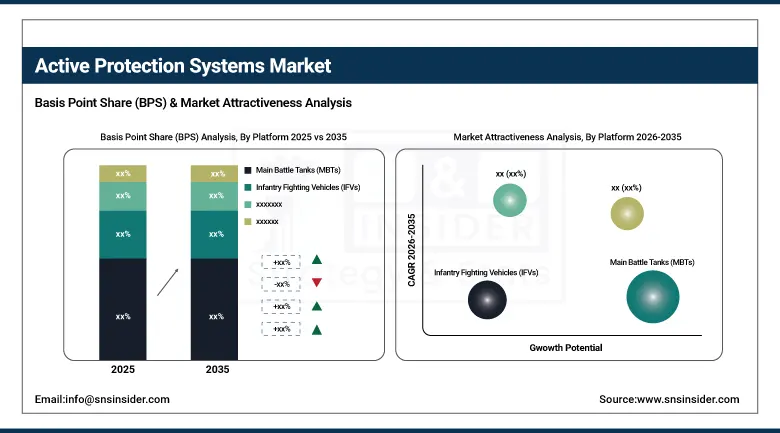
By Platform, Main Battle Tanks (MBTs) dominated the Active Protection Systems Market with 38.34% share in 2025; Light Protected Vehicles fastest growing CAGR.
-
By System Type, Hard-Kill Active Protection Systems dominated the Active Protection Systems Market with 48.15% share in 2025; Hybrid Active Protection Systems fastest growing CAGR.
-
By Component, Radar Systems dominated the Active Protection Systems Market with 35.85% share in 2025; Processing Units & Control Systems fastest growing at CAGR.
-
By Threat Type, Anti-Tank Guided Missiles (ATGMs) dominated the Active Protection Systems Market with 46.24% share in 2025; Loitering Munitions / Drone Threats fastest growing CAGR.
By Platform, Main Battle Tanks (MBTs) segment dominates the Active Protection Systems Market, Light Protected Vehicles expected to grow fastest
In 2025, the Main Battle Tanks (MBTs) segment maintained its dominant position in the Active Protection Systems Market, accounting for 38.34% of total revenue. It is largely attributed to the fact that APS technologies are extensively used in modernization programs for tanks, increased investments towards enhancing survivability of armored fleets and increasing integration of hard kill protection systems in combat platforms.
From 2026 to 2035, the Light Protected Vehicles segment is projected to record the highest CAGR. This rapid growth is driven by increasing demand for lightweight modular protection technologies, rising deployment of agile tactical platforms, and expanding military operations requiring enhanced mobility and survivability.
By System Type, Hard-Kill Active Protection Systems segment dominates the Active Protection Systems Market, Hybrid Active Protection Systems expected to grow fastest
In 2025, the Hard-Kill Active Protection Systems segment held the largest share of 48.15% in the Active Protection Systems Market, backed by the demand for real-time threat interception systems and greater use against anti-tank guided missile threats, rocket-propelled grenades, and projectiles on the battlefield.
The Hybrid Active Protection Systems segment is expected to register the highest CAGR of 8.03% during 2026–2035. Growth is driven by greater demand for layered defense systems that incorporate both hard-kill and soft-kill options, increased use of artificial intelligence-based threat assessment systems, and the multi-threat engagement environment.
By Component, Radar Systems segment dominates the Active Protection Systems Market, Processing Units & Control Systems expected to grow fastest
In 2025, the Radar Systems segment dominated the Active Protection Systems Market with a 35.85% share, motivated by its importance in the areas of threat detection, target tracking, and situation awareness in combat vehicles. The role of radar technology within APS systems is crucial since radars can quickly detect threats and counteract them using fast response capabilities.
From 2026 to 2035, the Processing Units & Control Systems segment is expected to record the highest CAGR . This growth is fueled by increasing integration of AI-powered decision engines, sensor fusion capabilities, and advanced battlefield data processing technologies. Modern defense systems are increasingly prioritizing faster computational performance and autonomous response capabilities, significantly expanding demand for next-generation APS control systems.
By Threat Type, Anti-Tank Guided Missiles (ATGMs) segment dominates the Active Protection Systems Market, Loitering Munitions / Drone Threats segment expected to grow fastest
In 2025, the Anti-Tank Guided Missiles (ATGMs) segment maintained its dominant position in the Active Protection Systems Market, accounting for 46.24% of total revenue. The domination is chiefly fueled by the rise in proliferation of anti-armor missiles, the application of guided weapons on the battlefield, as well as the increase in usage of APS which aim at counteracting missiles.
From 2026 to 2035, the Loitering Munitions / Drone Threats segment is projected to record the highest CAGR . Rapid growth is being driven by the increasing use of autonomous drone systems, expanding asymmetric warfare tactics, and rising demand for next-generation counter-UAS and anti-drone protection technologies across defense operations.
Regional Insights
|
Region |
Major Country |
Share within Region (%) |
|---|---|---|
|
North America |
United States |
92.24% |
|
Europe |
Germany |
30.14% |
|
Asia Pacific |
China |
42.49% |
|
Middle East & Africa |
UAE |
27.86% |
|
Latin America |
Brazil |
34.59% |
North America Active Protection Systems Market Insights
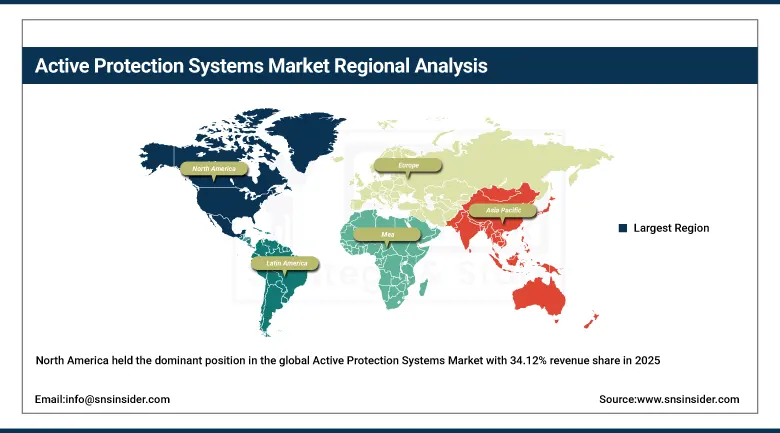
North America held the dominant position in the global Active Protection Systems Market with 34.12% revenue share in 2025, re significantly reinforced by the existence of numerous military modernization efforts, defense budget allocations, and the application of modern technology for improving the survivability of armored vehicles. In addition to having some of the best companies providing top-of-the-line defense, this region enjoys substantial improvement through armored vehicle upgrades and adoption of hard kill and hybrid protection systems. This dominance is due to the United States, the main contributor within the region, which makes substantial investments in advanced APS technology in response to emerging threats.
Additionally, recent developments such as the U.S. Army expanding deployment of Trophy Active Protection Systems across Abrams platforms and increasing next-generation vehicle survivability initiatives under modernization programs are reinforcing innovation and competitive intensity across the North American APS ecosystem.
Get Customized Report as per Your Business Requirement - Enquiry Now
Asia Pacific Active Protection Systems Market Insights
The Asia Pacific is projected to register the highest CAGR of 7.76% from 2026–2035, driven by increasing military expenditure, quick advancements in the armed forces, and purchasing of state-of-the-art armor fighting machines in the developing countries. China, India, Japan, South Korea, and Australia, among other nations, are the major consumers, due to the rise of geopolitical tensions, indigenous defense manufacturing, and upgrading of their fleets of armor fighting vehicles. India and China, in particular, have been driving this market due to investment in technology.
India accelerated indigenous armored protection development initiatives under defense self-reliance programs, while South Korea expanded next-generation combat vehicle programs integrating advanced survivability technologies for future battlefield operations.
Europe Active Protection Systems Market Insights
Europe remains an important player in the global Active Protection Systems Market owing to the rising level of preparedness for defense, increasing initiatives in the procurement of armored vehicles, and increasing interest in the modernization of armies in member states of the NATO alliance. Nations like Germany, UK, France, Italy, and Poland are major adopters, especially in the areas of survivability enhancement of armored vehicles and implementation of countermeasure systems.
Germany expanded armored vehicle modernization initiatives incorporating advanced protection suites, while defense manufacturers across Europe increased collaborative programs focused on next-generation survivability and battlefield protection technologies.
Latin America, Middle East & Africa (LAMEA) Active Protection Systems Market Insights
There has been steady growth in the Active Protection Systems market in the LAMEA region owing to factors such as increased defense modernization activities, heightened border security concerns, and increasing acquisition of combat armored vehicles within developing countries. Countries like Brazil, Mexico, Saudi Arabia, UAE, Israel, and South Africa have played an important role in the growth of the regional market through military modernization activities.
In the Middle East, defense agencies accelerated procurement programs for advanced armored vehicle protection technologies amid evolving regional security challenges. In Latin America, military modernization initiatives and strategic defense collaborations supported growing interest in integrated vehicle survivability systems.
Growth Drivers: Rising anti-tank missile, loitering munition, and asymmetric warfare threats are accelerating demand for Active Protection Systems across global defense modernization programs.
The main structural factor that impacts on the Active Protection Systems market is the increasing need by military personnel to increase survivability of armored vehicles from ever-evolving threats on the battlefield. In the contemporary environment of warfare, there are increased usage of guided anti-armor weapons, autonomous drones and highly-evolved missiles that are able to penetrate traditional types of passive armor used in the military equipment. As the armed forces evolve their abilities to conduct warfare on land, survivability becomes a major concern.
Additionally, recent developments such as the U.S. Army expanding deployment of Rafael's Trophy APS on M1 Abrams platforms under armored modernization initiatives and Rheinmetall advancing StrikeShield active defense architecture with modular integration capabilities for future combat vehicles are reinforcing technology advancement and accelerating adoption across global defense programs.
Restraints: High procurement costs, complex integration requirements, and platform compatibility challenges limiting large-scale Active Protection Systems deployment.
A major constraint in the Active Protection Systems Market is the high cost of acquiring and integrating the state-of-the-art systems for hard-kill and hybrid protection technologies due to the complexities involved. Integration of the active protection systems entails not only modification of the platform but also proper calibration of the sensors and other components in the system in order for the system to be effective and reliable. Moreover, there is the issue of incompatibility with legacy platforms which poses problems in emerging markets due to budget constraints.
Opportunities: AI-enabled multi-layer defense architectures, next-generation armored vehicle modernization, and counter-drone battlefield protection expansion.
The evolution of combat vehicles into survivable combat platforms with multi-layer ecosystems is the biggest value creation prospect for the Active Protection Systems Market in the short term, owing to the revolutionary capabilities provided by advanced APS systems to detect and intercept emerging threats which traditional passive armor solutions cannot accomplish. Incorporation of AI-driven threat recognition, sensor fusion, and automatic response systems within combat platforms creates another lucrative technological landscape, allowing the simultaneous identification and neutralization of several threats with improved reaction time and efficiency. Moreover, the emergence of counter-drone and loitering munition defense systems is opening up a new demand channel for the next generation of APS solutions.’
Recent Developments:
-
2026: Rafael Advanced Defense Systems expanded next-generation Trophy APS integration programs for advanced armored combat vehicles, enhancing multi-threat interception capability and improving protection against anti-tank missiles and loitering munition threats across modern battlefield environments.
-
2026: Rheinmetall strengthened its armored survivability portfolio through expanded deployment and development of StrikeShield/ADS protection technologies, supporting modular vehicle integration and improved active defense capabilities for future combat platforms.
-
2025: Elbit Systems advanced its Iron Fist Active Protection System deployment initiatives through enhanced sensor fusion and lightweight architecture upgrades designed to improve interception performance and platform integration flexibility across armored vehicle programs.
-
2025: General Dynamics and defense modernization partners accelerated survivability enhancement initiatives for next-generation combat vehicle platforms through expanded integration of advanced active protection technologies and battlefield threat detection systems.
Active Protection Systems Market Key Players
-
Rafael Advanced Defense Systems Ltd.
-
Rheinmetall AG
-
BAE Systems plc
-
Elbit Systems Ltd.
-
ASELSAN A.Ş.
-
Saab AB
-
Leonardo S.p.A.
-
Israel Aerospace Industries (IAI)
-
Northrop Grumman Corporation
-
Thales Group
-
General Dynamics Corporation
-
RTX Corporation
-
HENSOLDT AG
-
KNDS N.V.
-
Hanwha Aerospace Co. Ltd.
-
QinetiQ Group plc
-
Artis LLC
-
Indra Sistemas S.A.
-
Terma A/S
-
Safran Electronics & Defense
| Report Attributes | Details |
|---|---|
| Market Size in 2025 | USD 4.49 Billion |
| Market Size by 2035 | USD 8.59 Billion |
| CAGR | CAGR of 6.82% From 2026 to 2035 |
| Base Year | 2025 |
| Forecast Period | 2026-2035 |
| Historical Data | 2022-2024 |
| Report Scope & Coverage | Market Size, Segments Analysis, Competitive Landscape, Regional Analysis, DROC & SWOT Analysis, Forecast Outlook |
| Key Segments | • By Platform (Main Battle Tanks (MBTs), Infantry Fighting Vehicles (IFVs), Armored Personnel Carriers (APCs), Light Protected Vehicles, Others) • By System Type (Hard-Kill Active Protection Systems, Soft-Kill Active Protection Systems, Hybrid Active Protection Systems, Reactive/Integrated Protection Systems) • By Component (Radar Systems, Infrared Sensors, Countermeasure Dispensers, Processing Units & Control Systems) • By Threat Type (Anti-Tank Guided Missiles (ATGMs), Rocket-Propelled Grenades (RPGs), Kinetic Energy Projectiles, Loitering Munitions / Drone Threats) |
| Regional Analysis/Coverage | North America (US, Canada), Europe (Germany, UK, France, Italy, Spain, Russia, Poland, Rest of Europe), Asia Pacific (China, India, Japan, South Korea, Australia, ASEAN Countries, Rest of Asia Pacific), Middle East & Africa (UAE, Saudi Arabia, Qatar, South Africa, Rest of Middle East & Africa), Latin America (Brazil, Argentina, Mexico, Colombia, Rest of Latin America). |
| Company Profiles | Rafael Advanced Defense Systems Ltd., Rheinmetall AG, BAE Systems plc, Elbit Systems Ltd., ASELSAN A.Ş., Saab AB, Leonardo S.p.A., Israel Aerospace Industries (IAI), Northrop Grumman Corporation, Thales Group, General Dynamics Corporation, RTX Corporation, HENSOLDT AG, KNDS N.V., Hanwha Aerospace Co. Ltd., QinetiQ Group plc, Artis LLC, Indra Sistemas S.A., Terma A/S, Safran Electronics & Defense. |
Frequently Asked Questions
The Active Protection Systems Market is expected to grow at a CAGR of 6.82% from 2026 to 2035.
The Active Protection Systems Market was valued at USD 4.49 billion in 2025.
Rising proliferation of anti-tank guided missiles, loitering munitions, and next-generation battlefield threats is the primary growth driver of the Active Protection Systems Market.
